

Get Started
Graphite's supplier management tool helps you onboard faster, cut time on risk reviews and streamline supplier validations. Save time and money.
What Every MRO Procurement Professional Should Know
Why MRO Procurement Is More Strategic Than You Think
Maintenance, Repair, and Operations (MRO) procurement doesn’t always get the spotlight. It’s often overshadowed by strategic sourcing or high-value negotiations. But here’s the reality: if MRO fails, operations stop.
Whether it’s replacing a worn-out sensor or restocking safety gear, MRO keeps your business running. Yet in many organizations, it’s treated as a tactical, reactive function—inefficient, fragmented, and riddled with delays.
It’s time for procurement leaders to give MRO the strategic attention it deserves.
What Makes MRO Procurement Different
MRO procurement is fundamentally different from direct or project-based sourcing. It covers a vast range of low-cost items that are bought frequently but unpredictably. Think filters, gloves, bearings, belts. While individually inexpensive, these items are mission-critical: the wrong part, or a missing one, can halt production or delay field maintenance.
Managing MRO also means navigating complex, decentralized requests. Procurement teams must coordinate with operations, maintenance, engineering, and safety teams, often across multiple sites with varying needs. And because companies rely on hundreds of specialized or local vendors, spend is spread thin, visibility is low, and standardization is difficult.
What Good Looks Like: Core Practices for MRO Procurement
To elevate MRO from reactive to strategic, procurement teams need a specific set of capabilities:
- Inventory coordination is essential. Procurement should work hand-in-hand with storerooms and maintenance to avoid both stockouts and overstocking.
- Data discipline keeps the system clean. Standardized SKUs, part numbers, and item descriptions prevent duplicate orders and mismatches.
- Supplier rationalization reduces friction. Consolidating the supplier base drives volume leverage, lowers admin overhead, and simplifies approvals.
Most importantly, MRO buyers need operational awareness. You can’t optimize what you don’t understand, especially in environments where urgency can override processes.
Where It Goes Wrong (and Why)
Even mature procurement teams fall into common traps. Emergency buys become routine, inflating costs and causing delays. Duplicate items are ordered under different names, clogging inventory systems. Siloed vendor bases and manual workflows create fragmentation that’s nearly impossible to untangle.
What’s often missing is standardization, not just in what you buy, but how you buy it. Without shared systems and processes across sites, procurement lacks the visibility to control spend or drive efficiency.
Where Technology Makes the Difference
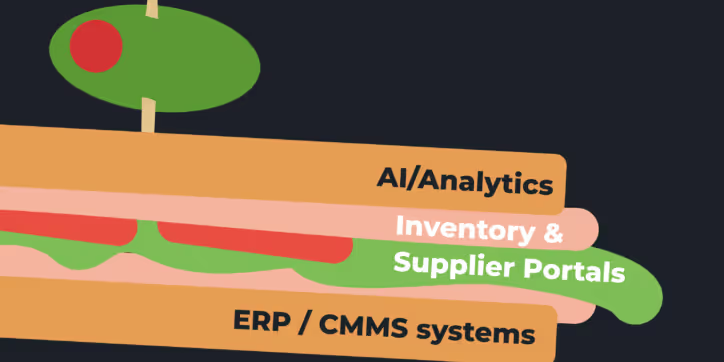
Modern platforms can simplify the chaos of MRO, if implemented thoughtfully. Here’s where digital tools drive the most impact:
- Supplier portals let vendors maintain their own catalogs, certifications, and pricing, reducing the admin load on procurement.
- Inventory integration ensures that procurement knows what’s on the shelf, and what’s not, so buying decisions are timely and accurate.
- Automated workflows streamline approvals for low-risk purchases, while spend analytics flag areas of waste or duplication.
With the help of AI, teams can also consolidate similar items and standardize descriptions, cleansing dirty data and improving order accuracy.
Conclusion: MRO Is Strategic—If You Let It Be
Treat MRO like a cost center, and it will behave like one—quietly draining time, money, and uptime. But treat it like a strategic category, and it becomes a source of real value.
When procurement teams bring structure, consistency, and technology to MRO, they free up their organizations to focus on growth, not firefighting. And in a world where every delay costs dollars, even the smallest bolt or bearing matters.