

Get Started
Graphite's supplier management tool helps you onboard faster, cut time on risk reviews and streamline supplier validations. Save time and money.
The New Procurement Tech Stack: What You Actually Need in 2026
Cutting through the noise to reveal the essential tools modern procurement teams rely on.
Introduction: Why Procurement Needs a New Tech Stack in 2026
Procurement has entered a new era—one defined by speed, transparency, and accountability. Yet many teams still operate with bloated, disconnected, or overly complex tech stacks built around legacy software and custom workflows that no longer serve the business.
In a time when supplier risk, regulatory requirements, and digital transformation are moving faster than ever, procurement leaders need something simpler and smarter.
This eBook is your guide to:
- Understanding which procurement technologies matter today
- Building a scalable, integrated stack centered around supplier engagement
- Evaluating tools in a crowded, noisy market
- Right-sizing your stack based on your company’s maturity and complexity
The future of procurement isn’t more tools—it’s the right tools, working together.
Chapter 1: Key Principles for Building a Future-Proof Stack
Modern procurement stacks aren’t just collections of software. They’re systems that must work together to deliver clean data, operational agility, and supplier engagement at scale.
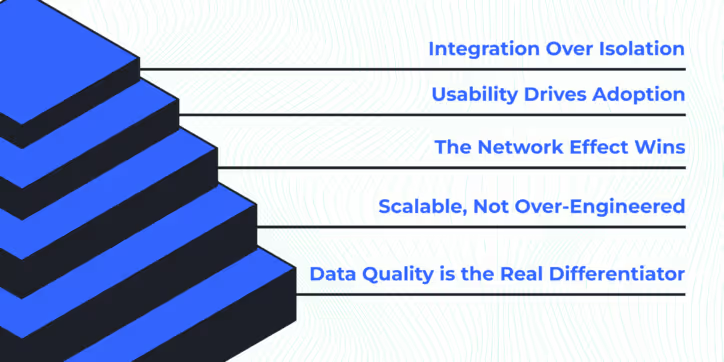
Here are the five principles driving future-ready stacks:
- Integration Over Isolation
Point solutions create friction. Look for platforms that connect seamlessly to the rest of your stack—without custom patchwork. - Usability Drives Adoption
If internal users and suppliers don’t use the tool, it’s not working. Prioritize systems that are intuitive and require minimal training. - The Network Effect Wins
Tools that connect you to a larger supplier ecosystem can drive faster onboarding, broader insights, and better collaboration. - Scalable, Not Over-Engineered
Custom-built systems often become bottlenecks. Choose tech that scales as your business grows, without excessive maintenance. - Data Quality is the Real Differentiator
Clean, validated, and connected data drives every downstream procurement activity—from risk scoring to spend analysis to ESG tracking.
Chapter 2: The Core Procurement Tech Stack – What You Actually Need
A modern procurement stack is built around functionality, not brand names. What matters most is not what tool you use—but how well it solves your real-world challenges and works with the rest of your ecosystem.
Here are the six core capabilities every modern procurement stack should deliver:
FunctionPurposeWhy It MattersSupplier ManagementCentralized system for onboarding, compliance, data, and collaborationSupplier data is the source of truth for every other tool. If it’s wrong, everything breaks.Spend VisibilityUnified view of spend across categories, suppliers, and timeClear, clean data drives cost savings and informs strategic sourcing decisions.Contract LifecycleRepository and workflow for managing contracts, terms, and obligationsConnects sourcing, legal, and performance tracking with shared data and context.Sourcing & RFxTools to run competitive sourcing events efficientlyEnables faster decisions and broader supplier participation—when supplier data is preloaded.Risk & ESG ManagementVisibility into third-party risk and ESG posture across the supplier baseIntegrated insights prevent exposure and support sustainability goals.Procurement WorkflowsAutomation of POs, approvals, and payment processesReduces cycle times and ensures compliance—if powered by reliable supplier records.
The most successful stacks don’t attempt to stitch together dozens of disconnected systems. They start with supplier management at the core, ensuring clean data flows into every other function—from sourcing to spend analysis.
Chapter 3: How to Evaluate Tools in a Noisy Market
The procurement software market is louder and more saturated than ever. Slick demos and aggressive marketing often mask poor product fit or weak integration. Here’s how to evaluate tools effectively:
1. Start with the Pain Point, Not the Product
Clarify the job you need to do before comparing solutions. Don’t let software define your problem for you.
2. Prioritize Connectivity
Can the tool pull and push data across your systems—ERP, finance, risk, and supplier tools—without custom development?
3. Demand Proof of Adoption
If your team or your suppliers won’t actually use it, it’s shelfware. Ask for usage data, not just customer logos.
4. Look for Data Improvement, Not Just Visibility
A dashboard is only as good as the data feeding it. The best tools improve data quality at the source.
5. Beware of Overlap
Many tools claim to do everything. Make sure they don’t duplicate functionality—or make it harder to know which source of truth to trust.
The goal isn’t to build the biggest stack. It’s to build one that works end-to-end, without adding complexity.
Chapter 4: Example Tech Stacks by Company Maturity
There’s no one-size-fits-all tech stack. Your needs—and your ideal level of complexity—depend on your procurement team’s size, spend under management, and operating model.
Stage 1: Scaling Team (Under $50M spend)
- Focus: Streamline onboarding, centralize supplier data, get visibility
- Key Capabilities: Supplier management, lightweight spend tracking, onboarding automation
- Tech Goals: Ease of use, low IT lift, fast time-to-value
Stage 2: Mid-Market (50M–500M spend)
- Focus: Drive efficiency, enforce compliance, manage contracts and risk
- Key Capabilities: Full supplier lifecycle management, sourcing automation, risk and ESG tools
- Tech Goals: Integration across tools, clean data handoffs, cross-functional access
Stage 3: Enterprise (500M+ spend)
- Focus: Global scalability, deep analytics, governance
- Key Capabilities: Modular, API-enabled architecture, embedded risk insights, advanced reporting
- Tech Goals: Scalable systems of record, performance optimization, regulatory alignment
Conclusion: Less Tech, More Impact
Most procurement teams don’t need more tools—they need better alignment between tools. The future is simplified, integrated, and supplier-first.
By focusing on a core set of capabilities, starting with clean supplier data, and investing in systems that work together—not just sit side-by-side—you’ll gain:
- Faster sourcing and onboarding cycles
- Better risk and compliance outcomes
- Less supplier friction and higher adoption
- Clearer visibility into spend, savings, and performance
The modern stack isn’t built around features. It’s built around flow.