

Get Started
Graphite's supplier management tool helps you onboard faster, cut time on risk reviews and streamline supplier validations. Save time and money.
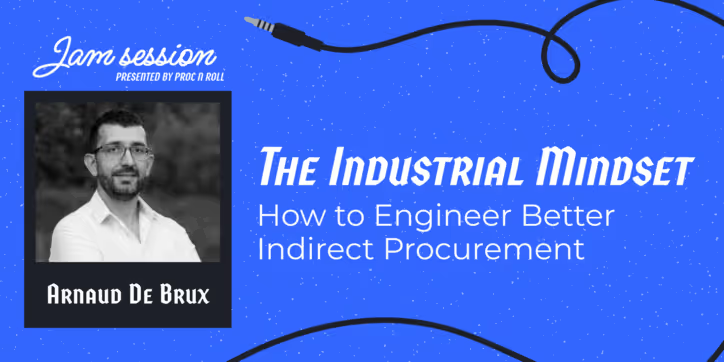
The Industrial Mindset: How to Engineer Better Indirect Procurement
“We basically jumped off the cliff and collected the plane as we were falling down.”
That is how Arnaud De Brux, Head of Indirect Procurement at BIC, describes one of the most defining projects of his career. It wasn’t a simple negotiation or a software implementation—it was building a non-GMO milk supply chain from scratch in less than two years.
In this week’s Proc & Roll Jam Session, Arnaud joins host Conrad Smith to discuss his unique path from mechanical engineering to procurement leadership. The conversation reveals a powerful truth: when you apply “factory floor” logic to procurement, you stop just saving money and start engineering business growth.
Here are the top takeaways from this masterclass in strategic procurement.
1. Apply the “Industrial Mindset” to Indirects
Arnaud started his career as an engineer, focusing on things like “mean time between failures” and production line efficiency. Today, he applies that same logic to indirect categories like Marketing, HR, and IT.
The lesson? Whether you are buying a robot for a factory or a software license, you must look beyond the sticker price. You have to consider the total ecosystem: maintenance, change management, and long-term value. By understanding the “why” behind a stakeholder’s request, procurement breaks down silos and becomes a true business partner.
2. Case Study: The 18-Month Supply Chain Sprint
Arnaud shared the incredible story of his time at Danone, where the business needed to launch a non-GMO yogurt line to gain a competitive edge. The supply chain didn’t exist, so procurement had to build it.
This required going all the way back to the source—changing the seeds in the ground, the feed for the cows, and the segregation lines in the factories. It was a massive risk that required deep collaboration with farmers and suppliers. The result was not cost savings, but value creation—unlocking a new market segment that competitors couldn’t touch.
3. Automate the “Busy Work” to Save the Strategy
One of the biggest hurdles to strategic procurement is the sheer volume of tactical noise. Arnaud argues that we must find efficient ways to automate “tail spend”—the low-value, high-volume transactions that distract the team.
“We cannot do [strategic work] if we’re too busy running small events on tactical spend,” Arnaud explains. The future of procurement relies on using AI and automation to handle the busy work so humans can focus on what matters: Supplier Relationship Management (SRM) and innovation.
4. The 2-to-1 Rule for Career Growth
Finally, Arnaud shared some timeless career advice. To grow in procurement, you must be curious and listen generously.
He follows the 2-to-1 Rule: “We have two ears and one mouth, so we should listen twice as much as we speak.”
Combined with his advice to volunteer for “scary” projects—because “if your goals don’t scare you, they’re not big enough”—this episode serves as a perfect guide for anyone looking to level up their career.
Watch now or read the transcript below.
Transcript: Proc-N-Roll | The Industrial Mindset: How to Engineer Better Indirect Procurement
Conrad: Hello everybody, welcome to Proc and Roll, your guide to practical procurement. Today we have a special edition of a jam session and joining me here today is Arnaud. He’s the Head of Indirect Procurement at BIC. And I’ve got to say, finding the Head of Indirect Procurement for BIC here in the Rocky Mountains in Utah was a little bit of a surprise to me. What brought you to Utah and what makes you stay?
Arnaud: I came to Utah by accident back in 2007. I was finishing a grad school degree in Arizona and looking for jobs in the US. I got a job offer through Danone, the yogurt company. It was supposed to be in New York, but halfway through the process, they said, “We’re sending you to Utah. Take it or leave it.” So I took it. I’ve gone in and out of Utah a few times, but I always end up coming back. It’s a beautiful place—the mountains have color, the air is crisp, and it’s really awesome.
Conrad: Tell me about your journey into procurement. Did you go to school and study procurement, or was your journey unique like many others?
Arnaud: No, I did not. I went to school originally for engineering—mechanical and industrial engineering. When I was growing up near Airbus in Toulouse, I wanted to be a pilot or work on Formula One cars. Throughout my engineering career, I realized being on the floor of a factory just working on processes was fun, but not something I wanted to do for my entire life. I got an internship in a procurement consulting company looking for someone with a technical background, and that got me into technical buying.
Arnaud: That kind of got me thinking that while understanding the technical things is nice, the impact you can have through procurement and the buying channel was intriguing. So I decided to go to business school right after engineering school. That degree in both engineering and business is how I got to the US.
Conrad: I love that you are bringing the engineering background into indirect procurement. How do you take that deep collaborative engineering out of the factory and apply those same principles to the indirect side?
Arnaud: To me, it is common sense. It is about looking at a business and aligning functions by going down to the processes to find the true need. What is it that we’re trying to achieve? What’s your “why” as a function? If you take HR, they have lots of different providers supporting payroll and employee benefits. What’s the strategy behind it? How do we get it together? Temporary labor is another one—what’s our people strategy? From there, we can find the right processes that make everybody’s life easier.
Conrad: You shared a story about working with dairies in a strategic way. Can you share that?
Arnaud: That is one of the best experiences of my professional life. At Danone, we wanted to differentiate ourselves as a dairy company. We wanted to be an affordable brand, yet we saw the benefit of organic milk. The question was: could we provide an organic benefit to the consumer at a price closer to conventional milk?
Arnaud: So Danone made a pledge to launch a non-GMO milk product to the market—milk coming from cows fed a non-GMO diet. That supply chain did not exist in the US whatsoever in 2016. We had 18 months to go to market. We had to create an entire supply chain to feed cows: you need the seed, they grow for five to six months, harvest them, ferment for six months, and then feed the cows for months before the yield starts.
Arnaud: We basically jumped off the cliff and collected the plane as we were falling down, and we were able to land it safely 18 months later.
Conrad: If you could grab a magic wand, what is your focus right now? What are you really trying to deliver and achieve?.
Arnaud: The big magic wand I wish we had is: how do we automate and manage the tail spend in a way that is easy for stakeholders?. We need to be able to free up resources from the tactical busy work to move to a more strategic level. I wish I could spend more time creating relationships with suppliers to unlock that next value proposition. Procurement is not saving money; procurement is bringing value.
Arnaud: Value is enabling growth, more consumer reach, and getting to the consumer faster than your competitor. That’s where supplier management is extremely important. We need to be closer to innovative suppliers, and we cannot do that if we are too busy running small events on tactical spend.
Conrad: What advice would you give your younger self? What are the big learnings that really stand out to you?
Arnaud: If there is a project that you come across that seems really interesting—that you feel in your belly is going to be a character-changing moment—go for it. If you expect change to come to you, it is never going to happen. You have to go get it.
Arnaud: Also, keep reading and learning. Go to networking events and listen generously. There is a rule someone told me once: the 2-to-1 rule. We have two ears and one mouth, so we should listen twice as much as we speak.
Conrad: I love that. One of our best friends at Graphite has a quote that says: “If your goals don’t scare you, they’re not big enough.”
Arnaud: Exactly. Go with your gut, be curious, don’t be scared, and ask for more.
This transcript has been edited for clarity while maintaining all substantive content