

Get Started
Graphite's supplier management tool helps you onboard faster, cut time on risk reviews and streamline supplier validations. Save time and money.
Beyond Savings: The KPIs That Matter in Modern Procurement
Introduction: Why the Old KPIs Are No Longer Enough
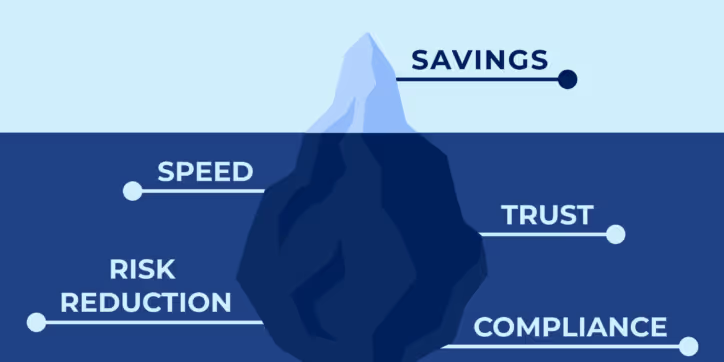
For decades, procurement success has been measured by a single number: savings. And while reducing costs will always be important, it’s no longer enough to capture the full impact of procurement in a modern, connected enterprise.
Today’s procurement leaders are navigating supply chain risk, ESG mandates, data transparency, and stakeholder expectations. Yet many teams still report into dashboards built around a savings-first mentality. It’s time to expand the definition of success — and the metrics that prove it.
The Problem with Over-Relying on Savings KPIs
The trouble with cost savings is that it encourages short-term thinking. When procurement is judged solely on how much it cuts, it can lead to unintended consequences: supplier instability, fractured relationships, or rushed sourcing decisions that create risk down the line.
Worse, it leaves strategic contributions invisible. Efforts to strengthen supplier diversity, improve onboarding speed, reduce risk exposure, or increase ESG compliance are often seen as “nice to have” because they don’t show up on the traditional savings ledger.
This narrow view also creates misalignment. When procurement is focused on squeezing suppliers, while other business units prioritize resilience or innovation, it creates tension. Procurement ends up isolated — not integrated.
The Modern Procurement KPI Framework
Leading CPOs are expanding their KPIs to reflect the complexity of modern procurement. Instead of just measuring cost outcomes, they track indicators of agility, resilience, and long-term value.
This includes metrics like:
- Supplier onboarding speed – showing how quickly new suppliers can be vetted and activated.
- Data accuracy and completeness – reflecting how well the supplier record supports automation, compliance, and reporting.
- Risk reduction – such as how early procurement identified a potential disruption and how it was mitigated.
- Supplier satisfaction – through NPS or qualitative feedback, giving insight into relationship strength.
- ESG alignment and supplier diversity – tracking how procurement supports broader company goals.
What all these metrics have in common is that they focus on what procurement enables — not just what it costs.
How to Shift the KPI Conversation Internally
Introducing new KPIs isn’t just about the data — it’s about changing the narrative. To gain traction internally, procurement leaders need to reframe the conversation around business value.
That starts with aligning new KPIs to goals your executive team already cares about: risk management, speed to market, ESG performance, or customer experience. Show how procurement’s work directly contributes to those outcomes — and back it up with real examples.
It’s also critical to speak the language of your stakeholders. Finance cares about auditability and risk; legal cares about compliance exposure; product teams care about onboarding speed. Tailor KPI stories to resonate across functions.
And finally, don’t abandon savings — just pair it with context. Highlight when automation creates efficiency and reduces risk. Or when a diverse supplier provides both cost advantages and brand value. This is how procurement earns strategic credibility.
Conclusion: Modern KPIs Reflect Modern Value
The evolution of procurement isn’t just about digital tools or new processes — it’s about mindset. And that mindset has to be reflected in the way success is measured.
CPOs who embrace broader KPIs position their teams as enablers of innovation, compliance, resilience, and stakeholder alignment. They move from cost-cutters to value creators. And in doing so, they redefine what procurement can be.