

Get Started
Graphite's supplier management tool helps you onboard faster, cut time on risk reviews and streamline supplier validations. Save time and money.
B2B Payments Explained: Methods, Challenges, and Best Practices
Business-to-business transactions have moved far beyond paper checks and manual invoicing. Companies now process millions of dollars through digital channels that demand speed, accuracy, and security. Understanding what B2B payments are and how the space has evolved matters for any business looking to scale efficiently.
This guide breaks down the core methods companies rely on, the biggest challenges they face, and the best practices that keep transactions secure and predictable. By the end, you'll have a clear picture of how modern B2B payments actually work.
What Are B2B Payments?
Before diving into methods and technology, it helps to establish a shared understanding of the term itself and why the category looks so different from consumer transactions.
Getting Clear on What B2B Payments Involve
B2B payments refer to financial transactions between businesses rather than between a business and an individual consumer. A manufacturer paying a raw materials supplier, a software company invoicing a corporate client, or a wholesaler settling accounts with a distributor all fall under this umbrella.
Answering what are B2B payments requires looking beyond the simple transfer of funds, since these transactions often involve invoicing terms, purchase orders, and multi-step approval chains that consumer payments rarely require. The scale also differs dramatically. While a retail purchase might total a few dollars, B2B transactions frequently run into the tens or hundreds of thousands, which raises the stakes for accuracy and security at every step.
Why B2B Payments Are More Complex
Because business transactions typically involve larger sums and longer timelines, the payment process carries more moving parts. Invoices might include net-30 or net-60 terms, discounts for early payment, or penalties for late settlement. Multiple stakeholders, including procurement teams, finance departments, and approving managers, often need to sign off before funds move.
Vendor relationships add another layer of complexity, since businesses frequently juggle dozens or hundreds of supplier accounts with different payment preferences and banking details. Each of these factors increases the surface area for errors, delays, and fraud, which is why so much attention has shifted toward specialized tools built for this exact purpose, and toward verifying who is actually on the receiving end of every payment.
The Growing Role of Fintech
Traditional banking infrastructure was never designed for the volume or complexity that modern commerce demands. Fintech B2B payments providers have stepped in to fill that gap, offering faster processing, better visibility, and integrations that legacy banks simply don't provide. B2B payments fintech companies now offer everything from automated invoicing to real-time currency conversion, and their growth reflects a broader shift away from relying solely on banks for financial infrastructure.
As more businesses adopt these tools, the gap between companies using modern payment technology and those still rely on manual processes continues to widen. That shift naturally raises the question of which specific payment methods are available and how each one fits into a company's operations.
Common B2B Payment Methods
Selecting the right payment method depends heavily on transaction size, vendor location, and the speed at which funds need to move.
Traditional Methods
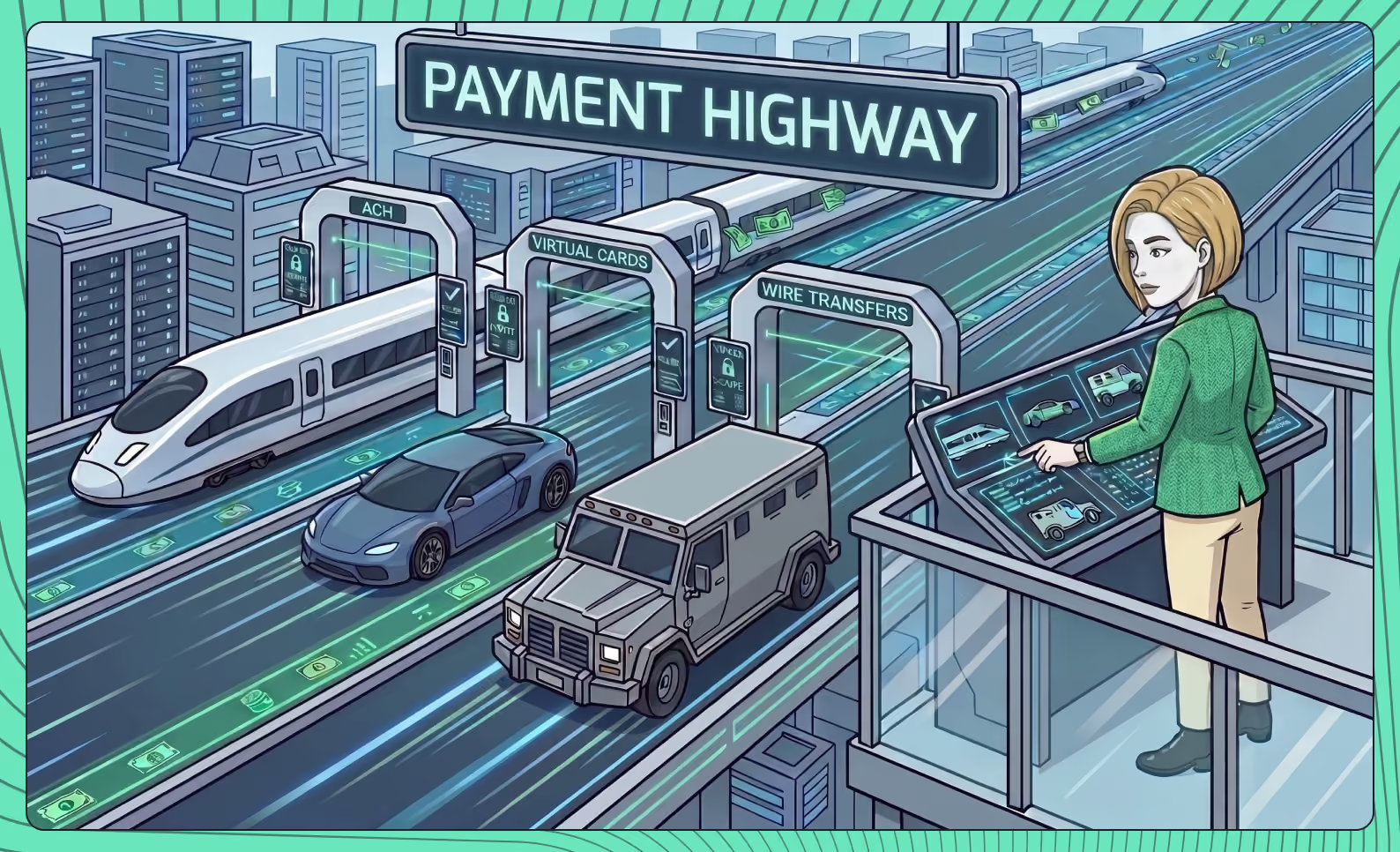
Checks, wire transfers, and cash still show up in business transactions more often than many people expect. Paper checks remain common in industries where digital adoption has lagged, partly due to established habits and partly because some smaller vendors haven't invested in electronic systems.
Wire transfers offer a faster alternative for larger sums, though they come with fees that add up quickly for businesses making frequent payments. While rare in formal B2B settings, cash transactions still occur in certain industries and geographic regions.
The drawback across all three methods is consistent: slow reconciliation, limited visibility into transaction status, and a heavier administrative burden on accounting teams that must manually match payments to invoices.
ACH and Bank Transfers
ACH B2B payments have become a preferred option for domestic transactions because they combine relatively low cost with reliable processing. The Automated Clearing House network allows businesses to move funds directly between bank accounts without the higher fees associated with wire transfers. Processing times typically range from one to three business days, which is slower than a wire transfer but often sufficient for standard vendor payments.
One consideration that trips up many finance teams is confirming account details before initiating a transfer. Learning how to verify bank account information correctly can prevent failed transactions and costly delays, and understanding how long bank verification takes helps set realistic expectations for when funds will actually arrive. Getting these details right up front saves significant time down the line and reduces the risk of a payment landing in the wrong account.
Digital and Electronic Methods
B2B electronic payments have expanded well beyond ACH to include virtual cards, digital wallets, and API-driven transfers that settle in real time. Businesses looking to speed up B2B payments increasingly turn to these tools because they eliminate much of the manual work involved in traditional processing.
Digital B2B payments platforms often include built-in approval workflows, automatic invoice matching, and instant notifications when a payment clears. Real-time payment rails, still relatively new in many markets, promise to compress settlement times from days to seconds, potentially reshaping how businesses manage cash flow in the coming years.
Choosing the Right Method for Your Business
No single payment method works for every situation. A business making frequent, high-volume payments to domestic vendors might lean on ACH for its cost efficiency, while one dealing with international suppliers may need faster, more flexible B2B payments processing options.
Transaction size, vendor location, and how quickly funds need to settle all factor into the decision. With domestic methods covered, it's worth considering the added complexity that arises when transactions cross borders.
Cross-Border and International B2B Payments
Global commerce introduces a set of challenges that domestic transactions simply don't have to contend with, starting with currency and regulatory hurdles.
Challenges of Global Transactions
Cross-border B2B payments and international B2B payments come with friction that domestic transfers rarely encounter. Currency conversion introduces unpredictability, since exchange rates fluctuate constantly and can eat into margins if not managed carefully.
Compliance requirements vary by country, adding paperwork and delays that catch many businesses off guard. Global B2B payments also tend to take longer to settle, sometimes stretching to a week or more, depending on the countries and banks involved. Hidden fees compound the problem, with intermediary banks often charging along the way that leave the final recipient with less than expected.
Regulatory and Compliance Considerations
Navigating the patchwork of financial regulations across different countries requires careful attention to detail. Know Your Customer and Anti-Money Laundering requirements differ from one jurisdiction to another, and businesses paying international vendors need to confirm they're meeting local standards before funds are moved.
Failing to do so can result in delayed payments, frozen accounts, or regulatory penalties. Bank account verification services have become essential tools for confirming that international vendor details are accurate and compliant before a transaction proceeds, reducing the risk of costly mistakes and providing finance teams with a documented trail to point to during an audit.
Solutions for Global B2B Payments
Multi-currency accounts have made a noticeable difference for businesses that regularly transact internationally, allowing them to hold and pay in multiple currencies without constant conversion fees. Partnerships with B2B payments fintech providers have also simplified much of the complexity that once made global trade painful.
Fintech B2B payments platforms now offer transparent fee structures, faster settlement times, and built-in compliance checks, reducing the manual burden on finance teams. These tools have made global B2B payments significantly more predictable, though the underlying challenges around financial fraud and security remain a persistent concern across both domestic and international transactions.
Key Challenges in B2B Payments
Beyond the mechanics of moving money, businesses face operational and security risks that can disrupt cash flow and expose them to significant financial loss.
Manual Processing and Errors
Reconciling payments by hand remains one of the most time-consuming aspects of accounts payable work. Finance teams often spend hours matching invoices to payments, chasing down discrepancies, and correcting data entry mistakes. Beyond the time cost, manual processing obscures real-time visibility into cash flow, making it harder for businesses to forecast accurately or spot problems early.
A proper accounts payable risk assessment often reveals just how much exposure a company carries simply because its processes rely too heavily on manual intervention rather than automated checks and systematic vendor verification.
Fraud and Security Risks
Payment fraud often comes down to criminals exploiting gaps in verification processes and communication channels to redirect funds. One of the most common tactics is wire transfer fraud, where attackers intercept or manipulate payment instructions to send money to fraudulent accounts instead of legitimate suppliers.
Another growing threat involves impersonating senior leaders within an organization to create urgency and pressure employees into bypassing standard controls. Known as CEO fraud or executive impersonation fraud, these attacks rely on trust, authority, and rushed decision-making rather than technical sophistication.
Strong verification procedures and regular employee training remain some of the most effective ways to prevent these scams from succeeding.
Lack of Automation
Many businesses still rely on manual approval chains that slow down even routine vendor payments. B2B payments automation addresses this bottleneck by routing invoices through predefined approval workflows, automatically flagging discrepancies, and reducing the number of touchpoints required before a payment clears.
Automated B2B payments also reduce the human error that often accompanies manual data entry, catching issues like duplicate invoices or mismatched amounts before they become costly mistakes. Addressing these challenges effectively requires the right technology stack, which brings the conversation to the tools built specifically for this purpose.
B2B Payments Technology and Software Solutions
The right technology can address most of the operational and security challenges outlined above, provided businesses know what to look for when evaluating options.
Role of a B2B Payments Platform
A dedicated B2B payments platform centralizes transactions in a single system rather than scattering them across bank portals, spreadsheets, and email threads. Key features typically include real-time dashboards that show payment status at a glance, configurable approval workflows that automatically route invoices to the right people, and multi-user access that lets finance teams collaborate without stepping on each other's work.
B2B payments software built around these features dramatically reduces the administrative overhead of managing vendor relationships at scale.
Choosing the Right B2B Payments Solution
Not every B2B payments solution fits every business, so it helps to evaluate options against specific operational needs. Integration with existing accounting or ERP systems should be a top priority, since a disconnected platform creates more manual work rather than less.
Scalability matters too, particularly for growing businesses that expect transaction volume to increase over time. Vendor support, including responsiveness when issues arise, often separates a reliable B2B payments solutions provider from one that leaves finance teams stranded during a critical payment cycle.
B2B Ecommerce Payments
Online B2B marketplaces have their own set of requirements that differ from standard vendor payments. B2B ecommerce payments often need to accommodate bulk order transactions, negotiated credit terms, and invoicing structures that support net payment periods rather than immediate checkout.
B2B payments processing in this context needs to handle higher transaction volumes while still maintaining the flexibility that business buyers expect when purchasing at scale.
Evaluating B2B Payments Technology Providers
When comparing providers, a handful of criteria consistently separate strong options from weaker ones. Security should top the list, including how the provider handles bank account verification and protects sensitive financial data. Uptime reliability matters just as much, since payment delays caused by system outages can damage vendor relationships.
Ease of integration with existing software, along with responsive customer support, rounds out the criteria that businesses should weigh carefully before committing to a specific B2B payments technology provider. With the right platform in place, attention naturally shifts to the practices that keep day-to-day operations running smoothly.
Best Practices for Managing B2B Payments
Strong technology alone won't solve every problem. Pairing the right tools with disciplined internal practices is what actually keeps payment operations secure and efficient.
Standardize Supplier Onboarding
A consistent onboarding process sets the tone for every payment that follows. When new suppliers are added through an ad hoc process, finance teams end up with inconsistent records, missing documentation, and gaps that fraudsters can exploit later.
Standardizing onboarding means collecting the same set of information from every vendor, including tax documents, banking details, and business registration records, before a single payment goes out. It also means assigning clear ownership for reviewing and approving new supplier profiles, rather than leaving the task to whoever happens to be available.
Building this consistency early pays off as the vendor list grows, since a standardized intake process scales far more easily than one built around exceptions and workarounds. It also lays a reliable foundation for the identity checks that follow, since accurate onboarding data is what makes verification possible in the first place.
Verify Supplier Identities and Banking Information
Confirming that a vendor is who they claim to be, and that their banking details are accurate, closes one of the most common gaps fraudsters exploit. Bank account verification should happen at onboarding and again whenever a vendor requests a change to their payment details, since fraudulent account changes are a frequent tactic behind wire transfer fraud.
Relying on bank account verification services rather than manual phone calls or email confirmations reduces the chance that a scammer posing as a legitimate supplier slips through. Getting this step right protects against both simple errors and deliberate fraud attempts targeting vendor payments.
Automate Approval Workflows
Manual approval chains introduce delay and inconsistency, particularly as transaction volume grows. Automated approval workflows route each invoice to the right reviewer based on rules such as payment amount, vendor category, or department. Automated B2B payment processes also flag anomalies, such as duplicate invoices or amounts that fall outside expected ranges, before a payment ever reaches final approval.
This structure reduces the risk that a fraudulent request slips through simply because a busy employee approved it too quickly, a tactic often seen in executive impersonation fraud scenarios where urgency is used to bypass normal scrutiny. Automation also frees up finance staff to focus on exceptions rather than routine approvals, speeding up the entire payment cycle and making it more consistent across the board.
Monitor Payment Activity for Anomalies
Ongoing monitoring catches problems that onboarding checks and approval workflows might miss. Setting up alerts for unusual patterns, such as payments to a new account shortly after a vendor's banking details change, or a sudden spike in payment frequency to a single supplier, provides finance teams with an early warning system. Payment fraud in practical terms often comes down to spotting these small irregularities before they turn into significant losses.
Real-time dashboards built into most B2B payments platforms make this kind of monitoring far easier than sifting through spreadsheets after the fact. Pairing automated alerts with a periodic manual review ensures that anomalies get caught quickly, regardless of whether they stem from a technical error, an internal mistake, or a deliberate attempt at fraud targeting the payment process.
Maintain Audit Trails and Regular Reviews
Detailed audit trails give finance teams the documentation needed to catch problems and demonstrate compliance when questions arise. Every payment, approval, and vendor record change should be logged automatically, creating a clear history that can be reviewed at any point.
Conducting a periodic accounts payable risk assessment helps identify where controls might be weaker than assumed, whether that means outdated vendor records, inconsistent approval enforcement, or gaps in verification coverage. Regular reviews also reinforce accountability across the finance team, since staff know their actions are documented and subject to scrutiny.
Building this ongoing review schedule, rather than treating audits as a once-a-year formality, keeps payment operations resilient and gives leadership confidence that vendor relationships are managed securely at every stage.
Secure B2B Payments Start with Trusted Supplier Data
B2B payments are only as secure as the supplier information supporting them. Organizations that rely on spreadsheets, email requests, and manual bank account updates create unnecessary risk and administrative overhead.
Graphite Connect helps procurement teams verify supplier identities, validate banking information, and maintain a trusted supplier master record. A secure, standardized onboarding process reduces fraud exposure while improving payment efficiency and the supplier experience.
Schedule a call to see how Graphite Connect helps organizations build faster and safer B2B payment processes.