

Get Started
Graphite's supplier management tool helps you onboard faster, cut time on risk reviews and streamline supplier validations. Save time and money.
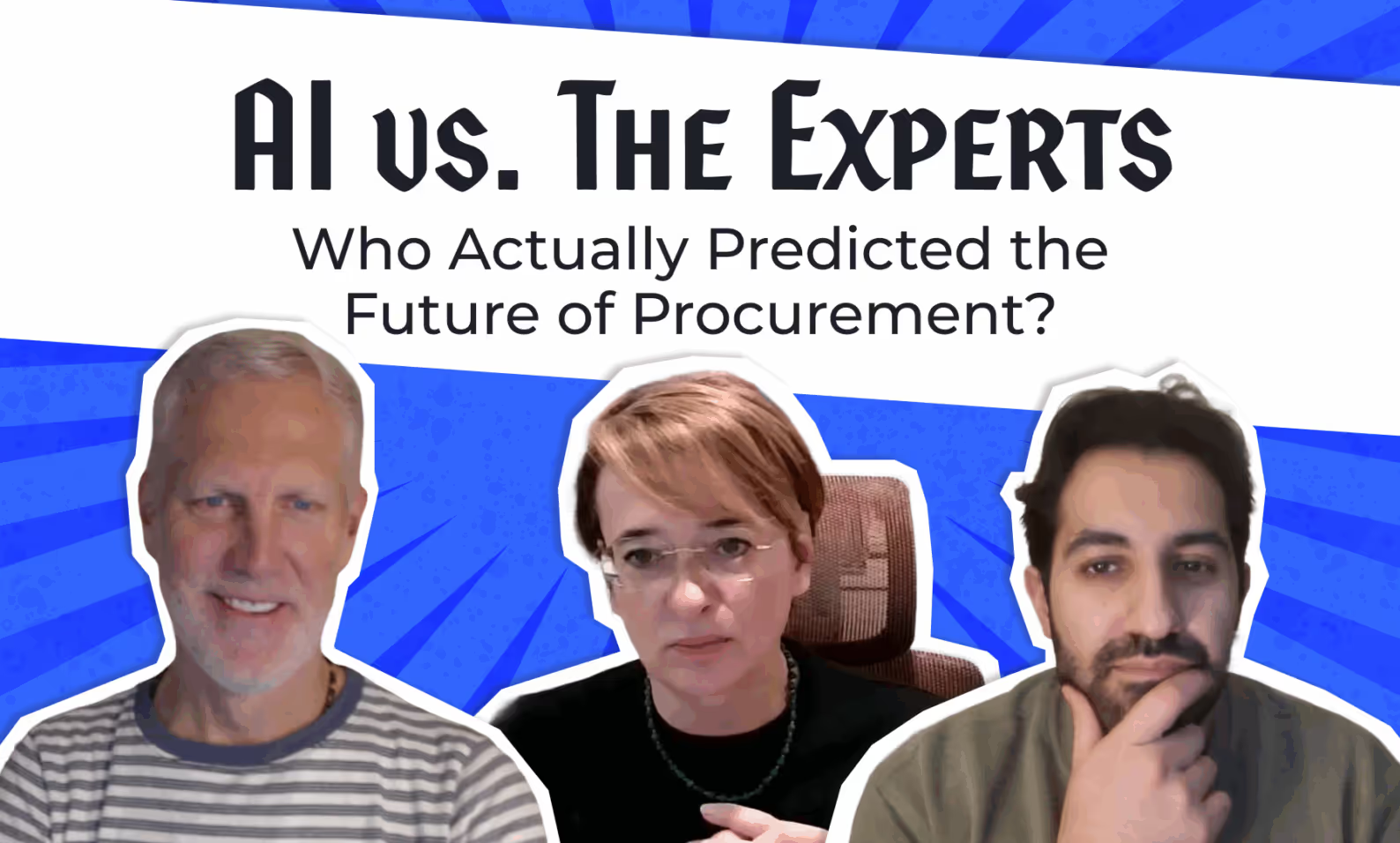
AI vs. The Experts: Who Actually Predicted the Future of Procurement?
2026 Predictions: Will Procurement Teams Shrink?
It’s that time of year! On the latest episode of Proc & Roll, hosts Conrad Smith, Natasha Gurevich, and Zachary Bachir fired up the crystal ball to look ahead at 2026.
But before looking forward, they looked back. Conrad even built an AI agent to “grade” their predictions from last year. The verdict? The team was frighteningly accurate about the “AI Hype Cycle” crashing into the “Data Wall.”
So, what is coming next? From the “Great Tech Stack Reshuffle” to the controversial idea of shrinking teams, here are the top predictions for procurement in 2026.
1. The Great Tech Stack Reshuffle
The era of unlimited software budgets is over. Natasha predicts that in 2026, every CPO will reassess their tech stack. Without incremental budget, leaders will have to “cancel some pieces and bring in others” to self-fund innovation.
This aligns with an AI-generated prediction Conrad shared: “The Suite Empire Strikes Back.” Expect big players to acquire niche tools, leading CPOs to consolidate subscriptions to save money.
2. The Controversial Take: Shrinking Teams
Natasha offered the boldest prediction of the episode: “Every procurement team will shrink in 2026.”
This isn’t about failure; it’s about evolution. As manual and repetitive tasks are automated or eliminated, the need for large operational teams decreases. The focus shifts to preparing people for strategic roles that embrace an “enterprise mindset” rather than a functional one.
3. Tangible Value from AI (Finally)
CPOs have spent the last two years pondering AI. Zach predicts that 2026 is the year we stop playing with “shiny toys” and demand tangible value.
It is not enough to just have a Co-Pilot. Leaders will ask: Where are the agents actually executing work? This shift will force a move from “Chat with your data” to an “Agentic Shift,” where we assign tasks to bots (e.g., “Go find three suppliers and send them an NDA”).
4. The Talent Crisis & The “Gig Expert”
If teams are shrinking and technology is changing, who do we hire? Conrad notes that hiring for specialized roles is becoming impossible.
The solution? The rise of the “Gig Procurement Expert.” Instead of hiring a full-time logistics manager, companies will hire deep domain experts for specific three-month projects.
5. The Death of the QBR
One of the most welcome predictions from the AI list? The death of the traditional PowerPoint QBR. Expect these time-consuming presentations to die a slow death, replaced by real-time dashboards that offer instant visibility into performance
Watch now or read the transcript below.
Transcript: Proc-N-Roll | AI vs. The Experts: Who Actually Predicted the Future of Procurement?
Zachary Bachir: Welcome to Proc and Roll, your guide to practical procurement, where we make procurement rock and roll. Hello Natasha and Conrad, my fellow co-hosts. I’m Zach, your expert on all things procurement. Great to see you guys, just a few days away from Christmas now.
Conrad Smith: I cannot believe 2025 is wrapping so quickly here. We recorded our previous forecast for 2025, the predictions episode, and here we are looking at 2026 coming down the barrel.
Zach: Thank you, Conrad. The topic today is looking back at our predictions from last year and seeing how right or wrong we were, and then putting our predictions forward for 2026. Natasha, I’ll start with you. You predicted getting the basics right, a maturity gap in technology, and a transition from savings to value. How have those played out? .
Natasha Gurevich: We are living in a schizophrenic world. On one hand, we are all about advanced AI. At the same time, many companies do not have the right supplier risk management programs or a single version of truth for spend analytics. There is not a single company who would say they figured out how to avoid redundancy. So our “back to basics” notion was rooted in the fact that there are basics that must be done: purify data and have a methodical approach to spend analytics.
Conrad: Let me give you the AI score for that. It was a hit: 8 out of 10. The AI hype cycle crashed into the wall of bad data in Q2 2025, and companies were forced to pause advanced AI projects to fix their master data. For your second prediction on tech maturity, AI says it’s a 9 out of 10. Massive shelf-ware issues this year. Companies bought advanced autonomous sourcing bots but didn’t have the category taxonomy to run them.
Zach: There is the last one, the savings to value prediction. Natasha, I see it as not happening in isolation; it happens alongside transformational programs. But Conrad, what have you seen?
Conrad: AI says that score is 5 out of 10. It is the procurement dream, but in the tight economy of 2025, the CFO still demanded hard dollar savings. Value is too fluffy for the board. However, tariffs and inflation played a big role in that focus on real dollars this year.
Natasha: I just want to add one thing. My whole professional life, we tried to convince CFOs not to view procurement as a cost center. This year, I heard it from five CFOs that they want procurement to contribute to revenue generation.
Zach: Okay, Conrad, your predictions were: more investment in technology (Amazon-like experience), a focus on talent, and risk growing in importance.
Conrad: The AI score for the Amazon effect is 10 out of 10. Intake management—LevelPath, Oro—became the hottest category because it solved the user experience problem. For talent scarcity, it gave me a 7 out of 10. Hiring was impossible for specialized roles, leading to the rise of “gig procurement experts” .
Zach: I’ve had interesting conversations around talent. My view evolved to looking for the “consultant style” talent profile because there is so much more knowledge work that needs to happen.
Conrad: On risk, the AI said it was “painfully true.” Carbon and regulations ate up 40% of strategic bandwidth this year.
Zach: My issue, Conrad, is that we are trying to funnel so many processes through risk screening. But are the risks actually being managed? I feel there is more maturity needed to elevate the operating model so you evaluate risks in proportion to the request.
Conrad: Zach, let me cue you up on your three. Changing fundamentals, cost to value, and category to enterprise focus.
Zach: I basically copied Natasha’s first two and slapped on the third one.
Conrad: The AI gave you a 7 out of 10. It said we saw this happen in IT procurement, but manufacturing stayed very siloed. You got an extra point for mentioning orchestration—the specific type of value making things flow is huge.
Conrad: So, what are the predictions for 2026? I’ll start. AI has enamored the world… but I haven’t seen that same massive breakthrough in procurement tech yet.
- Data Quality for AI: Everyone is caught up in the hype, but they are realizing that the usefulness of AI is measured by the quality of the data. Data is a huge focus for 2026.
- Talent Confusion: People are like deer in the headlights. Should they hire someone to make agents or negotiate contracts? Talent is going to become really hard in the year ahead.
- Persistent Risk: This isn’t going away. If we automate bad processes, we just turn up the risk dial. We need to ask more questions and do more research.
Natasha: Here are my top predictions for 2026.
- Reassessing the Tech Stack: Every CPO will reassess their tech stack in 2026. They will cancel some pieces and bring in others. They won’t get incremental budget, so they have to self-fund by reshuffling.
- Enterprise Mindset: Procurement leaders need to train their teams on the enterprise mindset versus the functional mindset. Stop talking to stakeholders about “procurement” and start approaching business problems with a mindset of “how will it benefit the company?”
- Shrinking Teams: Every procurement team will shrink in 2026. I know it’s controversial, but as manual tasks decrease, we need to prepare people for different roles—more strategizing, less repetitive tasks.
Zach: What do I see in the year ahead?
- Tangible Value from AI: CPOs have spent the last year pondering AI. Next year, they will ask: “Where is the tangible value?” It’s not enough to just have Copilot; where are agents actually being relied on in the process?.
- Intake & Orchestration: This will still be the number one shiny new technology because you need a single source of truth and a way to orchestrate all these systems.
- Decentralization & Outsourcing: We need to increase business partnering, which means decentralizing. But also, I think outsourcing (BPO) for transactional tasks will be very attractive again to free up the team for strategic work.
Conrad: I have a “Top 10” list for 2026 generated by AI. Here are a few highlights:
- The Agentic Shift: Co-pilots get fired. We start assigning tasks to autonomous agents, like “Go find three suppliers and send them an NDA.”
- The Suite Empire Strikes Back: Big players will acquire niche players or build “good enough” versions, and CPOs will cancel niche subscriptions to save money.
- The Anti-ESG Pivot: The branding will change because “ESG” is a dirty word politically, but the work continues because Europe demands it.
- The Death of the QBR: The traditional PowerPoint QBR dies a slow death, replaced by real-time dashboards.
Conrad: On the macro side, there is this coldness between the US and China. I predict in the next 12 to 18 months, there will be a thawing of that bitter battle because it is contrary to the benefit of the world.
Natasha: I think political decisions are always dictated by financial consequences. We’ll see some changes because people are suffering.
Conrad: Well gosh, Happy Hanukkah, Merry Christmas. We’re getting into 2026, which is mind-blowing.
Natasha: This was one of the fastest years. Happy holidays!
This transcript has been edited for clarity while maintaining all substantive content