

Get Started
Graphite's supplier management tool helps you onboard faster, cut time on risk reviews and streamline supplier validations. Save time and money.
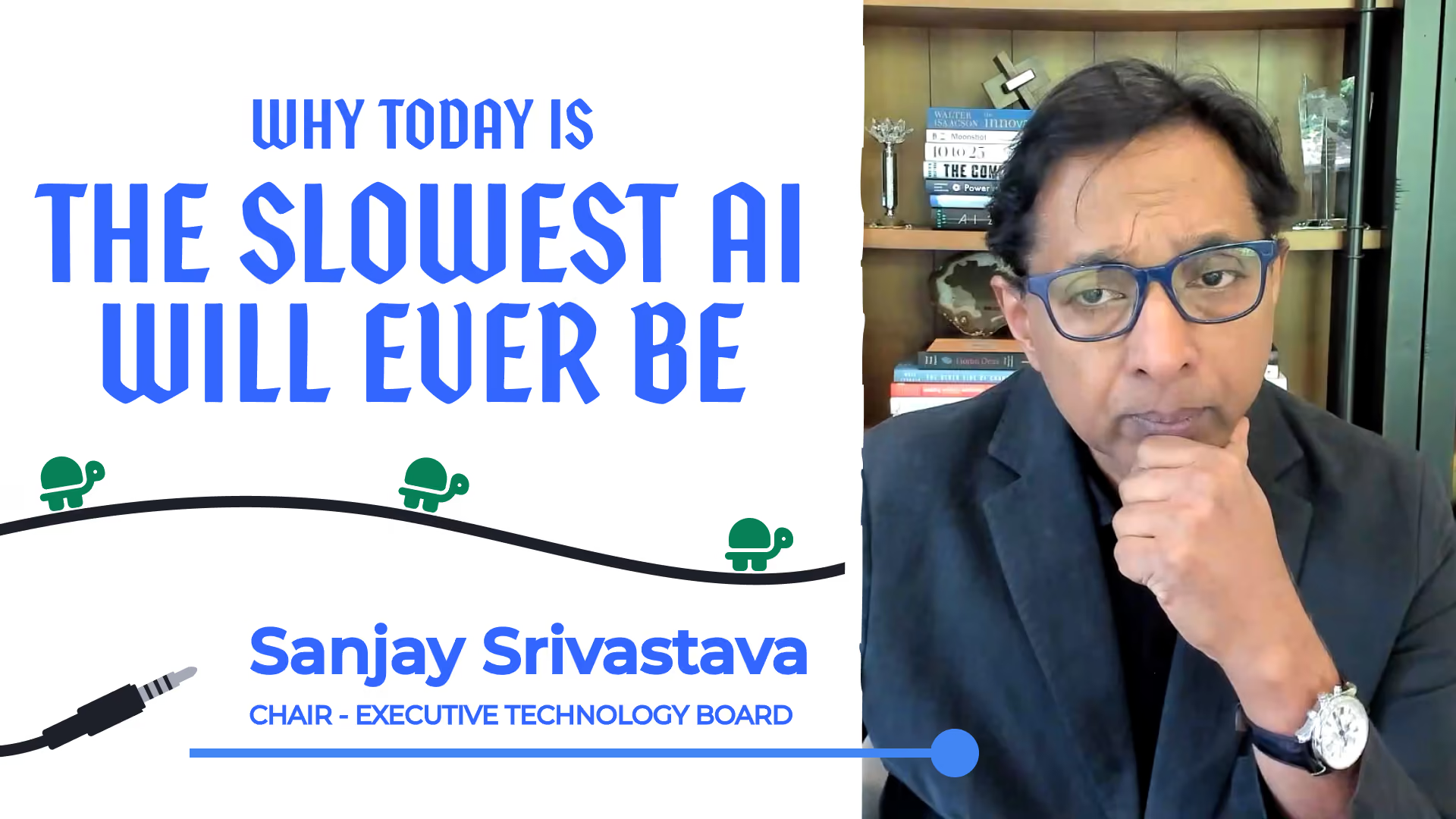
Why Today is the Slowestt AI Will Ever Be
This week on Proc N Roll, Zach and Natasha are joined by Sanjay Srivastava, the former Chief Digital Officer at Genpact, founder of the Executive Technology Board, serial entrepreneur, and author of the digitally Substack.
If you feel like the pace of technological change is overwhelmingly fast right now, Sanjay has a provocative wake-up call: structurally, this is the slowest it will ever be. Because AI is fundamentally software and language-based, it is uniquely suited to accelerate its own development.
In this jam-packed episode, Sanjay breaks down what enterprise leaders must do to survive and thrive in this new era.
Key Topics Discussed
- Transformation as a Permanent State: Historically, business transformation was triggered by episodic events like regulatory changes or new software releases. Today, the pace of change is so high that transformation must become a permanent, continuous state of adaptation.
- The AI Stress Paradox: AI is successfully reducing chore work for employees, but stress levels are paradoxically rising. Sanjay attributes this to "context switching," as AI allows us to jump rapidly between parallel tasks, which human brains are not naturally built to handle.
- The Marginal Cost of Code: We are heading toward a future where the cost of writing software drops to near zero, meaning companies could theoretically rewrite their applications every single night. In this world, the ultimate durable advantage will not be the code itself, but deep subject matter expertise and domain knowledge.
- 10 Oak Trees vs. 10,000 Wildflowers: Giving every employee an AI agent (10,000 wildflowers) is great for shifting corporate culture, but it rarely delivers hard ROI. To see massive returns, companies must adopt a "10 oak trees" strategy by funding and centrally managing a few large, highly focused projects.
- Who Owns AI?: Sanjay drops a massive truth bomb: if AI is run by the technology team, it is merely an IT project. If it is run by the business teams, it becomes a true business transformation.
- Tokenomics and "Day 2" Costs: The ongoing costs of maintaining, updating, and running AI models are growing exponentially. Sanjay advises leaders to multiply their current AI token costs by three before approving any new business cases to ensure realistic ROI.
- The 4x4 Board Framework: Sanjay shares a practical framework for CEOs and boards to consistently evaluate AI efforts across four quadrants: cost takeout, growth/new markets, industry structural transformations, and new threats.
Transcript: Proc-N-Roll | Why Today is the SLOWEST AI Will Ever Be
Zach: Hello and welcome back to Proc and Roll. Today we're joined by Sanjay Srivastava, the former chief digital officer and chief digital strategist at Genpact, founder and chair of the Executive Technology Board, which is an enterprise technology think tank, and a serial entrepreneur who's built and exited four technology companies. He writes one of the sharpest newsletters in enterprise tech on Substack. Sanjay, thank you so much for joining us.
Sanjay Srivastava: Zach, thank you. It's great to be here.
Natasha Gurevich: You got my attention a couple of times by saying that things are moving extremely fast, and yet this is the lowest that we will ever be. Can you please unpack that a little bit?
Sanjay Srivastava: We all know that the pace of change is incredible as we speak. In software engineering, we've gone from nearly zero code in 2022 to 67% of all code that's written today. But it's actually the slowest that'll ever be in the future. AI, which is fundamentally software, benefits structurally from AI. It's intrinsically suited structurally to help, and you don't necessarily need a human in the loop to write that code. The software just keeps improving itself.
Natasha Gurevich: I am observing that the readiness of the enterprises is significantly slower than the readiness of technology. How do we bridge the gap between the enterprise readiness and technological advancements?
Sanjay Srivastava: Historically we used to think about transformation as episodic. I think what's happening now is the pace of change is so high... that transformation is now a permanent state. Organizations that are building a muscle of continuous adaptation are getting ahead of the game. Furthermore, for employees that get the same access to tools and exactly identical training... the performance numbers are 10 to 20x apart. The hard part is how do you drive a culture of change and make it not episodic but constant.
Zach: Don't people need a break though? How do you incorporate the constant state of change while still satisfying all your stakeholders and not burning out your employees?
Sanjay Srivastava: Those employees have automated and therefore reduced kind of the chore work... but actually their stress levels have gone up. What it points to is context switching. The human brain is less used to or built for context switching, and AI is allowing us to switch contexts really fast. This is a chief human resource officer or chief people officer topic as much as it is a chief AI officer topic.
Natasha Gurevich: People who utilize AI heavily are actually saying that their workload went up. How do you explain that?
Sanjay Srivastava: There is a breadth component and there's a depth component. I can cover a lot more surface because I have the toolkitry... but I can actually go much deeper into analysis and recommendations. Some things are getting simpler and easier, and some things are getting more challenging and more difficult.
Natasha Gurevich: Procurement is able to step into the areas that may not traditionally being viewed as expense, blurring with revenue generation or getting market intel.
Sanjay Srivastava: The marginal cost of developing software is significantly going down. One of the things that's becoming very clear is that we will get to a point in the future when we will rewrite our applications every night because the cost of developing that code is going to be near zero. When we get there, the durable advantage is going to come from the domain knowledge and the subject matter expertise.
Natasha Gurevich: Conrad built himself a chief of staff that is doing a lot of things while he is asleep... and James consumed overnight the entire budget that was allocated to him on a monthly basis. How do we get agentic AI to be a cost-effective solution?
Sanjay Srivastava: While the cost of computing is definitely going down, token utilization and day two costs are exponentially growing. You need to actually almost have a policy-embedded control plane for AI in the enterprise that allows day-to-day employees to get the job done without getting encumbered with rules and pricing. In the future... most of these systems will head to a world where they'll become headless; they won't have all of this apparatus on top of it for me to interact with.
Zach: How do you as a corporate board or senior leadership actually make sure that the resources reach people at any level without getting stuck?
Sanjay Srivastava: The first phase of generative AI has been experimentation—the "ten thousand wildflower strategy" where we gave a tool to every employee. It transformed mindsets, but in terms of actual economic return, it has not delivered. On the flip side, a "ten oak tree strategy" focusing on massive, centrally managed projects that deliver 10 million plus in returns have all paid off. Also, if AI is run by the technology team, it's an IT project. If AI is run by the business teams, it's a business transformation.
Natasha Gurevich: Who should own AI strategy then? CFO, CEO, Chief Procurement Officer?
Sanjay Srivastava: The proximity to institutional knowledge... is the super important thing, so the business needs to take total accountability for the economics and returns. But the thing to watch out for is most people think about AI to automate what they do today; it almost never goes to how do I completely replace what I do today and do something entirely different. Regulators are starting to see a movement that went from "explain to me why you are using AI" to "explain to me why you are not using AI" because human scale just isn't possible anymore.
Zach: Do you try to get an agent to execute an end-to-end process replacing a person, or completely reimagine how the work gets done?
Sanjay Srivastava: Thinking about organizational design is key. A leading bank in Southeast Asia ran a project around agentic AI and found that one agent can handle the entire flow from sales to service better than two agents in two halves. Should we today collapse the sales and services departments into one organization to transition into this next phase? This is a business transformation question.
Natasha Gurevich: How would you inspire CEOs and CFOs from older generations to think about organizations of the future differently?
Sanjay Srivastava: You have to break it down to bite-sized chunks grounded in strategy. I use a four-by-four quadrant: 1) Cost takeout, 2) Growth and new markets, 3) Vision around structural transformations in the industry, and 4) New threats that AI creates. That starts the mindset of thinking about a much larger canvas around AI.
Natasha Gurevich: I think we could go on with this conversation forever. Every time I'm listening to you, Sanjay, I'm learning so much. We're very, very grateful for the insights you shared. Thank you.
Sanjay Srivastava: Thank you for having me. So good to be with you.
Zach: Thanks all.
This transcript has been edited for clarity while maintaining all substantive content