

Get Started
Graphite's supplier management tool helps you onboard faster, cut time on risk reviews and streamline supplier validations. Save time and money.
Who Owns Supplier Data? Why Governance Is a Team Sport
The Ownership Gap
Every business relies on supplier data to make decisions, manage risk, and stay compliant. But ask five departments who owns that data, and you’ll likely get five different answers.
Procurement might assume IT is responsible. IT points to procurement. Legal thinks it’s compliance’s domain. And suppliers? They’re often stuck re-entering the same information into multiple disconnected systems—all with different standards.
This isn’t just inefficient. It’s risky. The core issue isn’t bad data processes—it’s a lack of clear ownership.
The Ripple Effect of Unclear Ownership
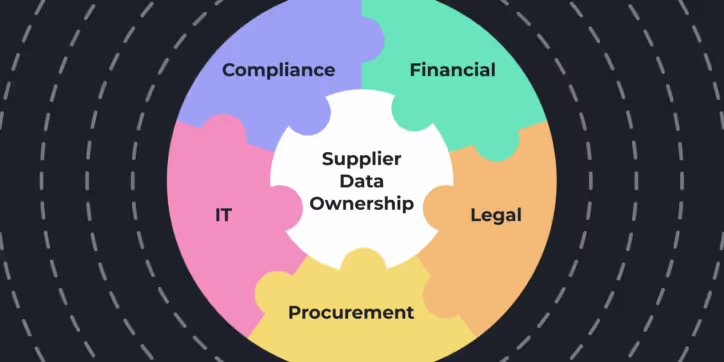
Supplier data travels across your organization—but without a clear owner, it often arrives broken. Procurement uses it to evaluate vendors. Legal needs it to validate contracts. Finance relies on it for payments. IT stores it in systems. Compliance checks it for audits. Even suppliers themselves are asked to maintain it.
But when responsibilities overlap—or worse, get ignored—data quality suffers.
Duplicate records can split supplier spend. Outdated certifications create compliance gaps. Disconnected systems delay onboarding. And without a single source of truth, audits become harder and internal trust erodes.
The damage isn’t just technical—it’s operational. Every misstep slows the business down and frustrates suppliers.
Making Supplier Data Governance a Team Sport
Solving this isn’t about adding more rules or paperwork—it’s about creating shared structure and accountability. Here’s how to do it:
1. Define a Governance Framework
Break down responsibilities by data type. Procurement might own supplier type, legal owns compliance fields, finance owns tax info, and suppliers manage contact details. Define it. Document it. Share it.
2. Appoint a Data Stewardship Lead
Assign a central owner (or small team) to oversee data quality and process consistency across functions. They won’t fill in every field—but they ensure others do.
3. Empower Suppliers to Manage Their Own Data
With secure platforms and validation rules, suppliers can keep their own profiles accurate and up-to-date. This not only reduces internal workload, it improves trust and accuracy across the board.
4. Establish a Single Source of Truth
Unify supplier records in a central system that connects across departments. One profile, many touchpoints—always in sync.
Conclusion: Cleaner Data Starts with Clearer Roles
Supplier data doesn’t manage itself—and no single department can do it all. But when ownership is defined, roles are coordinated, and suppliers are empowered, data quality transforms from a weakness into a competitive advantage.
Governance isn’t about slowing things down. It’s about building a foundation of trust, speed, and performance across the organization. That starts by treating supplier data ownership as a shared responsibility—not a passing burden.