

Get Started
Graphite's supplier management tool helps you onboard faster, cut time on risk reviews and streamline supplier validations. Save time and money.
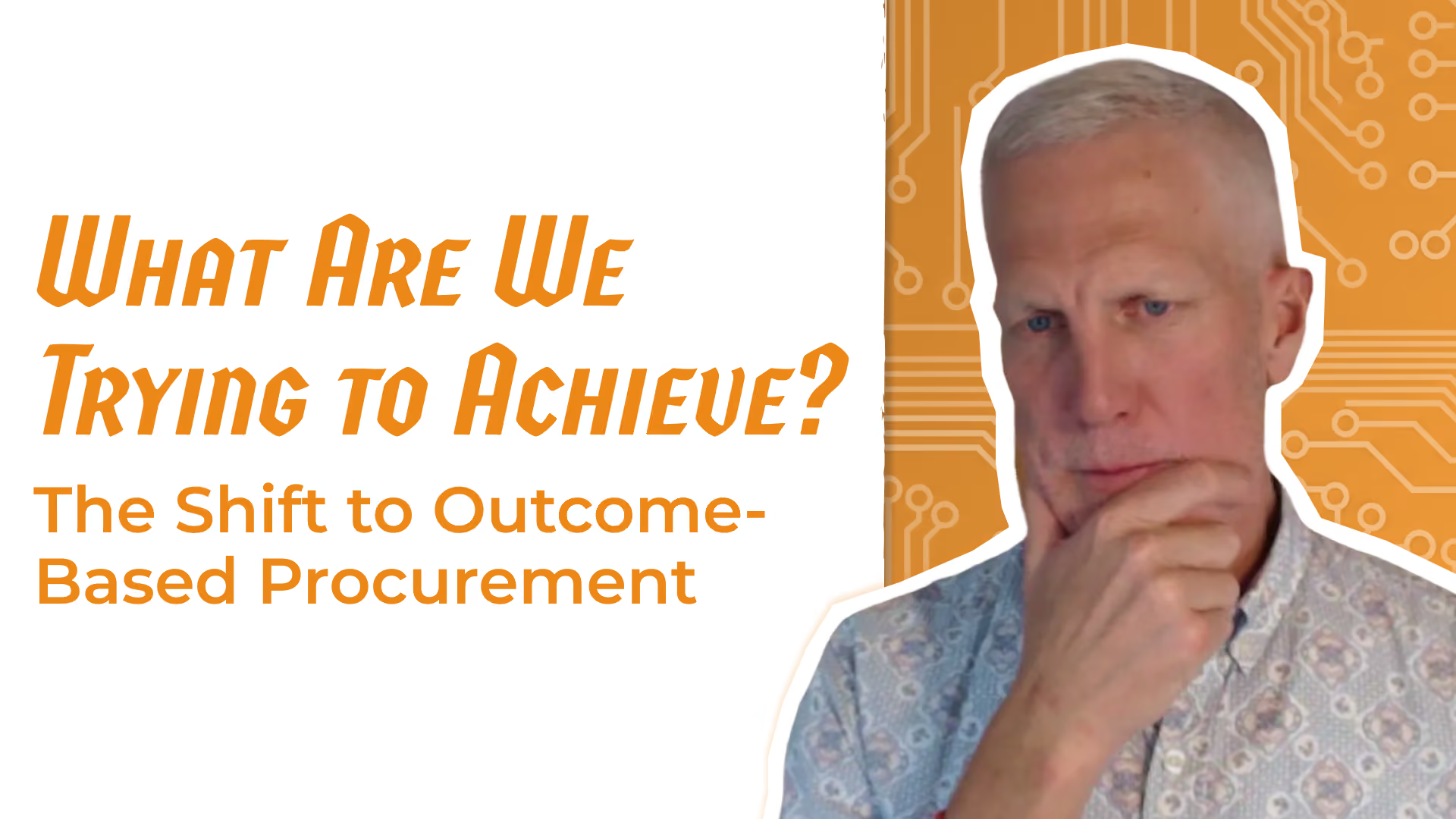
What Are We Trying to Achieve? The Shift to Outcome-Based Procurement
Welcome back to the Proc n Roll! In this week's episode, Conrad reconnects with procurement powerhouse Omid Ghamami. The two started their careers at Intel together in 1994, navigating the corporate world with zero formal training in procurement—because, as Omid points out, almost nobody plans to go into this field.
Today, Omid is sharing the exact mindset shift that allowed him to take his workweek from a grueling 70 hours down to just 15 hours. If you are tired of spending your days putting out supplier fires, this episode is a massive wake-up call.
Here are the game-changing takeaways from their conversation.
The Problem With "Goods and Services"
According to Omid, the root cause of 90% of our problems in procurement is the fundamentally flawed concept that our goal is to acquire "goods and services". This is a 1970s perspective.
When you contract purely for goods and services (like price, delivery date, and warranty), you aren't tying the agreement to actual performance outcomes. Because of this, procurement professionals end up spending 70% to 90% of their day on unplanned firefighting activities. Omid even argues that the entire discipline of Supplier Relationship Management (SRM) only exists because we write bad contracts and have to rely on "relationship management" to fix them post-signature.
Parasitic Negotiations and the 18% Hidden Cost
Everyone wants to be known as a great negotiator. However, Omid explains that fighting at the table for an extra 5% discount is "parasitic value creation"—you only gain at the supplier's expense.
The real money isn't found at the negotiation table; it is found at the end-user decision level. Omid's institute discovered that the way stakeholders articulate and create demand typically embeds about 18% in unnecessary, extra costs. This happens when users create custom scopes of work instead of standard ones, over-spec their requirements, or add unnecessary "gold-plated" features. If procurement doesn't challenge the demand early on, those unnecessary costs get hard-coded before negotiations even begin.
Real-World Disasters of Not Contracting for Outcomes
Omid shared two shocking stories that perfectly illustrate the danger of buying products instead of outcomes:
- The Wisconsin LED Traffic Lights: A county in Wisconsin put out an RFQ to replace their traffic lights with LEDs, awarding the contract to the lowest responsive bidder. But there was a massive oversight: LEDs do not generate heat, meaning they don't melt snow. Because procurement didn't specify "sufficient heat dissipation" as a required outcome, they got exactly what they asked for and now have to employ staff specifically to scrape snow off traffic lights every winter.
- The $30 Million Payroll Blunder: The San Francisco Unified School District paid millions for a new payroll system, but their highly detailed, 46-page contract focused entirely on activities. Not once did the contract stipulate the actual outcome: "the right people will get paid the right amount at the right time". The implementation was a disaster, the district had to pay an extra $30 million, and the supplier laughed all the way to the bank because they legally fulfilled the exact activities they were contracted to do.
Ignorance is Your Greatest Superpower
If you are a young buyer or transitioning to a new category, it can be intimidating to challenge specialized stakeholders. Omid’s advice? Embrace your ignorance.
You don't need to be an expert in light poles, software latency, or oxygen tubes. In fact, it is precisely your ignorance that allows you to step back and ask the most important question in outcome-based sourcing: "What are we trying to achieve?" instead of "What are we buying?".
Leadership Lesson: Crown Yourself
Omid closed the episode with a powerful piece of career advice. If you want to move up, pay attention to what is eating everybody alive inside your department, quietly become an expert in it, and solve the problem.
"Don't wait for other people to crown you. You can crown yourself," Omid advises. Do not make a public service announcement or ask for permission on Monday morning. Just solve the problem, and organically, you will become the internal consultant that leaders want to promote.
Transcript: Proc-N-Roll | What Are We Trying to Achieve? The Shift to Outcome-Based Procurement
Conrad: Welcome back to Proc Enroll. Today I am very excited to introduce Omid Ghamami. We have known each other for over three decades, dating back to when we both started in the same hiring class at Intel in May of 1994. We both kind of fell into this career by accident. Over the years, how have you shifted your focus from traditional negotiation to truly delivering value?
Omid: It is true that almost nobody plans for this career; I have asked roughly 30,000 people at conferences over 30 years if they planned to be in procurement, and only four people raised their hands. Today, everyone wants to focus on negotiations, but that is a 1950s perspective that usually results in "parasitic value creation," where you only gain a discount at the supplier's expense. The real money is actually at the end-user decision level. We have found that the way end users articulate demand typically has about 18% extra cost embedded in it due to custom, complex, or over-speced designs. For example, one client was buying highly pure oxygen tubes for $100 a meter, but we found a slightly lower grade that completely met their needs for just $6 a meter—a 94% reduction.
Conrad: It makes a ton of sense to focus on outcomes and stripping out unnecessary costs. But if you are stepping into a complex category like IT or facilities where you don't understand the terminology, how do you successfully engage stakeholders and get involved early?
Omid: First, you have to embrace that the greatest tool we have in procurement is ignorance. Being an outsider allows you to critically observe things that don't make sense. Second, you have to realize that end users don't engage us early because we focus on procurement policy compliance instead of their actual business unit outcomes. You have to build the "know, like, and trust" triangle, leverage reciprocity by praising them publicly, and listen more than you talk. Also, when starting out, do not go to the stakeholder with the biggest spend; start with the stakeholder who is most sympathetic to procurement so you can secure an early win and create an internal ambassador.
Conrad: Do traditional tools like RFPs and RFQs still work for outcome-based sourcing, and how do we shift away from just buying goods and services?
Omid: The root cause of 90% of our problems in procurement is the flawed concept that our goal is to acquire goods and services rather than outcomes. When you just buy goods and services, you spend 70% to 90% of your day firefighting post-contract complaints. In fact, Supplier Relationship Management only exists because we write bad contracts and have to manage the fallout. RFPs work perfectly, but you must define the outcomes correctly. If you don't, you end up like the San Francisco Unified School District, which paid millions for a payroll system based on a 46-page contract of activities, but never actually contracted the outcome that the right people would get paid the right amount at the right time. Or you end up like the county in Wisconsin that bought LED traffic lights from the lowest bidder, only to realize in winter that LEDs do not get hot enough to melt snow.
Conrad: That is terrifying. How does legal fit into this? Are they protecting us from these disasters?
Omid: Procurement mistakenly thinks that when a lawyer approves a contract, they are saying it is a good commercial deal. They are only looking at indemnification and liability risk. Procurement needs to ensure performance metrics measure results and establish clear legal and equitable remedies. For instance, contracting for "resolution time" instead of "response time" to prevent catastrophic IT outages. However, the end-user must provide the actual content and define those metrics because they are the ones who have to live with the final result.
Conrad: Before we wrap up, what is the best piece of leadership wisdom you would share with our listeners?
Omid: Pay attention to what is eating everybody alive inside your department, pick one thing, quietly become an expert in it, and solve the problem. Don't wait for other people to crown you; you can crown yourself. If you do this without making public announcements or asking for permission, you organically become an internal consultant and leaders will naturally want to promote you.
Conrad: I love this, what a fantastic insight. Thank you for joining us, Omid. Everyone, don't forget to subscribe, like, comment, and share to get these practical insights out to others!
This transcript has been edited for clarity while maintaining all substantive content