

Get Started
Graphite's supplier management tool helps you onboard faster, cut time on risk reviews and streamline supplier validations. Save time and money.
The True Cost of Dirty Data in Procurement
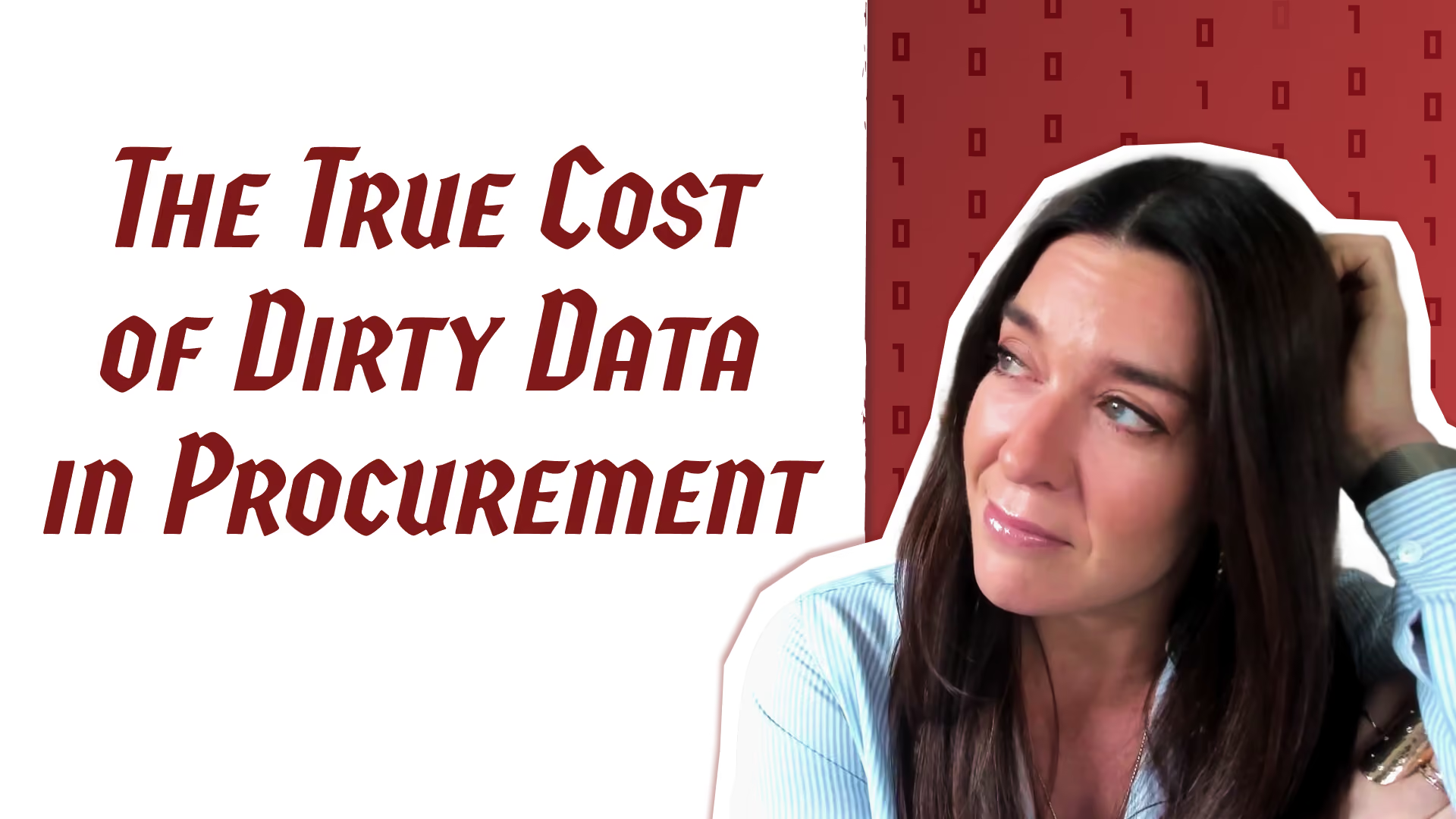
In this week's Proc N Roll, Conrad sat down with Stephany Lapierre, the founder of Tealbook and a well-known visionary in the procurement space.
If you have ever felt the pain of trying to pull a simple spend report only to spend three weeks manually cleaning up supplier names in a spreadsheet, this conversation is for you. Stephany and Conrad dig deep into the reality of modern source-to-pay processes and the data foundation required to actually make them work.
Here are the biggest takeaways from their Jam Session:
The "Ferrari" Analogy
Conrad opened the episode with a metaphor that perfectly captures the current state of procurement tech: we spend decades and millions of dollars buying procurement and process tools—our "Ferraris". But because we deprioritize the data that fuels them, we essentially end up putting sugar and mud into the gas tank and wondering why the car won't run.
Stephany saw this firsthand when she transitioned from her first company, Matchbook, into building procurement functions for biotech companies. She realized that no matter how many systems were implemented, bad data remained the ultimate blocker.
The Evolution of the "Scott" Problem
Conrad shared a story from his time at Intel in 1994 about a guy named Scott. Scott was the only person with access to the mainframe, making him the ultimate gatekeeper for anyone who needed to run reports or answer basic business questions.
Today, the problem hasn't disappeared; it has just mutated. Instead of one mainframe, companies have multiple systems, multiplying the amount of work. Now, data teams (our modern-day "Scotts") are overwhelmed by requests across the business, struggling to consolidate data from systems that lack consistent structures or naming conventions.
As Stephany pointed out, everybody believes they have their own source of truth, but nobody actually does. Without a centralized "brain" to share and format data efficiently, companies waste millions of dollars doing recurring, manual data cleanses.
The AI Illusion and Entity Resolution
With all the hype around artificial intelligence, many leaders assume AI will magically clean their messy ERP data. Stephany gave a rapid-fire reality check: Large Language Models (LLMs) do not fix data quality.
If you feed bad data into an LLM, it will simply give you a wrong answer with so much confidence that you might actually believe it.
The real challenge is entity resolution. Stephany used her own name as an example: how do you know if the "Stephanie with a Y" in one system is the same as "Stephanie with an F" or "SL Corporation" in another? Until you can definitively connect all contracts, invoices, and spend to the exact right company, your AI tools will be pulling from a flawed foundation.
Leadership Lesson: Pare Down the Vision
Stephany closed the episode with a powerful piece of advice for founders and procurement leaders alike. When Tealbook started building ML models in 2016, she was driven by a massive vision to fix the entire data problem.
However, she admitted that the problem was almost too big for people to digest at the time. People have daily jobs and KPIs they need to hit right now. Her advice? Pare down your grand vision into something consumable. Start with a focused wedge—like improving supplier onboarding—to prove value and gain the trust needed to drive larger change management
Transcript: Proc-N-Roll | The Big 50: Practical Steps to Building the Procurement Model of the Future
Conrad: Welcome back to Proc and Roll, everyone. Today, I am thrilled to be joined by Stephany Lapierre, the founder of Tealbook. We have a serious problem in our industry: we have spent decades buying expensive procurement systems—our "Ferraris"—but we completely deprioritize the data. We essentially put sugar and mud into the gas tank and expect these multi-million dollar systems to run perfectly. How did your career lead you to focus so heavily on solving this data problem?
Stephany: It all started about 19 years ago when I launched a matchmaking service called Matchbook. Coming from the pharmaceutical industry, I constantly struggled to find real innovation, so I built a business to solve that gap. Over time, my network started launching biotech companies, and I pivoted to building their procurement functions. I quickly realized that implementing software early was great, but the data would fall apart almost immediately. Even when we tried to build a "LinkedIn for suppliers," we hit a wall because of portal fatigue; you simply cannot rely on suppliers to constantly log in and update their profiles across countless systems.
Conrad: That resonates so much. When I was at Intel in 1994, we had one guy named Scott who was the sole gatekeeper of the mainframe. If you needed to know your spend or understand your suppliers, you had to beg Scott for his time. I actually learned to write SQL queries just to bypass him, which involved a painful 20-step process of pulling a jumbled text file off a mainframe and forcing it into Excel. It is shocking how, decades later, when a crisis hits, companies still face a mad dash to find their modern-day "Scott" to get basic answers.
Stephany: Exactly, and today it is exponentially worse because teams are dealing with multiple disconnected systems. Everyone believes they have their own source of truth, but nobody actually does. I recently spoke with a Fortune 50 company that has 650,000 records spread across 16 different ERPs. They are going through M&As and hired a consulting firm to optimize spend, but the data is so messy that the consultants cannot even begin their work. Another company was spending $1.5 million a year just to manually cleanse their vendor master data every three weeks. If procurement can take ownership and fix this, you change the entire conversation with supply chain and finance.
Conrad: The only practical solution is to design intelligent data hygiene directly into your processes upfront, rather than relying on endless, expensive cleanup cycles. With all the hype right now, many practitioners just assume that AI is going to magically step in and clean this bad data for them. What is your rapid-fire take on that?
Stephany: Large Language Models (LLMs) do not fix data quality. If you feed unverified data into an LLM, it will just give you a wrong answer with so much confidence that you might actually believe it. We use specialized AI to do the hard work of entity resolution. For example, if a CFO asks how much we spend with "Stephany," the system has to know if "Stephanie with a Y," "Stephanie with an F," or "SL Corporation" are all the same entity before it can give a trusted answer. A generic chatbot cannot resolve those foundational issues.
Conrad: Looking back over your career and the massive solutions you have built, what is the one leadership lesson you wish you had understood earlier?
Stephany: I wanted to solve the entire source-to-pay data problem, but it was too big for people to digest back in 2016. If I could go back, I would pare down that grand vision into something smaller and more consumable. Focus on a specific wedge, like fixing supplier onboarding. People have daily KPIs they have to hit right now. If you can make their everyday jobs easier and prove value in a pilot, you earn the permission and buy-in needed to drive that massive, world-changing vision over time.
Conrad: That is a fantastic point—leadership is having the vision, but also laying out a tangible path that people can follow today so they aren't starving while waiting for the 10-year goal. Thank you for this amazing conversation, Stephany. Everybody, please go ahead and comment, like, and share!
This transcript has been edited for clarity while maintaining all substantive content