

Get Started
Graphite's supplier management tool helps you onboard faster, cut time on risk reviews and streamline supplier validations. Save time and money.
The Death of Procurement Middle Management (And How to Survive AI)
If you are relying on massive, step-by-step process documentation to run your procurement function, it is time to rethink your blueprint. The rise of Artificial Intelligence and autonomous agents is not just introducing new tech tools is completely rewriting the procurement operating model.
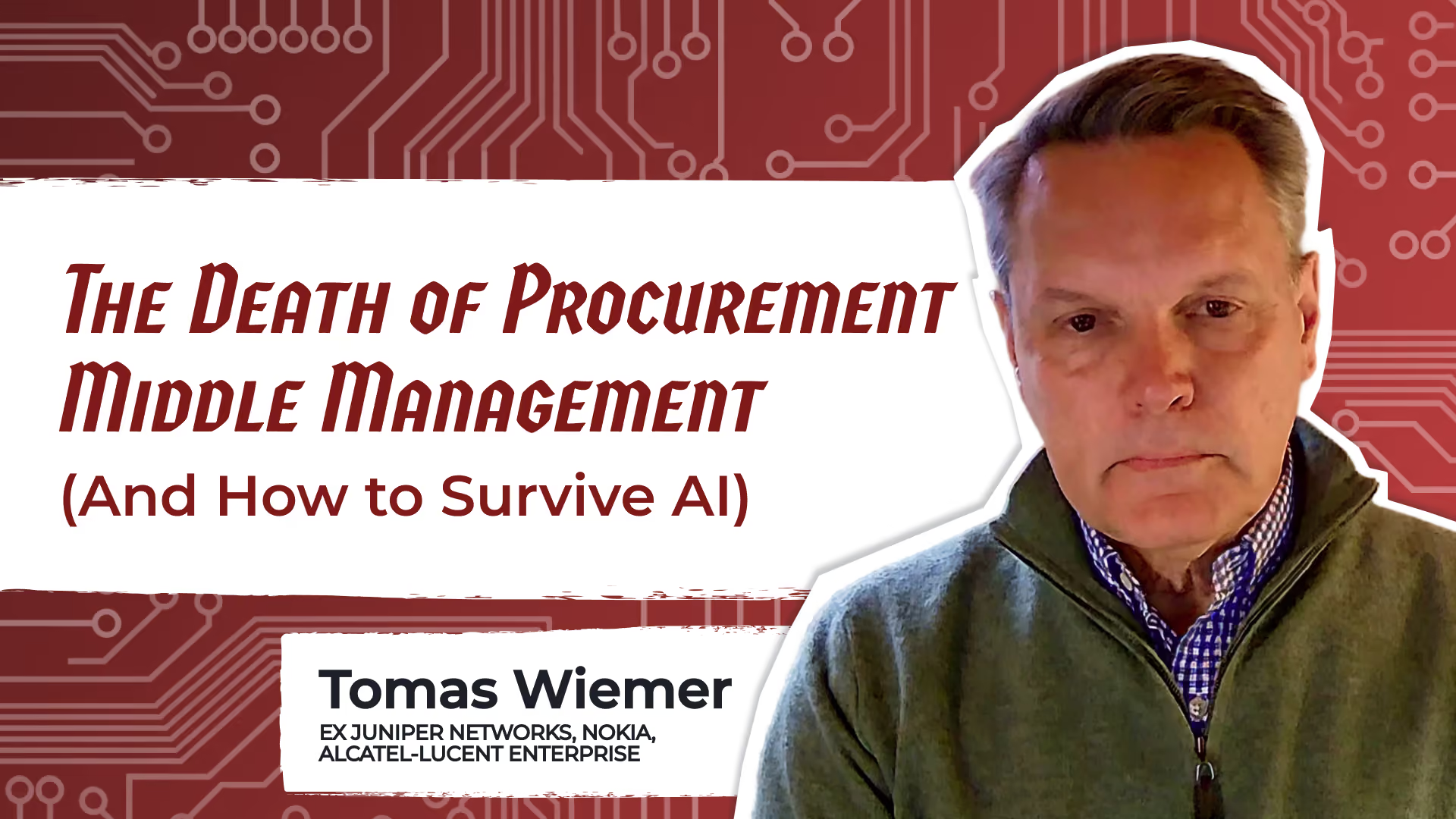
In this week's Proc & Roll podcast, hosts Conrad Smith and Zachary Bachir sat down with Tomas Wiemer, former Head of Procurement at Juniper Networks, for a deep dive into what this new world looks like.
Here is a breakdown of the biggest takeaways from their jam session and how you can prepare your team for the agentic future:
1. Redefining Value and the Operating Model
At its core, an operating model is simply the blueprint for how a business function delivers value. Traditionally, this encompasses layers like people, process, technology, service delivery, and governance.
However, as Tomas pointed out, the definition of "value" in procurement has fundamentally shifted. It is no longer strictly about cost savings. Today, value is defined by risk minimization, speed, and delivering fast business solutions that help stakeholders hit their goals.
2. Outcomes Over Process: The End of the Process Map
In an AI-driven world, the traditional way of documenting end-to-end processes is becoming obsolete.
Business is complicated, and human workers have always had to use reasoning to navigate edge cases that could never be fully documented. AI agents are now capable of that same reasoning. Instead of following rigid step-by-step instructions, agents focus on the outcome. Procurement teams will shift from managing micro-processes to defining high-level procedures, guardrails, and policies that agents must comply with while they autonomously find the best path to the desired result.
3. The Middle Management Squeeze and the "Player-Coach"
The daily tasks of a sourcing professional are evolving rapidly. Soon, humans will no longer be generating RFPs or redlining contracts from scratch; AI agents will. The human's job will transition to reviewing the agent's work, evaluating its quality, and teaching the model what "good" looks like.
This creates a massive squeeze for middle management. Leaders who only know how to manage people, but not the actual work, are at risk as automation rises from the bottom. To survive, managers must roll up their sleeves and become "player-coaches" who understand the technology deeply enough to train and refine the agents executing the tasks.
Furthermore, HR structures must adapt. The traditional corporate ladder dictates that you must manage people to move up. In the future, individual contributors managing highly leveraged AI agents will possess incredible value and need a career path that rewards their technical influence without requiring traditional people-management.
4. Radical Efficiency and "Supplier Insurance"
The speed of AI is staggering. Zachary shared a recent example of building a Total Cost of Ownership (TCO) model. In the past, researching and building a robust TCO model could take weeks. Today, an agent can generate those insights in an hour or less.
But the efficiency goes beyond just analytics. Tomas and Conrad brainstormed a radical future for onboarding and contracting. Instead of spending weeks or months negotiating standard NDAs and liability clauses, what if B2B transactions relied on community standards and a simple "Supplier Insurance" model?. Much like paying a small premium for error insurance on a CPA's invoice, businesses could pay a nominal fee to protect themselves, completely removing the friction of endless redlining.
Transcript: Proc-N-Roll | The Death of Procurement Middle Management (And How to Survive AI)
Conrad: Welcome back to Proc & Roll. Last week, we talked about OpenClaw and how agentic AI is going to rule the world. Today, we are exploring the implications of that technology: how are AI agents going to change the procurement operating model? To help us sort through this, we have Zach and our special guest Tomas Wiemer, the former head of procurement at Juniper Networks. Zach, you build these models all the time. What exactly does an operating model entail?
Zachary: Very simply, an operating model is how a business function delivers value. The framework we use consists of six layers: people, process, technology, service delivery, governance, and performance analytics. It is the complete blueprint of what skills we need, what the tech stack looks like, and how we execute our workflows.
Tomas: In my career across Europe and the US—in telecom, chemicals, and tech—traditional procurement was always viewed through the lens of category management and cost savings. Because of this, stakeholders and salespeople often viewed us as complicated roadblocks and tried to avoid us. The new aspiration, driven by emerging technologies, is for procurement to become a fast, true business solution where we collaborate with stakeholders to maximize their budgets quickly and compliantly.
Conrad: Historically, as a cost-saving measure, we transitioned away from centralized support. Just like companies got rid of internal travel agents and made employees book their own flights, procurement pushed complex tasks onto business users and called it "self-service". We took work that required expertise and shoved it onto engineers and marketers to save procurement headcount. But AI agents are reversing this trend. Soon, every person in the enterprise will have an "AI expert" on their shoulder to guide them through complex buys, ending the era of pure self-service.
Zachary: That shifts how we look at the process layer of the operating model. Today, organizations have hundreds of pages documenting end-to-end processes. In an AI-agentic world, that massive process map is dead. Humans rarely execute steps perfectly anyway because real life is full of edge cases. Agents can use reasoning to navigate those edge cases, meaning we will shift from dictating strict step-by-step processes to simply defining the required outcomes and the high-level policies the agent must comply with.
Zachary: This changes the "people" layer entirely. Today, a human's job is to redline a contract or write an RFP. Tomorrow, agents will generate the RFPs. The human's job will be to review the agent's output, provide feedback, and teach the AI what "good" looks like. Once you've reviewed 500 perfect RFPs generated by an agent, you'll likely stop reviewing the 501st, but your role as the strategic guide remains critical.
Tomas: That requires a massive mental shift, as it is not natural for humans to accept teaching a machine. Furthermore, this disrupts the corporate hierarchy. The middle management layer might step-by-step disappear. HR needs to rethink how we level employees. You shouldn't have to manage human beings to grow your salary; you should be rewarded for the technical skills required to manage and influence these AI agents.
Conrad: Exactly. If you are a middle manager, you are at risk of losing your job as automation comes up from below. You must roll your sleeves back up and become a "player-coach" who deeply understands the technology. We are taking this so seriously at Graphite that we actually added three AI agents to our official org chart as individual contributors last month, because they are doing the work people traditionally did.
Tomas: Another major hurdle in the current operating model is the lack of safe, accurate external market intelligence during negotiations. Also, onboarding is too slow. With thousands of suppliers, we end up negotiating thousands of different NDAs and liability clauses, which is a massive waste of time. What if we could implement "Supplier Insurance"? Just like paying a $90 error insurance fee on your CPA's invoice, companies could pay a small premium to protect themselves, completely bypassing the need to negotiate standard terms.
Zachary: That is a brilliant idea. And regarding market intelligence, AI is already solving the speed issue. I recently built an agent to do a Total Cost of Ownership (TCO) breakdown. In the past, learning and building a TCO model would take several weeks. With the agent, I had a comprehensive breakdown in just an hour. It's a radical productivity boost.
Conrad: Before we wrap up, what is your final advice for procurement leaders facing this massive shift?
Zachary: Adopt an abundance mindset. Don't assume agents just mean shrinking your headcount; figure out how to use them to scale the value you deliver across all layers of your operating model.
Tomas: Don't be afraid. Start small. Bring in a contractor or experiment with new services to show your C-suite what is truly possible now that procurement is front and center.
Conrad: Your operating model is your blueprint to value. The future will be different, and you need to roll up your sleeves and become the architect of that blueprint today—otherwise, fate and circumstance will design it for you.
This transcript has been edited for clarity while maintaining all substantive content