

Get Started
Graphite's supplier management tool helps you onboard faster, cut time on risk reviews and streamline supplier validations. Save time and money.
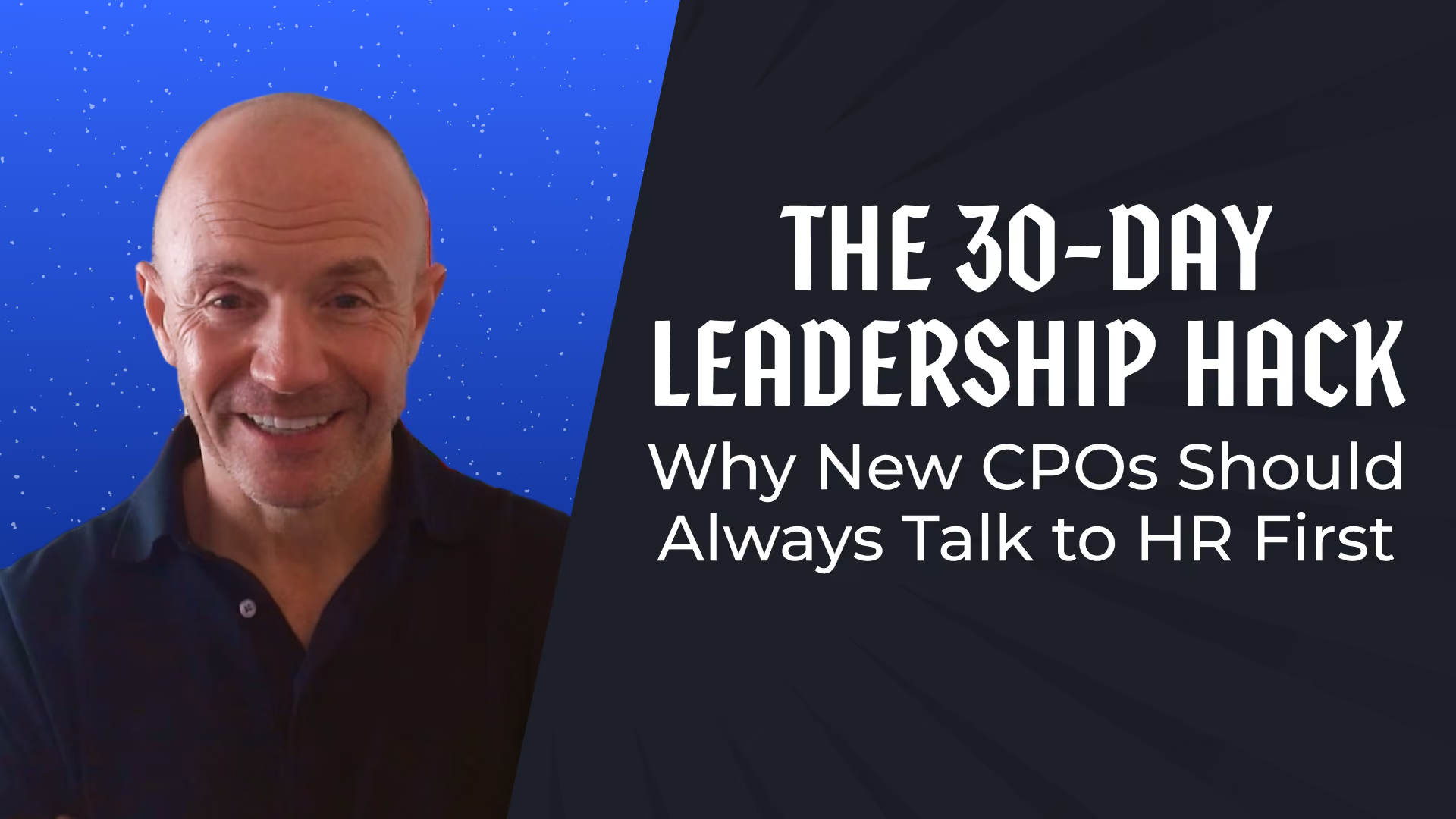
The 30-Day Leadership Hack: Why New CPOs Should Always Talk to HR First
Conrad and Zach sit down with Bart Reekmans, a former Belgian Air Reserve Commando who transitioned into a powerhouse career as a global Chief Procurement Officer. With experience leading multi-billion-dollar procurement teams at GE, Suez, Honeywell, and Wordpac, Bart brings a wealth of knowledge on building elite teams and navigating extreme corporate cultures.
Whether you are stepping into a new leadership role, struggling to drive innovation with suppliers, or trying to decide whether to build or buy procurement technology, this episode is a masterclass in executive leadership and adaptability. Bart shares his unique strategy for "engineering a crisis" to build team muscle memory and explains exactly why the phrase "seat at the table" needs to be retired forever.
Topics Tackled:
Intro & The Air Commando: Conrad introduces Bart’s fascinating background, from the Belgian Defense Forces to pioneering digital procurement in the 90s.
Culture Shock & Military Leadership: How military service taught Bart to listen, and how he adapted to extreme corporate cultures—from the "shouting" of automotive to the military precision of GE.
The Day One HR Hack: Bart’s brilliant practical advice for any new leader: go to HR to find out exactly what success looks like and who the successful people are.
Engineering a Crisis: Why great leaders intentionally create "sprints" or crises to build organizational muscle memory and prepare for real disruptions.
Becoming the Customer of Choice: The keys to unlocking true supplier collaboration and innovation during both good and bad times.
Taking Over a Mega-Team: Bart details his strategy for stepping into a 400-person organization at Honeywell during COVID—focusing on business outcomes and stakeholder alignment first.
Build vs. Buy in AI & Tech: Bart's framework for procurement technology investments and why agility often beats owning the platform.
Rapid Fire Questions: Banning the phrase "seat at the table," executing the ultimate fixed-price contract flex during a negotiation, and why The Goal by Eliyahu Goldratt is a must-read.
Transcript: Proc-N-Roll | The 30-Day Leadership Hack: Why New CPOs Should Always Talk to HR First
Conrad: Let's get started. Hello everybody, and welcome to Proc and Roll, your guide to practical procurement. Today I am thrilled to introduce my good friend Bart Reekmans. His background is incredibly diverse—he started as an air reserve commando officer in the Belgian Defense Forces, traded petrochemicals across Eastern Europe in the 90s, and ran B2B auctions before most people even had broadband. He’s also served as Chief Procurement Officer at massive organizations like GE Water, Suez, Honeywell, and Wordpac. We actually went for a run up Little Cottonwood Canyon in Utah last weekend, and the conversation was so good I knew we had to get him on the podcast.
Zach: I’m based in London and have been doing procurement consulting for over a decade. I’m really looking forward to picking your brain today. We have a lot of overlapping interests, particularly when it comes to delivering results in tough private equity environments, as well as exploring how AI and agentic technology will change how enterprises operate in the future.
Bart: I'm really looking forward to it. I still have fond memories of my military days, and for the sake of the video, I'll even wear my old air commando hat for the occasion! As an air commando, you're actually allowed to wear it indoors.
Conrad: That is super badass. I have to ask, how did your military service set a foundation for how you think about leadership, work, and managing teams today?
Bart: It was honestly a massive culture shock for me. Going into officer training, you are surrounded by university-educated professionals, but then you are put in charge of forty people who come from all different layers of society. Hearing their stories and struggles taught me how to truly listen and figure out how to support them. In the corporate world, that adaptability is crucial because cultures vary wildly. GE had a very military, performance-focused structure where execution was everything. Suez, being a French company, was all about walking the hallways, shaking hands, and building your network. Then I went to an automotive company, Arvin Meritor, and the culture there involved a lot of intense shouting to get things done. You have to take the best pieces of every culture and adapt your own approach to fit the environment.
Conrad: With all those different environments, how do you evaluate a new corporate culture and adapt your leadership style during your first 30 to 60 days on the job?
Bart: My immediate strategy is to go straight to the HR teams and ask them an open question: "How do you build a career here, and who are the successful people?" Once they give me those names, I go talk to those individuals to immediately understand what behaviors are rewarded. Then, I focus on listening. When I took over at Honeywell, it was a massive operation. Over my time there, we went through three CEOs and four business presidents, meaning I constantly had to reinvest in those relationships. I spent my first months listening to the business presidents and vice presidents to understand their specific revenue and customer challenges. Only after I understood their expected outcomes did I go back to the procurement team to translate those needs into actionable strategies.
Zach: I love that practical approach. But how do you manage your immediate team and drive them to get things done, especially in disruptive environments where the landscape is constantly shifting?
Bart: I strongly believe in engineering a crisis or a sprint. Conrad and I know from endurance running that you cannot run at your marathon race pace all the time. By intentionally creating a focused sprint or a crisis moment for your team, you force them out of their comfort zone and build up their execution muscle. I'll assign someone ownership of a specific sprint, which gives them the exposure to shine. Once the sprint is over, you balance out again, take a breather, and build on those new skills. It ensures that when real black swan events hit—like COVID, tariffs, or the container traffic disruptions across Russia—your team already has the muscle memory and the playbooks to react quickly.
Zach: That is a brilliant playbook. On the topic of supplier relationships, how do you practically achieve collaboration and unlock actual innovation from your partnerships?
Bart: You have to change the conversation and ask suppliers, "How can I be your customer of choice?" so that you get priority when things go wrong. But innovation requires investment. I had a great example at GE where a supplier, Solvay, actually had an HR KPI across their board dedicated to innovation. We worked collaboratively to integrate their specific technology into our filters. When a supplier brings innovation, procurement has to be ready to give something back in return—whether that means fixed pricing for a longer term, a most favored nation clause, or giving them a base load of other products to manufacture.
Conrad: With the incredible speed of AI and technology right now, what is your advice to CPOs on whether they should build or buy their procurement tech stack?
Bart: I am definitely a "buy" person. Technology moves way too fast, and you cannot afford to keep all of those specialized skills in-house. Huge Oracle or SAP implementations have become so expensive that I am hesitant to make those massive bets. I prefer to bolt things on or use orchestration layers, but I always want an exit strategy. I need the flexibility to pull my data back out so I am not locked into one platform forever if the technology evolves. Ultimately, I want tools that provide "actionable insights"—systems that don't just show data, but actually tell my buyers, "Based on this global event, you need to go issue a PO to your second source right now."
Conrad: As you reflect on your career, what is the biggest leadership mistake you've made that you learned from?
Bart: I'd say not going deep enough into the detailed content of a product or a problem. You have to be able to go really deep into the weeds—understanding exactly how a chemical interacts or where the root cause of a supply issue is—to build trust with your leadership and business partners. Once you have that deep understanding, then you can step back out and drive the solution.
Conrad: Let's jump into some rapid-fire questions. What is a procurement buzzword you would ban forever?
Bart: "Seat at the table." It is an entitlement; you don't just get a seat. You have to build trust and earn it, and once you do, you will be there when you need to be there.
Conrad: What is the best negotiation you've ever witnessed?
Bart: A supplier's senior VP came into a meeting to announce they were increasing our prices and lowering our volumes. Luckily, I pulled up our contract, which explicitly stated that our prices were fixed and allowed us to increase their volumes instead. The VP on the other side of the table had no idea that contract existed. It made the rest of the negotiation very fun for us.
Conrad: Favorite restaurant city, and what's your favorite leadership book?
Bart: Antwerp is the best food city. I actually use ChatGPT now to recommend restaurants based on my preferences instead of the old Foursquare app. As for books, Good to Great is fantastic for team building, but I always recommend The Goal by Eliyahu Goldratt for its insights into process and operational excellence.
Conrad: If running a procurement operation is like a marathon, what does the "Business Decision Week" feel like?
Bart: It feels like the last six miles of the marathon. You have done all the holding back and building up, and now you are in the final sprint delivering the results. You can't necessarily go faster, but you have to maintain the pace and keep executing.
Zach: This entire conversation has been a masterclass playbook on leadership. Thank you for sharing all of these insights.
Conrad: I absolutely agree. Bart, to wrap things up, what is one practical thing procurement leaders should do differently on Monday morning?
Bart: Just listen. Touch base with your team, ask what is on their radar for the week, and truly listen instead of just dictating what needs to get done.
Conrad: This was amazing, Bart. Thank you so much for joining us, and everybody, don't forget to like, comment, and share!
This transcript has been edited for clarity while maintaining all substantive content