


Get Started
Graphite's supplier management tool helps you onboard faster, cut time on risk reviews and streamline supplier validations. Save time and money.
Best Supplier Management Portal Software: 10 Platforms to Consider in 2027
Managing supplier relationships through spreadsheets, emails, and disconnected systems can create unnecessary administrative work, data inconsistencies, and security risks.
Supplier management portal software gives businesses a centralized platform where suppliers can submit information, manage documentation, complete onboarding, and communicate with procurement teams. Modern solutions also support supplier verification, risk assessments, compliance monitoring, and ERP integration.
Below, we compare 10 supplier management platforms, highlighting their key capabilities and the types of businesses they serve best.
10 Best Supplier Management Portal Software Platforms to Consider in 2027
Supplier management platforms vary in their capabilities. Some focus on onboarding and supplier data verification, while others offer broader procurement, contract management, or accounts payable functionality. Here are 10 platforms worth considering.
1. Graphite Connect
Best for supplier onboarding, data validation, and fraud prevention, Graphite Connect helps businesses streamline supplier onboarding and maintain accurate supplier information through a centralized platform. Its supplier-managed profiles allow vendors to maintain essential business information, including tax details, banking information, and questionnaire responses, reducing repetitive data collection.
Key capabilities include automated supplier validation, tax ID and banking information checks, sanctions screening, and risk assessments. Graphite also supports direct ERP integration, helping procurement teams maintain consistent supplier records across business systems. Its focus on verified supplier information makes it particularly useful for organizations looking to reduce onboarding delays and prevent vendor fraud.
2. Gatekeeper
Best for vendor and contract lifecycle management, Gatekeeper combines vendor onboarding with contract lifecycle management. Its centralized vendor records allow procurement teams to collect supplier information, manage approvals, and maintain visibility into third-party relationships.
The platform supports identity verification, sanctions screening, duplicate supplier detection, and configurable approval workflows. Suppliers can also use its self-service portal to submit insurance certificates, policies, and compliance documents. Automated reminders help teams monitor document expiry dates and keep vendor records current.
Gatekeeper is worth considering for businesses that want to connect supplier onboarding, risk management, and contract administration.
3. Kodiak Hub
Kodiak Hub focuses on supplier relationship management, helping procurement teams centralize supplier information and improve visibility into supplier performance and risk.
Its capabilities include supplier onboarding, qualification, risk screening, performance evaluations, and customizable KPIs. Teams can assess suppliers across areas such as quality, delivery, commercial performance, collaboration, and sustainability.
The platform also brings together information from ERP systems, supplier contracts, financial reports, and compliance records. Kodiak Hub is particularly relevant to organizations that want to move beyond basic supplier administration and develop stronger strategic supplier relationships.
4. Precoro
Precoro combines supplier management with purchasing and procurement workflows. Its supplier management capabilities help businesses centralize supplier information, control approvals, and connect vendor records with purchasing activities.
The platform offers supplier approval workflows, centralized contracts, and a supplier portal for RFP invitations, purchase orders, invoice submissions, document exchange, and communication. Changes to critical supplier details, including banking information, can also trigger reapproval workflows.
Precoro suits businesses looking to manage supplier relationships alongside everyday procurement activities without maintaining separate systems for each process.
5. Tipalti
Tipalti focuses on automating accounts payable and supplier payment operations, with supplier onboarding forming an important part of its offering.
Its onboarding processes help businesses collect supplier business information, tax details, and banking information needed to process payments. Supplier verification and payment-related compliance checks help finance teams reduce errors and improve payment accuracy.
Tipalti also supports global supplier payment workflows, making it relevant to businesses working with suppliers across multiple countries. It is particularly suitable for organizations prioritizing payment readiness and accounts payable efficiency.
6. JAGGAER
JAGGAER provides supplier management capabilities designed for organizations with extensive and complex supplier networks.
Its dedicated supplier portal supports guided self-service onboarding, compliance checks, and configurable workflows. Other capabilities include supplier qualification, risk assessments, performance scorecards, and supplier development plans. Procurement teams can monitor supplier performance across areas such as delivery, quality, and compliance while using risk insights to identify potential issues.
JAGGAER is worth considering for enterprises that need supplier management integrated with broader strategic procurement activities.
7. Tradeshift
Tradeshift focuses on connecting businesses and suppliers through digital transaction and collaboration tools.
Its supplier network supports electronic invoicing, document exchange, and invoice status tracking. Suppliers can submit invoices, access purchase order information, and receive updates about invoice approvals and payments. Integration options also allow businesses to connect their accounting systems with the platform.
Tradeshift is particularly relevant to organizations looking to digitize supplier interactions and improve visibility across procure-to-pay processes.
8. Basware
Basware offers supplier-facing capabilities through its network and portal, with a strong focus on electronic invoicing and accounts payable automation.
Suppliers can use the Basware Portal to access invoices exchanged through the Basware Network. Businesses can use its broader procure-to-pay capabilities to streamline invoice processing and improve transaction visibility.
The platform is particularly suitable for organizations looking to digitize invoice exchanges and connect supplier interactions with their accounts payable operations.
9. Zycus
Zycus offers supplier management capabilities covering onboarding, qualification, performance, risk, and compliance.
Its supplier management solution brings supplier information, performance management, and risk management together through a centralized data layer. The platform also offers AI-powered onboarding capabilities designed to collect supplier information, validate tax and banking details, conduct compliance checks, and support supplier activation.
Zycus is a relevant option for enterprises looking to automate supplier lifecycle processes and maintain greater visibility into supplier risk.
10. Coupa
Coupa offers supplier collaboration through its Coupa Supplier Portal (CSP), which connects suppliers with the businesses they serve.
Suppliers can manage their profiles, maintain payment information, participate in sourcing events, and handle purchasing-related activities. The portal also supports supplier onboarding workflows, task management, and notifications that help suppliers complete buyer-specific requirements.
Coupa is particularly suitable for businesses that want to connect supplier interactions with broader spend management and procurement operations.
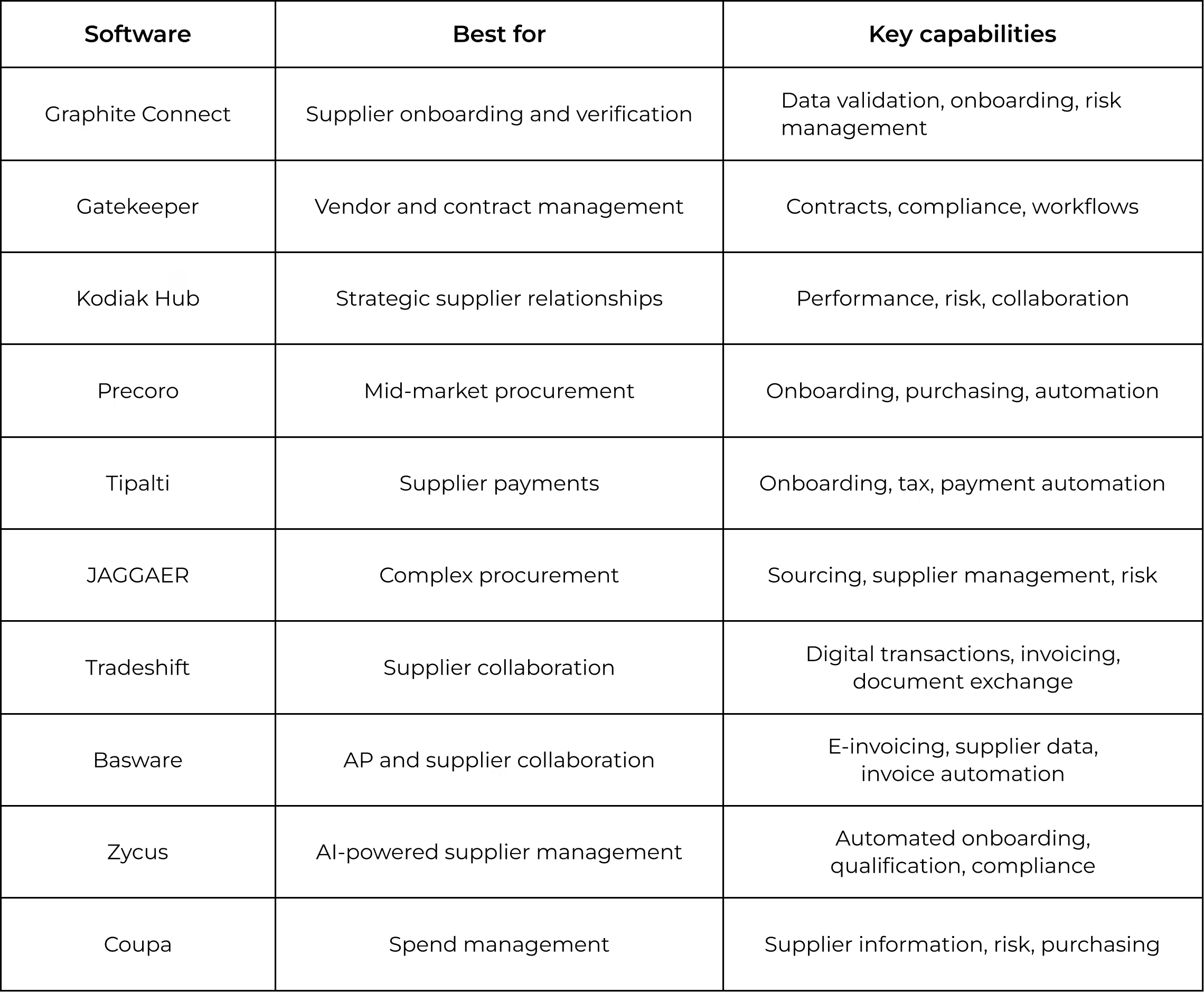
Supplier Management Portal Software: Comparison at a Glance
Use the following table to narrow down the options before evaluating individual features, integrations, and pricing.
Key Features to Look for in Supplier Management Portal Software
The right supplier management portal should address your organization's immediate procurement challenges while supporting long-term supplier relationship management. Consider these essential capabilities when comparing platforms.
Supplier Onboarding and Registration
Look for digital registration forms, customizable questionnaires, document collection, and automated approval workflows. Supplier self-service profiles and onboarding progress tracking can reduce administrative work and improve the supplier experience.
Supplier Information and Document Management
Centralized supplier records help procurement teams maintain accurate information in one place. Document repositories, automated collection, and renewal reminders also make it easier to manage certifications, tax forms, and compliance documentation.
Risk and Compliance Management
Prioritize platforms that support supplier risk assessments, identity verification, banking information validation, and regulatory compliance checks. Ongoing monitoring can help teams identify changes in supplier information before they create problems.
ERP Integrations and Automation
Integration with ERP, accounting, and procurement systems helps maintain consistent supplier records across departments. Automated data validation and approval workflows can also reduce repetitive manual tasks.
Supplier Collaboration and Performance Tracking
Shared communication channels, performance scorecards, and KPI monitoring help procurement teams maintain stronger supplier relationships. Depending on the platform, purchase order, invoice, and payment status visibility can further simplify collaboration.
FAQs About Supplier Management Portal Software
Choosing the right platform starts with understanding what supplier portals offer and how they fit into your procurement processes. Here are answers to some common questions.
What Is a Supplier Portal?
A supplier portal is an online platform where businesses and their suppliers exchange information, submit documents, manage orders, and communicate. It provides suppliers with a self-service environment while giving procurement teams greater visibility into supplier activities.
What Is the Difference Between Supplier Portal Software and Supplier Management Software?
Supplier portal software primarily facilitates communication and information exchange between buyers and suppliers. Supplier management software offers broader capabilities, including onboarding, qualification, risk assessment, compliance monitoring, and performance management. Many modern platforms combine both.
How Does Supplier Portal Software Improve Supplier Onboarding?
Supplier portal software digitizes registration, document collection, information validation, and approval workflows. Suppliers can submit their information directly, reducing manual data entry and email exchanges while helping procurement teams maintain more accurate records.
What Features Should the Best Supplier Portal Software Include?
The best supplier portal software should support supplier onboarding, centralized information management, document collection, risk assessment, compliance monitoring, and ERP integration. Collaboration tools and supplier performance tracking are also valuable.
Simplify Supplier Onboarding with Automated Verification and Validation
If your priority is faster supplier onboarding without compromising data accuracy or security, Graphite Connect is the best fit. Unlike broader procurement and accounts payable platforms, Graphite specializes in supplier onboarding, automated data validation, identity verification, and fraud prevention.
Its supplier-managed profiles and ERP integrations help you build a reliable source of supplier information from the start. Schedule a Demo and see how it can simplify supplier onboarding.