

Get Started
Graphite's supplier management tool helps you onboard faster, cut time on risk reviews and streamline supplier validations. Save time and money.
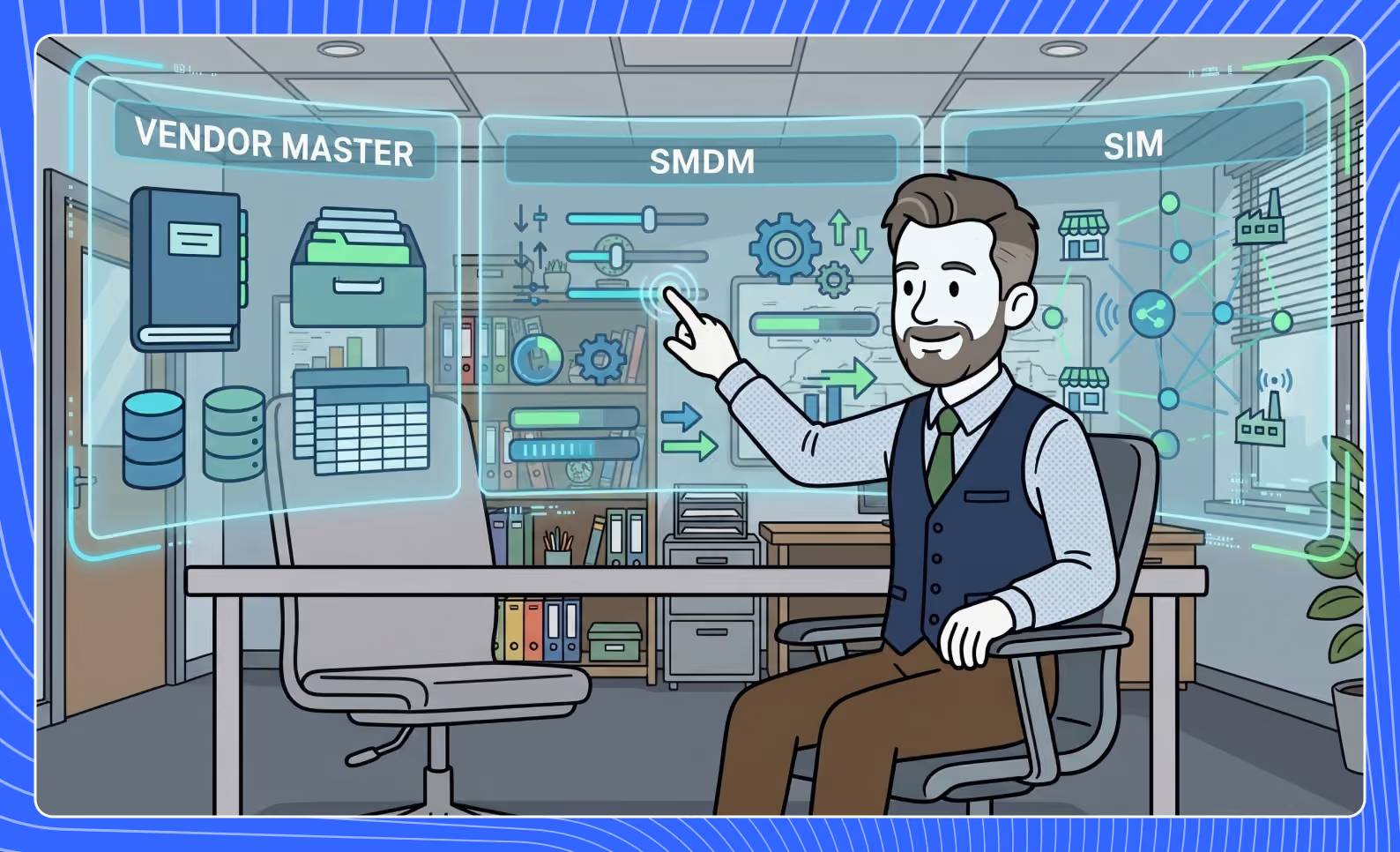
Supplier Information Management vs. Supplier Master Data Management vs. Vendor Master
Supplier information management, supplier master data management, and vendor master are often used interchangeably. They are related, but they solve different parts of the supplier-data problem.
The vendor master is typically the record used by an ERP or finance system to transact with a supplier. Supplier master data management governs the quality, consistency, and ownership of core supplier data across systems. Supplier information management extends further, giving suppliers and internal teams a structured way to collect, validate, maintain, and use supplier information throughout the relationship.
The distinction matters because supplier data has become more complex. Procurement, accounts payable, legal, risk, compliance, and business stakeholders all depend on accurate supplier information, but they do not always need the same information for the same purpose. A vendor master alone may be sufficient to issue a purchase order or payment. It is rarely sufficient to manage onboarding, risk reviews, certifications, supplier communications, and ongoing data changes.
Understanding where each concept fits helps organizations build a stronger supplier-data foundation without treating every business problem as an ERP problem.
What Is a Vendor Master?
A vendor master is the system record that enables financial and operational transactions with a supplier. It commonly resides in an ERP, procure-to-pay, or accounting system and includes the information needed to create purchase orders, process invoices, and issue payments.
Core vendor-master fields often include:
- Legal business name
- Vendor ID
- Remit-to address
- Tax identification details
- Banking and payment information
- Payment terms
- Currency and payment method
- Purchasing or accounting classifications
For finance and AP teams, the vendor master is essential. It determines who can be paid, where funds are sent, and how the supplier is represented in transactional systems. It must be accurate, controlled, and protected from unauthorized changes.
But a vendor master is designed primarily for transactions. It is not usually built to manage the full context of a supplier relationship. It may not capture detailed onboarding questionnaires, insurance certificates, cybersecurity assessments, sustainability data, contract documents, ownership changes, or supplier performance feedback. Nor does it typically give suppliers an easy, secure way to maintain their own information.
That does not make the vendor master inadequate. It simply means it is one important system of record within a broader supplier-data ecosystem.
What Is Supplier Master Data Management?
Supplier master data management, often shortened to supplier MDM, is the discipline of creating reliable, consistent, governed supplier data across the organization.
Where a vendor master is a record, MDM is the framework for managing the quality of that record and related supplier data over time. It addresses questions such as:
- Which system owns each supplier-data field?
- How is a duplicate supplier identified and resolved?
- What is the approved legal name and legal entity for this supplier?
- Which data must be standardized before it reaches the ERP?
- Who can request, approve, and update supplier information?
- How do connected systems remain aligned?
For example, a supplier might be known by different names in procurement, AP, contract management, and risk systems. One system may list a parent company, another a regional operating entity, and another an outdated trade name. Without governance, those differences can lead to duplicate payments, inaccurate spend reporting, ineffective risk monitoring, and unnecessary work for internal teams.
Supplier MDM establishes common data definitions, validation rules, ownership, and integration practices. The goal is not merely to clean up records once. It is to create an ongoing process that keeps supplier data trustworthy as suppliers change, systems evolve, and new requirements emerge.
In practice, supplier MDM often centers on the relationship between a supplier-data platform and one or more ERPs. The platform helps collect, validate, and govern data; the ERP uses approved information to support transactions.
What Is Supplier Information Management?
Supplier information management, or SIM, is the broader operational practice of collecting, organizing, validating, maintaining, and using supplier information across the supplier lifecycle.
SIM includes core master data, but it goes beyond it. A mature supplier information management program may manage:
- Supplier onboarding and qualification
- Tax, banking, and legal-entity information
- Compliance documents and certifications
- Risk questionnaires and assessments
- Supplier contacts and organizational details
- Contracts, terms, and supporting documentation
- Diversity, sustainability, and ESG information
- Supplier performance, communications, and remediation activity
The key difference is that SIM is designed for collaboration and ongoing maintenance. It gives procurement and other internal teams a central place to manage supplier information, while allowing suppliers to provide and update the information they own.
That supplier-managed approach is especially valuable when data changes. Suppliers are best positioned to know when banking details, tax documents, certifications, contacts, or legal entities need to be updated. Internal teams still need controls to validate and approve high-risk changes, but they should not have to chase suppliers through email or manually rekey every document into multiple systems.
A well-designed SIM process turns supplier data from a static record into a living business asset.
How the Three Concepts Work Together
Vendor master, supplier MDM, and SIM are most effective when they work together rather than compete for ownership.
The vendor master remains the transactional source used by finance and ERP processes. Supplier MDM provides the governance needed to standardize, validate, de-duplicate, and synchronize core data. SIM provides the workflow, supplier experience, and broader relationship context needed to keep that data current.
A typical flow might look like this:
- A supplier submits onboarding information, tax forms, banking details, certifications, and questionnaires through a supplier information management platform.
- The platform validates required data, routes risk-based reviews, and identifies missing or inconsistent information.
- Approved core fields are mapped to the vendor master through ERP integration.
- Supplier MDM rules help prevent duplicates, maintain common definitions, and keep updates aligned across connected systems.
- The supplier continues to manage its profile, while internal teams monitor changes, renewals, risk signals, and performance over time.
This model reduces a common point of friction: asking internal teams to use the ERP as both a transactional system and a supplier-collaboration platform. ERPs are critical systems, but they are not generally optimized for supplier self-service, document collection, risk workflows, or relationship management.
Why the Distinction Matters for Procurement and Finance
When these concepts are blurred together, teams often focus too narrowly on vendor setup. That can create a process that gets a supplier into the ERP but does not establish whether the supplier is fully qualified, whether its documents remain current, or whether the organization has a complete picture of the relationship.
The result is fragmented ownership. AP may own payment data. Procurement may own onboarding. Legal may maintain contracts. Risk teams may track due diligence in separate tools. Suppliers then receive multiple requests for the same information, while internal teams struggle to determine which record is current.
A clear supplier-data strategy creates better outcomes:
- Procurement can onboard and qualify suppliers more efficiently.
- AP can reduce payment exceptions and vendor-master errors.
- Risk and compliance teams can monitor requirements before they lapse.
- Finance can improve spend visibility and reporting accuracy.
- Suppliers can provide information once, rather than repeatedly responding to disconnected requests.
- Leadership can make decisions using a more complete, dependable supplier profile.
Building a Practical Supplier Data Strategy
Organizations do not need to replace every existing system to improve supplier data management. The first step is to define the role each system should play.
Start by identifying the fields that belong in the vendor master and the controls required for changes to payment, tax, and legal-entity information. Then establish supplier MDM rules for data standards, ownership, duplicate prevention, and synchronization across systems.
Next, evaluate how suppliers submit and maintain the broader information that supports onboarding, compliance, and relationship management. If that work still depends on email, shared spreadsheets, and manual follow-up, a supplier information management platform can provide the missing operational layer.
Graphite Connect supports this model by centralizing supplier-managed profiles, validation, workflow, and ongoing updates while integrating approved data with ERP environments. Its supplier information management capabilities help teams create a more complete supplier profile, while its integrations help keep vendor-master data aligned with the systems used for purchasing and payment. Graphite also supports data validation, document collection, risk-based workflows, and supplier updates—functions that extend beyond a traditional vendor master.
The objective is not to create another data silo. It is to give each system a clear purpose and establish a reliable flow of approved supplier information between them.
From Vendor Record to Trusted Supplier Data
A vendor master is necessary for transactions. Supplier MDM is necessary for consistency and governance. Supplier information management is necessary for managing the full supplier relationship.
Organizations that understand the difference can move beyond basic vendor setup toward a more connected approach to supplier onboarding, validation, risk, compliance, and collaboration. When suppliers, procurement, finance, and risk teams work from governed, current information, the business can move faster without giving up control.