

Get Started
Graphite's supplier management tool helps you onboard faster, cut time on risk reviews and streamline supplier validations. Save time and money.
Supplier Data Ownership: A Procurement, AP, IT, and Risk RACI Model
Supplier data is the connective tissue between procurement, finance, risk, legal, and technology. It determines whether a supplier can be onboarded, whether invoices can be paid, whether compliance requirements are met, and whether leaders can trust the reporting built on top of those records.
Yet ownership is rarely straightforward. Procurement may collect information during onboarding. Accounts payable (AP) may manage payment-related fields. IT may govern the systems, integrations, access controls, and data architecture. Risk and compliance teams may review certifications, sanctions exposure, information security questionnaires, and other due-diligence requirements.
When these responsibilities are not clearly defined, supplier data becomes fragmented. A request can sit in multiple queues. A critical field can be updated without the right review. Teams can maintain different versions of the same supplier record. Suppliers may be asked for the same information more than once because no function has a complete view of what is already available.
The answer is not to assign all supplier data to one department. It is to establish a shared operating model with clear decision rights. A supplier-data RACI model helps organizations define who performs the work, who is accountable for the outcome, who must be consulted, and who simply needs visibility.
Why Supplier Data Ownership Is a Cross-Functional Issue
Supplier data is not a single type of information. It includes basic business details, payment instructions, tax documentation, legal-entity records, insurance certificates, cybersecurity questionnaires, risk assessments, contracts, supplier contacts, and performance information.
Each type of data supports a different business decision. AP needs verified banking and tax information to process payments. Procurement needs supplier profiles, category data, and onboarding status to enable purchasing. Risk teams need current compliance and due-diligence information to assess exposure. IT needs secure, reliable systems that control access, integrate records, and protect sensitive information.
Problems arise when ownership is assumed rather than documented. Procurement may believe AP owns a bank-account update, while AP assumes procurement has verified the supplier request. IT may be asked to fix duplicate records without having authority to decide which record is correct. Risk may identify an expired certification but lack a clear escalation path to prevent further purchasing.
A RACI model makes these handoffs visible. It establishes a practical framework for managing supplier data as a shared business asset rather than a collection of disconnected administrative tasks.
What a RACI Model Means for Supplier Data
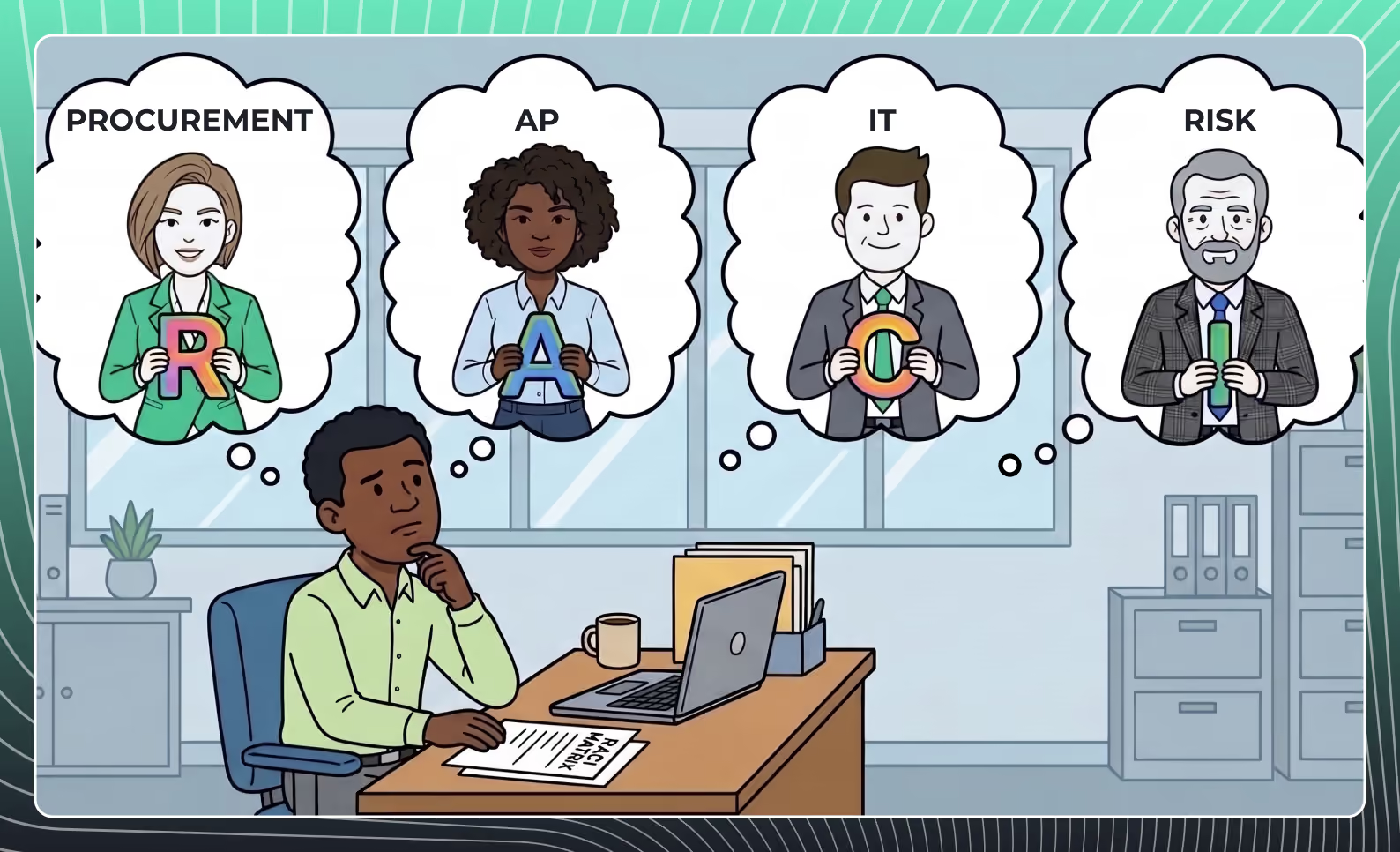
RACI is a responsibility-assignment framework:
- Responsible: The person or team that completes the work.
- Accountable: The person or team with final ownership of the decision or outcome.
- Consulted: Stakeholders who provide input before a decision is made.
- Informed: Stakeholders who need visibility after the decision or update.
The distinction between responsible and accountable is especially important. Several teams may contribute to a supplier-data process, but each activity should have one clear accountable owner. Without that accountability, issues are often discovered only after they affect a payment, audit, supplier relationship, or reporting process.
A supplier-data RACI should be specific enough to guide daily work. Broad statements such as “procurement owns suppliers” or “IT owns the data” do not resolve the decisions teams face during onboarding, updates, exceptions, and ongoing monitoring.
The Core Supplier Data RACI Model
The following model is a starting point for organizations that need to clarify responsibilities across procurement, AP, IT, and risk. Legal, tax, information security, and business owners may also need roles for certain supplier categories or higher-risk changes.
Define Supplier Data Standards
Responsible: Procurement and IT
Accountable: Procurement
Consulted: AP and Risk
Informed: Business stakeholders
Procurement should typically be accountable for defining what a complete supplier profile requires from a business perspective. That includes establishing standard data fields, onboarding requirements, supplier classifications, and processes for requesting supplier information.
IT should help translate those requirements into system configuration, data definitions, integrations, and access controls. AP and risk teams should be consulted to ensure standards include the information needed for payment processing, compliance, and due diligence.
The outcome should be a documented data standard: what information is required, where it is collected, which system is authoritative, who can change it, and how exceptions are handled.
Collect and Validate New Supplier Information
Responsible: Procurement
Accountable: Procurement
Consulted: AP, Risk, and IT
Informed: Requesting business owner
Procurement is generally best positioned to own the supplier onboarding experience. It manages the relationship with the supplier, confirms the business need, and coordinates the information required before the supplier enters downstream systems.
AP should be consulted on payment and tax requirements. Risk should determine whether the supplier requires enhanced due diligence, certifications, or security reviews. IT should be involved when onboarding depends on system integrations, access provisioning, or technical data requirements.
This structure keeps the process moving while preventing procurement from becoming the sole reviewer of every specialized data element.
Approve Banking, Tax, and Payment Changes
Responsible: AP
Accountable: AP
Consulted: Procurement and Risk
Informed: IT and the relevant business owner
Payment-related information requires heightened controls because it can create direct financial exposure. AP should be accountable for approval of bank-account details, remit-to addresses, tax forms, payment methods, and other fields that affect payment execution.
Procurement should be consulted to verify the supplier relationship and help confirm that the request is legitimate. Risk may need to review changes that introduce fraud indicators, sanctions concerns, or ownership-related issues. IT should be informed when the change affects integrations, workflow rules, or master-data synchronization.
High-risk updates should never depend on a single email or a single reviewer. Independent verification, supporting documentation, segregation of duties, and a complete audit trail are essential.
Manage Supplier Risk and Compliance Information
Responsible: Risk or Compliance
Accountable: Risk or Compliance
Consulted: Procurement, IT, and AP as needed
Informed: Business owners and relevant stakeholders
Risk and compliance teams should own the policies and decisions associated with certifications, sanctions screening, insurance requirements, information security reviews, and other supplier-risk criteria. They are responsible for defining the level of diligence required by supplier type, geography, spend, access, or business criticality.
Procurement should be consulted because it manages supplier engagement and can coordinate remediation. IT may need to assess cybersecurity questionnaires, system-access risks, or data-security requirements. AP may need visibility when a supplier’s risk status affects payment holds or vendor status.
The goal is not to turn risk into a bottleneck. It is to apply the appropriate review at the right time and establish clear escalation paths when information expires, changes, or creates an unacceptable exposure.
Maintain Systems, Integrations, and Access Controls
Responsible: IT
Accountable: IT
Consulted: Procurement, AP, and Risk
Informed: Process owners and leadership
IT should be accountable for the technical environment supporting supplier data: system availability, access roles, integrations, data synchronization, retention, and security controls. IT does not necessarily own the business definition of supplier data, but it owns the technical mechanisms that allow that data to move securely and reliably.
Procurement, AP, and risk teams should define the workflow, approval, and reporting requirements they need. IT then helps ensure those requirements can operate across ERP, procure-to-pay, contract, risk, and supplier-management systems.
This distinction prevents a common failure mode: expecting IT to resolve data-quality problems that actually require business decisions about ownership, standards, or supplier status.
Monitor Data Quality and Resolve Exceptions
Responsible: Procurement, with support from AP, IT, and Risk
Accountable: Procurement
Consulted: Relevant data owners
Informed: Leadership and business stakeholders
Supplier data quality needs an ongoing owner. Procurement is often the most practical accountable function because it sees the supplier relationship across onboarding, sourcing, maintenance, and performance management. However, each functional team remains responsible for correcting the data it owns.
AP should resolve payment-data exceptions. Risk should resolve compliance and due-diligence gaps. IT should resolve technical defects, integration failures, and access issues. Procurement should coordinate suppliers and manage exceptions that cross functional boundaries.
Useful data-quality measures include duplicate supplier records, missing documentation, data-change turnaround time, failed validations, supplier onboarding cycle time, and the number of manual touches required to activate or update a supplier.
Make the RACI Model Operational
A RACI model only works when it is embedded in real workflows. It should be reflected in onboarding forms, approval routes, system roles, service-level expectations, exception processes, and reporting.
Start with the highest-risk activities: new supplier creation, bank-account changes, tax updates, legal-entity changes, supplier offboarding, and expired compliance documents. Define the accountable owner, required approvers, evidence requirements, and escalation path for each one.
Then establish a supplier-data governance forum with representatives from procurement, AP, IT, and risk. This group does not need to approve every supplier update. Its role is to resolve recurring ownership questions, review data-quality trends, update standards, and prioritize improvements to systems and workflows.
Technology can make this model easier to sustain. A supplier information management platform gives teams a shared environment for collecting supplier information, routing workflows, validating critical data, maintaining audit trails, and synchronizing approved records with connected systems. It helps each function work from the same supplier profile while preserving the controls and accountability each team needs.
Treat Ownership as a Shared Discipline
No single department can own every aspect of supplier data. Procurement, AP, IT, and risk each bring necessary expertise, authority, and context to the process.
The goal of a supplier-data RACI model is not to create more handoffs. It is to remove ambiguity. When teams know who is responsible, who is accountable, and when to involve others, supplier data becomes more accurate, more secure, and easier to use across the business.
A clear operating model turns supplier data from a source of cross-functional friction into a trusted foundation for onboarding, payment, risk management, and supplier relationships.