

Get Started
Graphite's supplier management tool helps you onboard faster, cut time on risk reviews and streamline supplier validations. Save time and money.
Risk-Based Supplier Onboarding: How to Tier Requirements Without Slowing the Business
Every new supplier should be vetted appropriately. That does not mean every supplier should face the same onboarding process.
A low-spend office-supplies vendor, for example, does not present the same exposure as a software provider with access to sensitive data, a manufacturer essential to production, or a supplier that will receive high-value payments. Applying identical requirements to each supplier creates unnecessary work for suppliers and internal teams. Applying too little scrutiny creates financial, operational, and compliance risk.
Risk-based supplier onboarding solves this problem by matching the level of due diligence, documentation, and approval to the supplier’s risk profile. It allows procurement teams to move low-risk suppliers through a streamlined process while applying deeper review where the potential impact is greater.
The goal is not to lower standards. It is to apply the right controls at the right time, so the business can move quickly without treating every supplier relationship as equally safe.
What Is Risk-Based Supplier Onboarding?
Risk-based supplier onboarding is an approach that assigns onboarding requirements according to the risks a supplier presents to the organization.
Rather than using one universal checklist, procurement teams define a set of risk factors and use them to determine what a supplier must provide, which internal teams must review the submission, and what approvals are required before the supplier can transact.
The process usually considers factors such as:
• Spend level and expected payment volume
• Supplier category and the goods or services provided
• Access to company systems, facilities, data, or customers
• Geographic location and sanctions exposure
• Regulatory or industry-specific requirements
• Supplier criticality and availability of alternatives
• Banking, tax, ownership, and legal-entity complexity
• Environmental, social, governance, or cybersecurity requirements
The result is a more proportional supplier onboarding process. A low-risk supplier can be activated more quickly, while suppliers with higher potential impact receive the deeper scrutiny they require.
Why a One-Size-Fits-All Process Creates Friction
Many supplier onboarding processes begin with good intentions: create a complete checklist, send it to every supplier, and ensure no requirement is missed. Over time, that checklist often grows to include tax forms, bank information, insurance certificates, security questionnaires, sustainability questions, diversity documentation, legal agreements, and risk assessments.
The problem is that not every item is relevant to every supplier.
When a low-risk supplier receives a long and complex questionnaire, the result is often delay rather than better risk management. Suppliers may struggle to identify the right person to complete each section, procurement teams spend time chasing unnecessary documents, and business stakeholders become frustrated when routine purchases take weeks to complete.
At the other extreme, a simplified process can fail to identify the suppliers that require additional review. A supplier might be activated before the organization has validated payment details, confirmed insurance coverage, assessed information-security practices, or identified a sanctions concern.
Risk-based onboarding gives teams a way out of this tradeoff. It removes unnecessary steps for low-risk suppliers while protecting the time and attention needed for high-risk cases.
Build a Supplier Risk-Tiering Framework
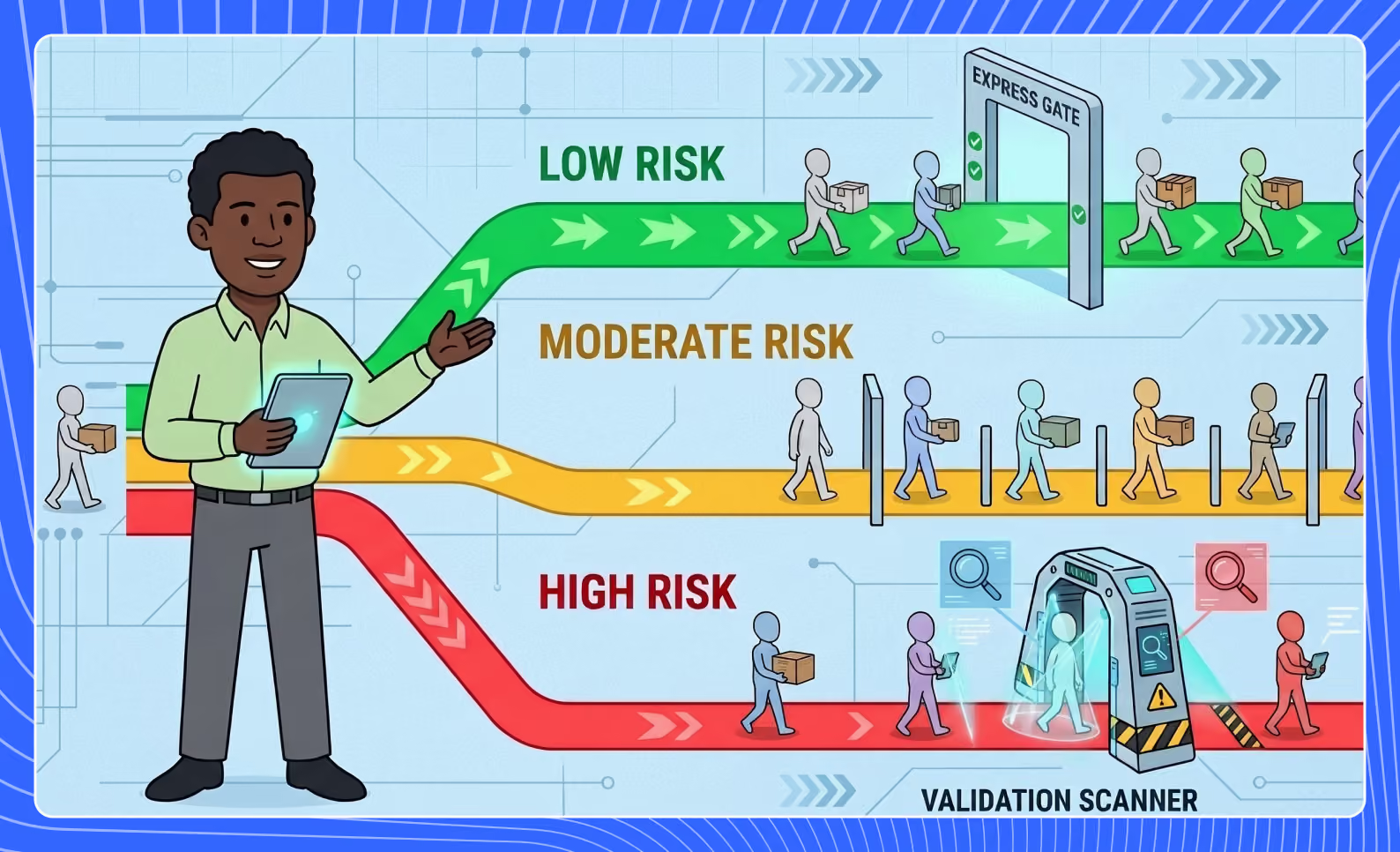
A usable tiering model should be clear enough for employees to apply consistently and flexible enough to reflect the organization’s actual risk environment. Most teams can begin with three tiers: low, medium, and high risk.
The exact labels matter less than the rules behind them. Each tier should specify the minimum information required, the validation steps, the approving functions, and the circumstances that trigger escalation.
Tier 1: Low-Risk Suppliers
Low-risk suppliers generally have limited spend, provide noncritical goods or services, and do not access sensitive data, facilities, or regulated operations.
Examples may include office-supplies vendors, local event providers, low-value professional services, or businesses used for occasional purchases.
A Tier 1 process may require:
• Basic legal name, address, and contact information
• Tax and payment information where applicable
• A business justification and budget confirmation
• Basic screening against applicable sanctions or restricted-party lists
• Procurement or AP approval before activation
The objective is to collect the minimum information needed to establish an accurate supplier record and transact safely. Teams should not require a lengthy security assessment or extensive compliance package unless the supplier’s role warrants it.
Tier 2: Moderate-Risk Suppliers
Moderate-risk suppliers may support important business processes, receive meaningful spend, operate in a higher-risk geography, or provide services that require more oversight.
Examples can include consulting firms, logistics providers, facilities contractors, recurring software vendors without highly sensitive-data access, or suppliers supporting a core business unit.
In addition to Tier 1 requirements, a Tier 2 workflow may include:
• Insurance certificates or relevant licenses
• Ownership and legal-entity information
• Contract and legal review
• Category-specific compliance documentation
• Risk or business-owner review
• Additional validation of bank and tax details
• Periodic renewal requirements for time-sensitive documents
Tier 2 gives procurement teams a structured middle ground. It avoids treating operationally important suppliers as routine while preventing every moderate-risk relationship from being processed like a major third-party risk assessment.
Tier 3: High-Risk or Critical Suppliers
High-risk suppliers can materially affect the organization’s finances, compliance posture, operations, customers, or reputation. They may handle sensitive data, support critical operations, receive high-value payments, work in regulated environments, or operate in elevated-risk jurisdictions.
Examples include strategic manufacturers, software providers with access to personal or confidential data, financial-service providers, suppliers with significant payment volumes, and vendors subject to strict regulatory or customer requirements.
A Tier 3 process commonly adds:
• Detailed information-security, privacy, or third-party risk assessments
• Enhanced sanctions, adverse-media, and ownership screening
• Verification of banking, tax, and legal-entity information
• Insurance, certifications, and regulatory documentation
• Review by legal, compliance, information security, finance, and the sponsoring business owner as appropriate
• Clear approval authority before activation
• Ongoing monitoring and periodic reassessment after onboarding
The key is to make these heightened requirements predictable. Suppliers and internal stakeholders should understand why a more rigorous process applies and what is needed to complete it.
Use Clear Criteria to Assign Each Tier
Risk tiers should not depend entirely on an individual employee’s judgment. Procurement teams need defined criteria that turn an initial supplier request into an appropriate workflow.
A practical intake process can ask a few targeted questions:
• What will the supplier provide?
• How much is the organization expected to spend?
• Will the supplier handle company, employee, customer, or payment data?
• Will it need physical access to facilities or systems?
• Is the supplier critical to a product, service, or customer commitment?
• Does the supplier operate in a high-risk country or regulated industry?
• Are there specific insurance, cybersecurity, quality, or ESG requirements?
• Has the business selected the supplier already, or is sourcing still underway?
These questions do not need to burden requesters with a formal risk assessment. They simply provide enough information to route the supplier to the appropriate starting tier.
The process should also include escalation rules. For example, a supplier initially classified as low risk should move to a higher tier if it will receive larger payments than expected, need access to sensitive systems, or provide documentation that reveals a different legal entity or ownership structure.
Design the Workflow Around the Supplier’s Risk
Risk tiering only works when the workflow actually changes based on the result. A label without different requirements simply adds another administrative field.
For each tier, define:
• The information and documents the supplier must provide
• The checks that must occur before approval
• The internal teams responsible for review
• Service-level expectations for suppliers and reviewers
• The events that trigger an escalation
• The monitoring or renewal actions required after onboarding
Automation can make this significantly easier. A supplier portal can present only the questions relevant to the supplier’s tier, category, and geography. It can assign sections to the right supplier contacts, route responses to the appropriate reviewers, send reminders, and create an audit trail without requiring procurement to manage the process manually.
Graphite’s supplier onboarding platform supports configurable supplier onboarding flows based on category, location, risk, and ESG requirements. This helps teams keep the process simple for low-risk suppliers while maintaining controls such as bank and tax validation, identity verification, and cross-functional approvals where they are needed.
Keep Low-Risk Onboarding Fast Without Cutting Corners
Speed is not the enemy of control. Poorly designed controls are.
For low-risk suppliers, a streamlined process should still confirm the supplier’s identity, collect the information required for payment and recordkeeping, and apply basic screening. The difference is that the supplier does not need to complete requirements that have no connection to its role.
This approach benefits more than the supplier. Procurement can focus its attention on complex, high-impact relationships. AP receives more complete records with fewer manual corrections. Business stakeholders receive clearer expectations and fewer avoidable delays.
A tiered process also makes exceptions easier to manage. If the business needs an urgent supplier, the organization can see which requirements are truly essential for the supplier’s risk level and which can be completed later under a documented, time-bound exception.
Review and Refine the Model Over Time
Supplier risk is not static. A supplier can expand into a new service area, begin handling sensitive data, change ownership, or become more critical to the business. Onboarding tiers should therefore be reviewed when the relationship changes, not only at initial setup.
Teams should also measure where the process creates friction. Useful metrics include onboarding cycle time by tier, percentage of incomplete submissions, approval bottlenecks, supplier response time, exceptions requested, and documents that expire after activation.
Those insights can help procurement remove unnecessary steps, strengthen weak controls, and improve the supplier experience without sacrificing governance.
Make Risk-Based Onboarding a Business Enabler
The purpose of risk-based supplier onboarding is not to make every supplier process more complex. It is to help the organization spend its time where risk is highest while making routine onboarding easier for everyone involved.
By defining clear supplier tiers, tailoring requirements, automating routing, and monitoring changes over time, procurement teams can protect the business without becoming a bottleneck. The result is faster supplier activation, more reliable supplier data, and stronger confidence in the controls behind every new supplier relationship.