

Get Started
Graphite's supplier management tool helps you onboard faster, cut time on risk reviews and streamline supplier validations. Save time and money.
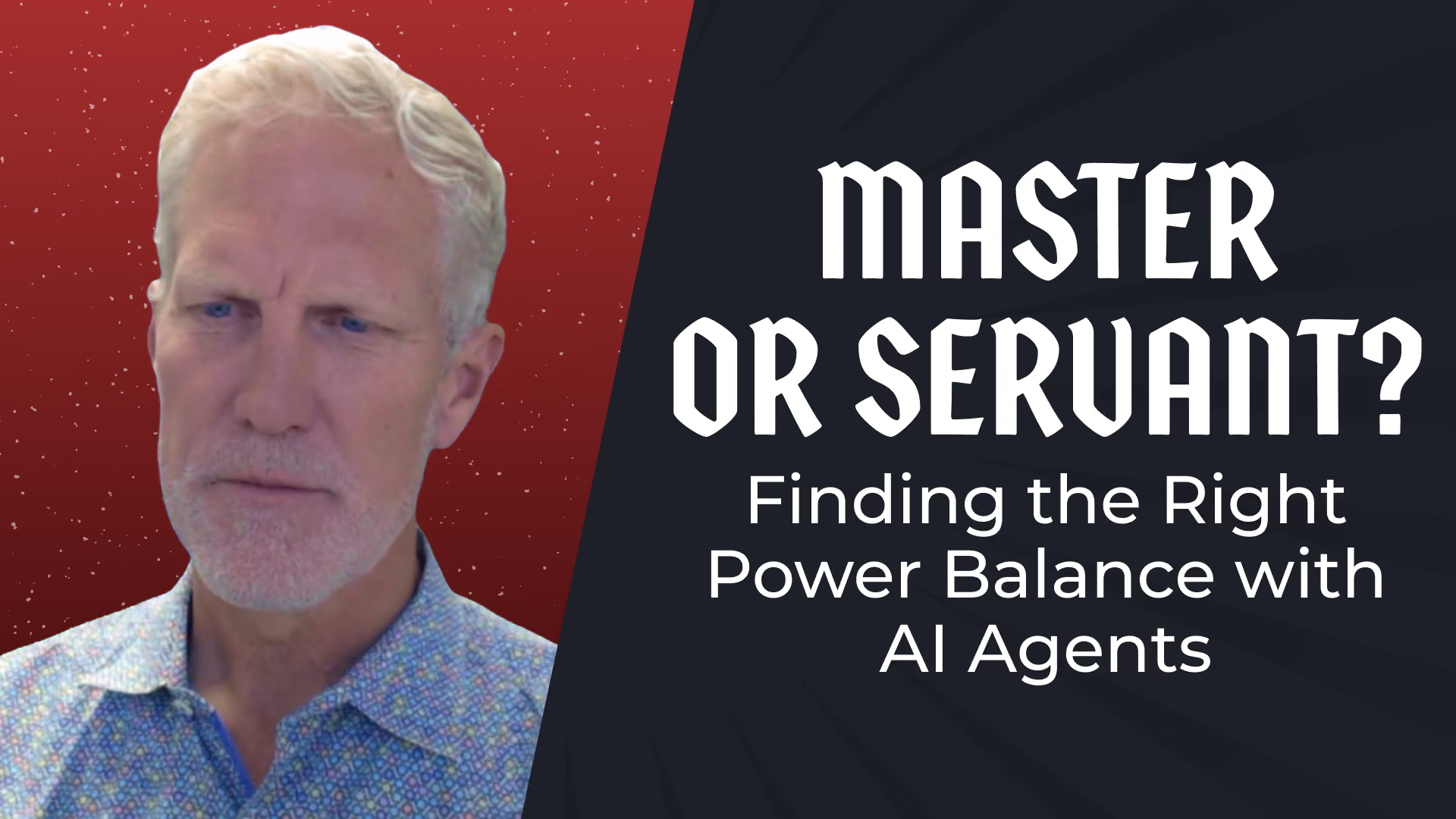
Master or Servant? Finding the Right Power Balance with AI Agents
On this episode of Proc and Roll, hosts Conrad, Natasha, and Zach continue their deep dive into leadership by tackling the biggest disruptor in modern business: Artificial Intelligence. Building on their previous conversations about extreme ownership, Ray Dalio's believability metrics, and Jeff Bezos's decision-making doors, the team debates how AI is fundamentally reshaping how executives make choices.
Here is a breakdown of the main topics and frameworks discussed in this thought-provoking episode.
1. The "Autopilot" Trap and Automation Bias
Conrad cautions leaders about the very real dangers of "automation bias"—the tendency to default to AI to guide almost everything we do. He draws a striking parallel to the aviation industry:
- The Loss of Muscle Memory: Just as pilots who rely too heavily on autopilot can lose their ability to manually land a plane or react to contradictory signals in high-stress moments, business leaders risk losing their decision-making "muscle".
- Manipulating Thought: Conrad points out that interacting with AI can actually begin to manipulate your own thinking and beliefs by feeding and guiding the conversation.
- Accountability: Ultimately, leaders make material decisions that impact their employees' livelihoods and the viability of their companies. Turning those critical choices entirely over to a machine is a massive risk.
2. Who is the Master and Who is the Servant?
For Natasha, the integration of AI comes down to a strict hierarchy: humans must remain the master, and AI must remain the servant.
- Scrutinize Everything: While Natasha frequently uses AI to help form her perspectives and gather data points, she scrutinizes every piece of output.
- Irreplaceable Judgment: Until AI is 100% foolproof, she argues it cannot replace human judgment, resourcefulness, or the ability to compile multiple factors logically.
- The Value of Experience: Natasha notes that when clients pay for consulting or services, they are paying for the judgment, empathy, and practical experience built over decades—not a 30-second output generated by ChatGPT.
3. The Rise of Autonomous Agents
Taking a highly optimistic, technology-forward stance, Zach shares his vision for the future of autonomous AI agents.
- End-to-End Execution: Zach is actively building and researching agents that can execute entire procurement workflows from intake to completion, complete with human supervision checkpoints.
- The Evolution of Work: Rather than fearing AI, Zach believes that human intuition and roles will simply evolve. Just as technology made certain jobs redundant a century ago, AI will shift human focus toward managing agents and designing better technological systems.
- Plurality of AI: Zach envisions a future filled with diverse AI models that apply judgment differently, mirroring the diversity of human thinking today.
4. The Threat of Intellectual Laziness
One of the most pressing concerns raised in the episode is the potential societal impact of AI on independent thought.
- The Next Generation: Natasha voices deep concern for younger generations who are currently using AI to write schoolwork, do research, and even ask for personal advice.
- Losing the Spark: She fears this constant reliance will create widespread "intellectual laziness". Without the necessity to fire neurons and connect facts, we risk creating a workforce that is excellent at formulating prompts but entirely incapable of independent, critical thinking when a crisis arises.
- The Human Differentiator: The ability to think, feel, make decisions, and exercise free will is what separates humans from the rest of the animal kingdom. Outsourcing our judgment means risking our core humanity.
Transcript: Proc-N-Roll | Master or Servant? Finding the Right Power Balance with AI Agents
Conrad: Welcome back to Proc and Roll, your guide to practical procurement! Today we are continuing our leadership series by combining decision-making with Artificial Intelligence. Last week we talked about extreme ownership, Jeff Bezos's one-way and two-way doors, and Ray Dalio's believability-weighted decisions. But now we have a new player in our decision making. I was listening to a podcast that compared AI to calculators, arguing that while calculators didn't change our belief in math, interacting with AI actually starts to manipulate our thinking and beliefs. I worry about the "autopilot" effect. There are examples of pilots who lose their ability to make the right decision to protect the plane when the autopilot gives them weird signals. Are we just trusting AI to take over?
Natasha: For me, it comes down to who is the master and who is the servant. I continue to be a strong believer that I am the master and AI is the servant. I use it heavily to gather data points and form my perspective, but I scrutinize everything it produces. For example, AI built a beautiful itinerary for my walking trip through the Cotswolds in England, but it didn't take into consideration that three pontoon bridges were closed, adding 10 extra kilometers to my walk. Until it is 100% foolproof, it cannot replace human judgment or our ability to compile multiple factors logically.
Zach: I look at it from the perspective of autonomous agents running end-to-end procurement processes. I believe AI can apply judgment and make decisions if we provide the right context. As models from firms like Anthropic and OpenAI improve, their reasoning capabilities get much better. If we give the agent the context that bridges might be closed, it can reason through that. If we test these models rigorously with the right scenarios, they can process massive amounts of context much faster than we can.
Conrad: But there is a real automation bias happening. People weight the believability of AI so high that they just default to it for everything. If we delegate all our decisions to an agent, aren't we losing the intuition and "gut" feeling we build through years of hands-on experience? When you are making leadership decisions that impact people's employment, mortgages, and families, a couple of really bad choices can absolutely torpedo a fragile young business. You cannot just turn that level of accountability over to a machine.
Natasha: Exactly. I recently received a proposal from a service provider, and I felt cheated because it was a 30-second ChatGPT spit-out, but they still evaluated their pricing based on their hourly rate. When people pay for services, they are looking for the practical experience built over 30 years in the industry. We also have to ask which areas of life we want to remove judgment from. Do we want AI making a judge's verdict, purely by the book, without any human empathy?
Zach: That's an interesting point about judges, Natasha. There's a famous study showing that human judges in Israel had much higher conviction rates right before lunch, and became much more empathetic after they ate. So humans are highly flawed too. I am not saying AI should replace judges, but human roles will evolve. Instead of doing the mundane tasks, we will manage the agents and the technology. In my autonomous procurement agent, I compress the decisions I don't want to make into checkpoints where I step in, review the work, and remain accountable before the email ever goes out.
Conrad: But we are on a treadmill that keeps moving people away from rolling up their sleeves and gaining the foundational experience needed to actually manage or architect those systems in the future. If we aren't careful, people will just accept whatever the AI feeds them, similar to how society accepted processed food and ate itself into obesity. We stop thinking for ourselves.
Natasha: I completely agree. If we take decision-making out of our lives, we risk losing our willpower and free choice, which is the main attribute that separates us from the animalistic world. I highly recommend the book Culpability which touches on this relationship between humans and AI. I am especially worried about the younger generation. If they use AI for everything from writing schoolwork to planning their lives, it creates intellectual laziness. They will be great at formulating prompts, but incapable of being independent thinkers when a crisis hits. Humans need structure and necessity to apply our energy to, or we will just create trouble.
Conrad: That is a great way to wrap it up, Natasha. As leaders, we are the ones putting our chips on the table and taking accountability; we cannot just turn that responsibility over to an AI or get lazy in our chairs. Next time, we are going to bring all of these concepts together—intuition, AI, and frameworks—and build a concrete recipe for making great executive decisions.
This transcript has been edited for clarity while maintaining all substantive content