

Get Started
Graphite's supplier management tool helps you onboard faster, cut time on risk reviews and streamline supplier validations. Save time and money.
How to Write a Supplier Management RFP That Actually Reveals the Best Platform
How to Write a Supplier Management RFP That Actually Reveals the Best Platform
Most supplier management RFPs ask the wrong questions. Here's a framework — with 60+ specific questions — designed to expose the real differences between platforms.
Why Most Supplier Management RFPs Fail
Every year, procurement teams invest months evaluating supplier management platforms. They send out RFPs, collect responses, score matrices, hold demos — and still end up surprised after implementation.
The problem isn't the process. It's the questions.
Generic RFPs produce generic answers. When your RFP asks "Do you support ERP integration?" every vendor says yes. When it asks "Do you offer risk management?" every vendor says yes. The responses are indistinguishable, and the differences that actually matter — architecture, data quality, verification methodology, compliance depth — stay hidden until it's too late.
After analyzing dozens of real-world supplier management RFPs from enterprise procurement teams, we've identified the questions that separate serious platforms from checkbox solutions. This guide gives you a framework to write an RFP that surfaces those differences.
What Your Supplier Management RFP Should Cover
A strong supplier management RFP evaluates eight capability areas. Each one below includes context on why it matters and specific questions you should ask.
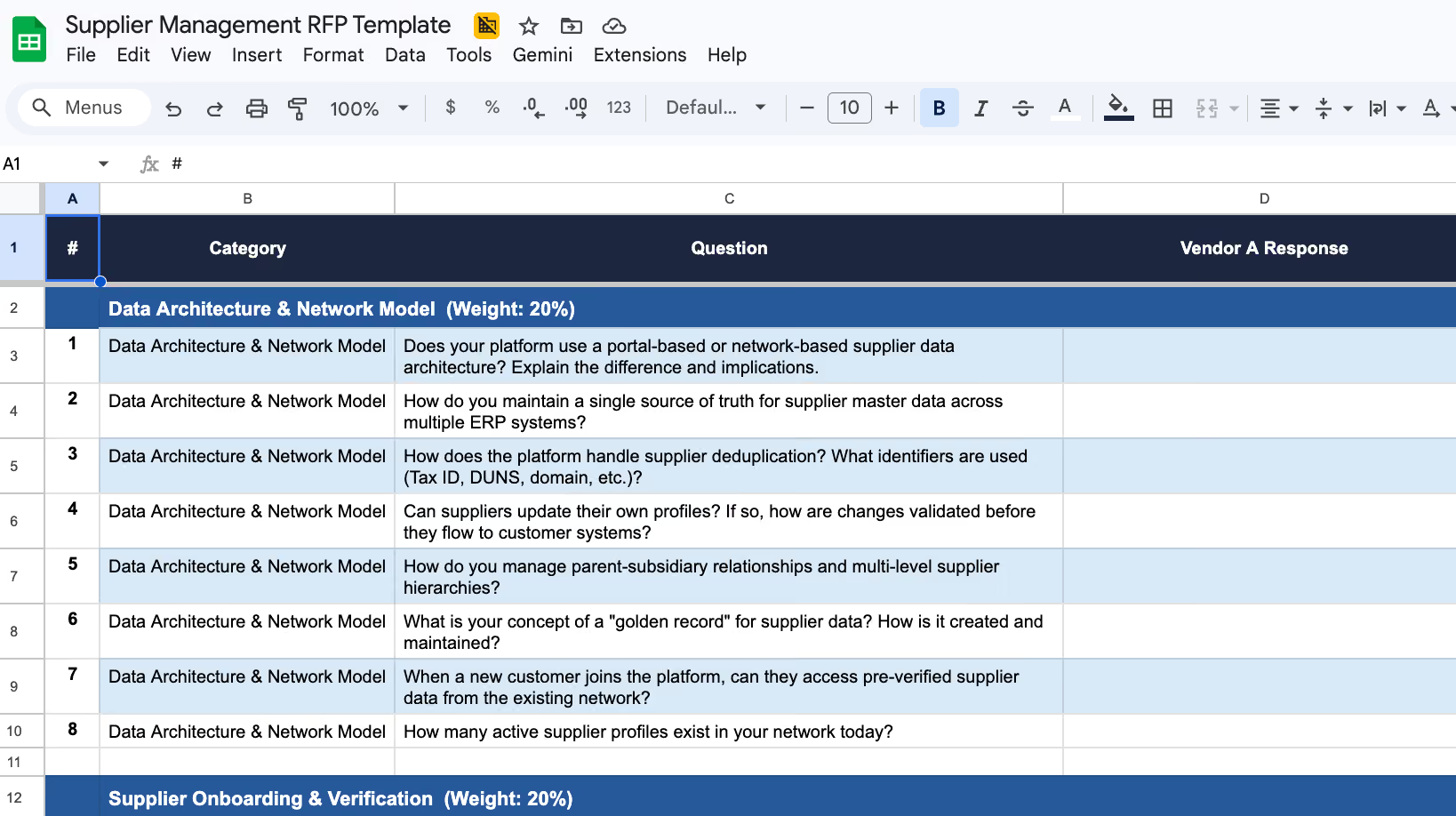
1. Data Architecture and Network Model
Why it matters: The biggest architectural decision in supplier management is whether the platform uses a portal model or a network model. In a portal model, each customer maintains a separate supplier database — suppliers re-enter their information for every new customer relationship. In a network model, suppliers maintain a single, verified profile that can be shared across multiple customers.
This distinction drives everything downstream: data quality, onboarding speed, verification accuracy, and long-term maintenance costs. Most RFPs never ask about it.
Questions to include in your RFP:
1. Does your platform use a portal-based or network-based supplier data architecture? Explain the difference and implications.
2. How do you maintain a single source of truth for supplier master data across multiple ERP systems?
3. How does the platform handle supplier deduplication? What identifiers are used (Tax ID, DUNS, domain, etc.)?
4. Can suppliers update their own profiles? If so, how are changes validated before they flow to customer systems?
5. How do you manage parent-subsidiary relationships and multi-level supplier hierarchies?
6. What is your concept of a "golden record" for supplier data? How is it created and maintained?
7. When a new customer joins the platform, can they access pre-verified supplier data from the existing network?
8. How many active supplier profiles exist in your network today?
2. Supplier Onboarding and Verification
Why it matters: Onboarding speed and verification rigor are in direct tension — unless the platform is architected to handle both. The best platforms reduce average onboarding from months to days without sacrificing identity verification, bank account validation, or compliance checks.
Pay close attention to bank verification methodology. Payment diversion fraud is a growing threat, and the differences between platforms' verification approaches are significant.
Questions to include in your RFP:
9. What is the average supplier onboarding time for your existing customers? Provide benchmarks with customer references.
10. Describe your bank account verification process step by step. Include all verification methods used (automated ownership checks, telecom verification, identity verification, manual callbacks).
11. What identity verification providers do you integrate with (e.g., Jumio, Onfido, Trulioo, Plaid)?
12. Do you offer any financial guarantee against payment fraud resulting from verified accounts? If so, what are the terms and coverage limits?
13. How do you handle bank account changes after initial verification? Is re-verification automatic?
14. What percentage of supplier verifications are completed without manual intervention?
15. Can suppliers use information already on file to fast-track onboarding with a new customer (i.e., network effects)?
16. How does the platform handle supplier non-responsiveness during onboarding? What automated follow-up and escalation capabilities exist?
3. ERP Integration
Why it matters: Supplier management doesn't exist in a vacuum. The platform needs to sync cleanly with your ERP environment — and "we have an API" is not enough. You need to understand the depth of integration: whether it supports bidirectional sync, real-time updates, field-level mapping, and your specific ERP variant.
Questions to include in your RFP:
17. List all ERP systems you currently integrate with. For each, specify whether the integration is bidirectional, real-time, and field-level configurable.
18. For SAP S/4HANA: Do you support SAP MDG (Master Data Governance)? Can you forward supplier registrations to SAP Business Network?
19. For Oracle: Which Oracle variants do you support (Cloud, EBS, JDE, PeopleSoft)? Describe the integration architecture for each.
20. For Workday: Do you support REST, SOAP, Studio, and EIB integration methods?
21. How many total ERP integrations have you deployed? What is the typical integration timeline?
22. Do you support iPaaS platforms (e.g., SAP CPI/BTP, MuleSoft, Dell Boomi) for integration?
23. How are integration errors handled? Describe your error logging, alerting, and retry logic.
24. Can we use your platform as the master system of record for supplier data, with ERP as the downstream consumer?
4. Risk Management and Compliance
Why it matters: Supplier risk management has evolved beyond point-in-time assessments. Regulations like DORA (for financial services), the German Supply Chain Due Diligence Act (LkSG), and CSDDD require continuous monitoring, not just annual reviews. Your RFP should distinguish between platforms that check a box at onboarding and platforms that maintain ongoing vigilance.
Questions to include in your RFP:
25. Do you provide continuous, real-time risk monitoring or point-in-time assessments? Describe the frequency and triggers for re-screening.
26. Which sanctions lists do you screen against (OFAC, UN, EU, HMT, DFAT, country-specific)?
27. Do you screen for Politically Exposed Persons (PEPs)? Which data sources do you use (World-Check, Dow Jones, Compliance.ai)?
28. Describe your approach to adverse media monitoring for suppliers.
29. How do you support DORA compliance for financial services customers? Do you provide pre-built DORA assessment templates?
30. Do you support EBA outsourcing register exports?
31. How do you support supply chain due diligence regulations (LkSG, CSDDD)? Are there pre-built templates?
32. Describe your ESG/sustainability risk scoring capabilities. Which frameworks do you support (SASB, GRI, TCFD)?
33. How many industry-standard assessment questions are available in your question library?
34. Can risk assessments be automated based on supplier attributes (industry, country, spend tier)?
5. AI and Automation
Why it matters: AI in supplier management ranges from genuine automation (document extraction, automated risk scoring, intelligent routing) to marketing buzzwords. Your RFP should ask for specific use cases with measurable outcomes.
Questions to include in your RFP:
35. Describe each AI-powered feature in your platform. For each, explain the input, process, and output.
36. Do you offer AI-powered document extraction (OCR) for supplier-submitted documents? What document types are supported?
37. Can AI automatically score supplier questionnaire responses? How is the scoring model configured?
38. Does the platform offer AI-powered chatbot or assistant capabilities for suppliers during onboarding?
39. Do you use AI to detect data inconsistencies, potential fraud, or sanctions compliance issues?
40. How does AI support real-time translation? How many languages are supported, and is translation bidirectional?
41. Can AI auto-populate supplier profiles using publicly available data?
42. What is your AI model governance approach? How do you handle bias, accuracy, and data privacy?
6. Security and Data Privacy
Why it matters: Supplier management platforms hold some of the most sensitive data in your organization: bank account details, tax IDs, beneficial ownership records, compliance documents. Security isn't a feature — it's a prerequisite.
Questions to include in your RFP:
43. List all current security certifications (SOC 1, SOC 2 Type II, ISO 27001, PCI, etc.) with audit dates.
44. Where is customer data hosted? Do you offer data residency options (specific regions, sovereign cloud)?
45. Describe your encryption approach for data at rest and in transit (algorithms, key management).
46. Do you support customer-managed encryption keys (CMEK)?
47. Describe your authentication and identity management capabilities (SAML 2.0, OIDC, SCIM 2.0 provisioning).
48. What is your penetration testing cadence? Will you share the most recent report?
49. What are your RTO (Recovery Time Objective) and RPO (Recovery Point Objective)?
50. How long are audit logs retained?
51. Do you have an active bug bounty program?
52. Describe your GDPR compliance posture. Where are data processing activities located?
7. Implementation and Support
Why it matters: Implementation timelines vary wildly in supplier management — from 8 weeks to 12+ months. Understanding the vendor's methodology, resource requirements, and post-go-live support model prevents surprises.
Questions to include in your RFP:
53. What is your typical implementation timeline? Break it down by phase (discovery, configuration, integration, UAT, go-live).
54. What resources are required from the customer during implementation?
55. Describe your training approach. Do you offer self-serve knowledge bases, video libraries, certification programs, and live webinars?
56. What does post-go-live support look like? Do enterprise customers receive a dedicated Customer Success Manager?
57. Describe your support tiers (standard, premium, enterprise). What are the SLAs for each?
58. Do you provide quarterly business reviews (QBRs) for enterprise accounts?
59. What is your platform uptime SLA? What has your actual uptime been over the past 12 months?
8. Customization and Workflows
Why it matters: Every procurement organization has unique approval chains, compliance requirements, and intake processes. The platform needs to accommodate your workflows without custom development.
Questions to include in your RFP:
60. Describe your workflow builder. Is it visual/drag-and-drop? Does it require coding?
61. Can workflows include conditional logic (IF/THEN branching based on supplier attributes)?
62. How does the platform handle multi-level approvals (parallel and sequential)?
63. Does the platform support out-of-office routing and task delegation?
64. Can we create custom questionnaires with conditional logic and branching?
65. How many pre-built assessment templates are available?
66. Can we configure custom fields, custom objects, and custom dashboards without vendor involvement?
67. Describe your mass communication capabilities for supplier outreach (reminders, re-certifications, data updates).
How to Score Responses
Not all RFP sections carry equal weight. Based on what enterprise procurement teams consistently rank as most impactful post-implementation, here's a suggested weighting:
| Data Architecture & Network Model | 20% |
| Supplier Onboarding & Verification | 20% |
| ERP Integration | 15% |
| Risk Management & Compliance | 15% |
| Security & Data Privacy | 10% |
| AI & Automation | 8% |
| Implementation & Support | 7% |
| Customization & Workflows | 5% |
The top two categories — data architecture and onboarding — deserve nearly half the total weight because they determine whether the platform fundamentally solves the speed-vs.-quality trade-off or just manages it.
Frequently Asked Questions
How many vendors should I include in a supplier management RFP?
Include 4–6 vendors for a full RFP process. More than 6 creates evaluation fatigue; fewer than 4 limits competitive tension. Start with a long list of 8–10 and narrow to your shortlist after initial capability screening.
What's the typical timeline for a supplier management RFP?
Plan for 10–14 weeks: 2–3 weeks for RFP drafting, 3–4 weeks for vendor response, 2–3 weeks for evaluation and demos, 2–4 weeks for negotiations and selection.
Should I include a demo or proof of concept in the RFP process?
Yes. Demos are essential because supplier management platforms vary significantly in user experience, configuration complexity, and supplier-facing workflows. Ask vendors to demo using your actual onboarding scenario.
What's the difference between supplier management, vendor management, and supplier lifecycle management?
These terms are often used interchangeably. Supplier management typically covers onboarding, data management, and risk assessment. Vendor management sometimes emphasizes contract and performance oversight. Supplier lifecycle management (SLM) is the broadest term, covering everything from initial qualification through ongoing relationship management and offboarding.
How important is the data architecture (portal vs. network) decision?
It's the most consequential architectural decision in the evaluation. Portal-based tools require every supplier to create a new profile for each customer — leading to duplicate data, redundant verification, and slow onboarding. Network-based tools allow suppliers to maintain one profile across all customers, dramatically improving data quality and speed. According to recent survey data, organizations using network-based supplier management achieve up to 85% faster onboarding compared to portal-based approaches.
What should I look for in bank verification capabilities?
Look for a multi-layered approach: automated bank ownership verification as the first step, followed by telecom-based checks, identity verification through third-party providers, and manual callback options as a final fallback. Avoid platforms that rely solely on document-based verification, as these are vulnerable to sophisticated fraud. Financial guarantees against verified-account fraud are a strong differentiator.
Next Steps
A well-structured RFP is the single most effective tool for identifying the right supplier management platform. The 67 questions in this guide are designed to surface the architectural, technical, and operational differences that generic RFPs miss.
If you're beginning a supplier management evaluation, Graphite Connect offers a complimentary RFP consultation to help procurement teams structure their requirements. Request a demo to see how a network-based approach compares to the platforms on your shortlist.
This guide is based on analysis of enterprise procurement RFPs from organizations across financial services, manufacturing, consumer goods, and technology sectors.