

Get Started
Graphite's supplier management tool helps you onboard faster, cut time on risk reviews and streamline supplier validations. Save time and money.
HCP Engagement Compliance: Building an HCP Readiness Workflow Before Every Engagement
Executive Summary: The Operational Reality of HCP Interactions
Achieving consistent HCP engagement compliance is rarely a question of corporate intent or regulatory policy—it is a complex operational coordination challenge. Medical Affairs, Commercial, Clinical Development, and Compliance teams frequently manage interactions with Healthcare Professionals (HCPs) across siloed software applications, localized email chains, and manual tracking spreadsheets. When executing high-visibility initiatives such as product launches, key opinion leader (KOL) advisory boards, or regional educational symposia, verifying that an HCP is cleared to participate requires cross-referencing multiple moving requirements. Teams must confirm active state medical licenses, check federal Office of Inspector General (OIG) exclusion lists, validate Fair Market Value (FMV) tiering, execute fee-for-service contracts, and establish active payee records in the corporate ERP. When these dependencies live in isolated systems, life sciences organizations face significant execution lag or, worse, premature engagement before clearance is fully documented.
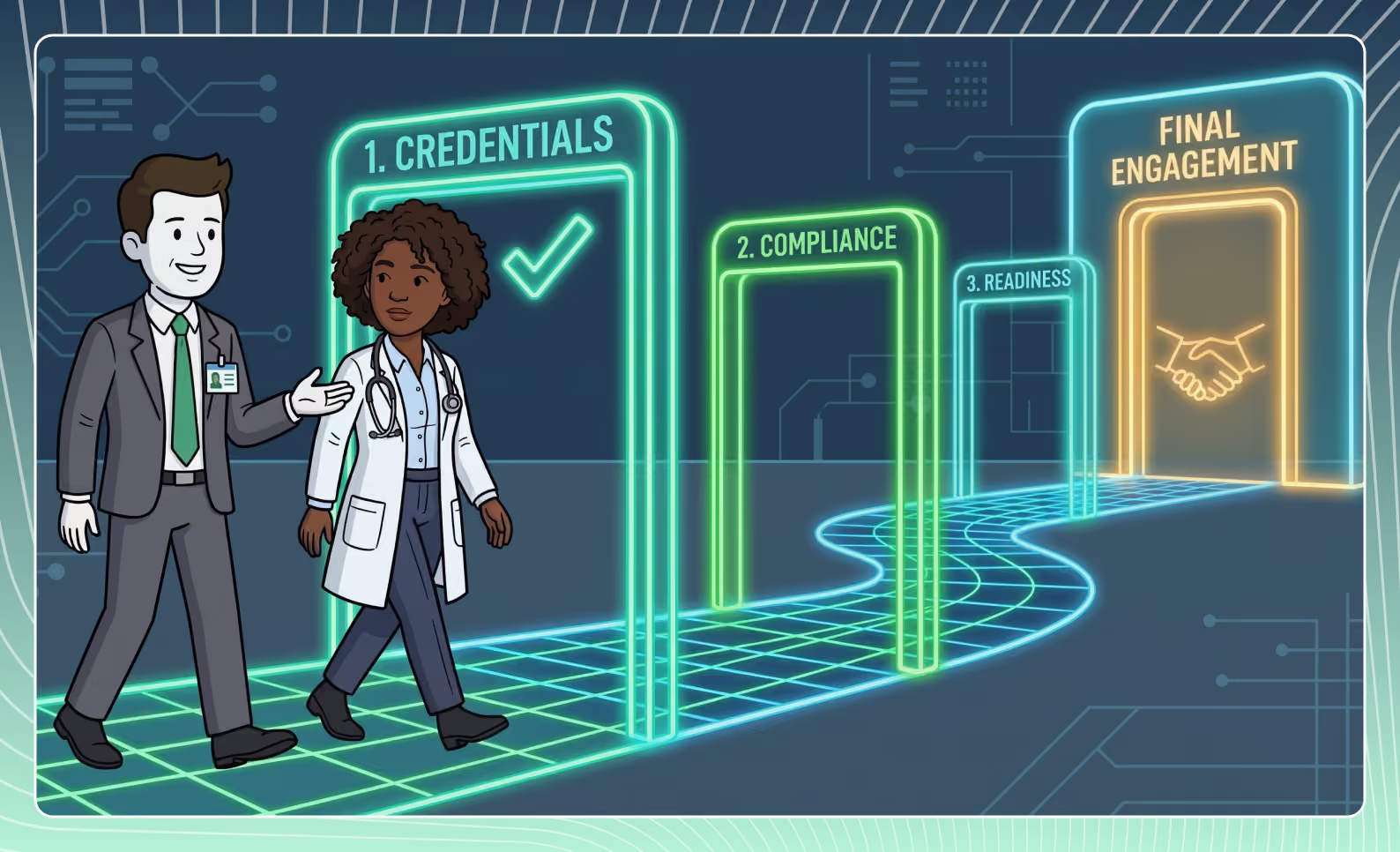
To eliminate these friction points, forward-thinking life sciences companies are replacing reactive compliance checks with automated HCP readiness workflows. By embedding continuous validation checkpoints prior to event scheduling and contracting, organizations can ensure audit readiness while streamlining operational throughput across commercial and medical departments.
The Core Friction Points in Legacy HCP Compliance Workflows
1. Fragmented Data and System Silos
In many life sciences companies, the data required to validate an HCP is scattered across multiple internal departments. Commercial teams initiate requests in a Customer Relationship Management (CRM) system, Legal drafts consulting agreements via a Contract Lifecycle Management (CLM) tool, Compliance manually checks federal and state sanction databases, and Procurement configures payment records in an ERP system. Without a centralized integration layer, cross-departmental handoffs depend on manual data re-entry and email notifications. This fragmentation creates blind spots where critical compliance checks—such as verifying active state licensure or checking for recent sanction updates—are skipped or delayed. Implementing an integrated pharmaceutical vendor management platform allows organizations to unify these workflows into a single transparent pipeline, ensuring all functional groups operate from a single source of truth.
2. Point-in-Time Screenings vs. Continuous Monitoring
Traditional compliance models rely heavily on point-in-time checks conducted during annual master service agreement (MSA) renewals or initial onboarding. However, an HCP’s compliance status is dynamic. Medical licenses expire, disciplinary actions occur, and sanction lists (such as OIG-LEIE or System for Award Management) update monthly. Relying on static background checks leaves organizations vulnerable to contracting with excluded individuals during interim periods between onboarding and engagement execution. Adopting continuous supplier compliance monitoring ensures that exclusion databases and medical board registries are queried automatically, raising immediate alerts if an HCP's eligibility status changes prior to an upcoming event.
3. Manual Payee Setup and Financial Reconciliation
Even when regulatory and legal requirements are met, payment processing bottlenecks can cause severe operational friction. Setting up individual HCPs as vendors in financial systems often requires collecting sensitive tax documentation (W-9/W-8BEN) and banking details manually. Inaccurate master data leads to payment delays, miscalculated transfers of value, and reporting errors under the Physician Payments Sunshine Act. Establishing robust vendor master data governance in life sciences streamines payee activation while enforcing strict data validation rules, eliminating administrative friction for both internal operations and external experts.
Deconstructing the Six Pillars of an HCP Readiness Architecture
Pillar 1: Automated Credential & License Verification
Before initiating any business discussion regarding consulting services, organizations must verify the specialist's professional standing. Automated credentialing tools query state licensing boards to confirm active, unencumbered licensure across all jurisdictions where the practitioner provides services, verifying NPI numbers, primary specialties, and board certifications automatically.
Pillar 2: Real-Time Sanctions and Exclusion Screening
To satisfy Anti-Kickback Statute guidelines and federal healthcare program regulations, life sciences firms must verify that engagement candidates are not debarred or excluded from participating in federal healthcare programs. Real-time screening queries the OIG-LEIE, SAM.gov, TRICARE, and state-level Medicaid exclusion databases continuously.
Pillar 3: Objective Fair Market Value (FMV) Tiering
Compensating healthcare professionals above standard FMV rates presents significant legal and regulatory risks. An operational readiness workflow enforces standardized FMV tiering matrix calculations based on clear objective criteria—including years of clinical experience, publication history, academic titles, and geographic region—ensuring compensation rates are consistently applied and documented prior to agreement generation.
Pillar 4: Streamlined Contracting & Scope Enforcement
Whether executing a broad Master Services Agreement or event-specific Statements of Work (SOW), contracting workflows must enforce legitimate business need documentation. Pre-approved template libraries, electronic signature integrations, and automated SOW generation accelerate contract execution while preserving strict legal controls.
Pillar 5: Comprehensive Activity Logging & Transparency Reporting
Every interaction, document submission, approval step, and financial transaction must be captured in an immutable audit trail. This centralized data capture simplifies Sunshine Act reporting and state disclosure compliance, reducing annual data reconciliation effort and mitigating audit exposure.
Pillar 6: Frictionless Payee Activation & Expense Processing
Integrating compliance verification directly with ERP vendor master setup enables rapid payment processing upon completion of services. Validated banking information, tax details, and fee-for-service documentation ensure prompt reimbursement while maintaining financial controls.
Operationalizing Compliance Across Key Engagement Types
Managing Pharmaceutical Speaker Program Compliance
Maintaining rigorous pharmaceutical speaker program compliance requires managing high event volumes alongside strict regulatory constraints. Speaker bureaus demand real-time tracking of annual compensation caps, slide deck version control, mandatory training certifications, and attendee logistics. By implementing an automated pre-engagement gate, event managers can verify speaker eligibility and remaining annual cap headroom before sending event invitations, eliminating the risk of exceeding contractual limits or utilizing unapproved presentation materials.
Ensuring Advisory Board Compliance
Executing effective advisory boards requires gathering key scientific experts while maintaining clear compliance boundaries. Achieving seamless advisory board compliance involves documenting the specific scientific rationale, establishing panel size justifications, defining clear objectives, and confirming that all participating consultants have completed credentialing and contracting prior to the meeting date. Automated workflows ensure all required pre-meeting approvals are recorded and accessible for audit reviews.
Handling Individual Consulting & Fee-for-Service Arrangements
For individual consulting engagements, such as manuscript co-authorship, clinical protocol design, or ad-hoc technical advice, specialized healthcare consulting compliance processes prevent scope creep and ensure compensation accurately reflects work performed. Automated SOW templates link directly to predefined FMV tiers, requiring explicit deliverables verification prior to invoice approval and payment release.
Conclusion: Transforming Compliance into an Operational Advantage
In modern life sciences management, regulatory compliance and operational speed do not have to be mutually exclusive. By shifting from fragmented manual checks to an automated orchestration framework, organizations build a scalable foundation for all HCP interactions. Structuring proactive HCP readiness checks protects the company against legal exposure under the Anti-Kickback Statute and Sunshine Act while empowering commercial and medical teams to execute critical scientific engagements efficiently and transparently.