

Get Started
Graphite's supplier management tool helps you onboard faster, cut time on risk reviews and streamline supplier validations. Save time and money.
GxP Supplier Onboarding: How to Accelerate Qualification Without Weakening Controls
The Operational Friction Between Speed and Governance
In regulated pharmaceutical, biotechnology, and medical device environments, the friction between operational speed and regulatory governance is nowhere more apparent than in GxP supplier onboarding. When a Contract Research Organization (CRO), Contract Development and Manufacturing Organization (CDMO), API supplier, or specialized analytical testing laboratory faces onboarding delays, the downstream consequences are immediate and severe: clinical trials stall, manufacturing schedules slip, and market entry dates slide. Yet, rushing quality reviews or bypassing critical risk controls to meet aggressive commercial deadlines is never an acceptable option under Global Health Authority regulations.
The core operational imperative for enterprise life sciences leaders is not to eliminate compliance friction entirely, but rather to eliminate redundant, manual friction. Traditional vendor intake processes are frequently hampered by fragmented communication, duplicate data collection, and static questionnaires. By transforming how organizations execute GxP vendor qualification, quality and procurement operations can achieve significant time savings without degrading their risk posture or compromising regulatory integrity.
The Business and Regulatory Impact of Delayed Onboarding
The commercial cost of slow supplier activation extends far beyond administrative overhead. In modern life sciences supply chains, third parties perform mission-critical functions across the entire product lifecycle—from early-stage clinical assay testing to commercial sterile fill-finish. A bottleneck during initial vendor setup ripples across multiple functional departments.
Clinical and Manufacturing Disruption
When a critical vendor remains stuck in qualification limbo, operational progress grinds to a halt. In clinical operations, delays in activating a specialized central lab or clinical packaging vendor can stall patient enrollment and push back protocol milestones. In commercial manufacturing, a delayed raw material or component supplier can lead to idle production lines, batch rescheduling, and missed market supply commitments. Every day a critical vendor is held up in administrative review represents accrued holding costs and lost market opportunity.
Regulatory and Inspection Risks
Conversely, attempts to bypass established onboarding steps to accelerate timelines create unacceptable regulatory liabilities. Regulatory agencies, including the US FDA, EMA, and MHRA, explicitly mandate that life sciences companies maintain rigorous oversight of all contracted services and materials. In medical device supplier onboarding, for example, failing to properly evaluate a critical component manufacturer under ISO 13485 or 21 CFR Part 820 standards can result in Form FDA 483 observations, warning letters, or product recalls. Life sciences firms must ensure that every third party operates within a fully validated quality framework before any GxP-impactful work commences.
Workflow Controls and Common Onboarding Failure Points
Understanding why supplier qualification stalls requires examining the systemic failure points inherent in traditional enterprise workflows. In most life sciences organizations, supplier onboarding involves a complex web of handoffs across Procurement, Quality Assurance, Regulatory Affairs, Legal, Finance, and Information Security.
Fragmented Intake and Disparate Systems
A primary failure point in traditional onboarding is reliance on email-driven intake, static spreadsheets, and isolated departmental portals. Procurement may initiate a vendor request in an ERP system, while Quality collects quality risk assessments via email attachments, and Legal negotiates Quality Agreements and Non-Disclosure Agreements in a separate contract repository. Because these systems rarely communicate, no single team maintains complete visibility into vendor readiness. This fragmentation forces business sponsors to constantly chase updates, resulting in extensive cycle times.
One-Size-Fits-All Risk Evaluations
Another significant inefficiency occurs when organizations apply uniform, non-tiered evaluation processes to all vendors. Requiring a low-risk facilities maintenance contractor to complete the same exhaustive GxP quality questionnaire as a high-consequence sterile drug substance CDMO creates unnecessary administrative burden. Without dynamic, risk-based intake routing, quality teams spend valuable hours reviewing non-critical vendor submissions while high-priority GxP suppliers sit in lengthy review queues.
Document Decay and Manual Verification
Compiling and maintaining audit-ready supplier documentation is an ongoing operational challenge. ISO certifications, GxP audit reports, manufacturing licenses, and insurance certificates carry strict expiration dates. When records are maintained manually across spreadsheets or local drives, monitoring for lapsed credentials becomes error-prone. Inevitably, auditors uncover expired certifications during inspections, forcing teams into reactive remediation cycles.
Orchestrating Cross-Functional Onboarding Workflows
To overcome these systemic bottlenecks, leading life sciences companies are modernizing their vendor onboarding architecture. The solution lies not in replacing existing enterprise software—such as Quality Management Systems (QMS), Enterprise Resource Planning (ERP) platforms, or Contract Lifecycle Management (CLM) tools—but in deploying a dedicated orchestration layer that unifies data collection and workflow routing across all stakeholders.
Establishing Dynamic, Risk-Based Intake
Modern onboarding begins with intelligent intake logic. When an internal sponsor submits a new vendor request, the system evaluates key attributes—such as material GxP impact, direct patient contact, data handling requirements, and geographic location. Based on these parameters, the platform automatically triggers tailored questionnaires and routes task assignments to the appropriate functional specialists. Non-GxP vendors proceed through streamlined business reviews, while GxP-critical suppliers are instantly directed into specialized Quality, IT Security, and Legal review queues.
Facilitating Parallel Cross-Functional Reviews
Orchestration transforms sequential handoffs into parallel, highly efficient collaboration. Quality Assurance can conduct audit evaluations and negotiate Quality Agreements simultaneously while Legal reviews contract terms, Finance performs risk checks, and Information Security validates data privacy controls. To effectively manage supplier risk across multi-departmental workflows, teams must share real-time visibility into onboarding status, blocking items, and outstanding documentation.
Centralizing Validated Golden Records
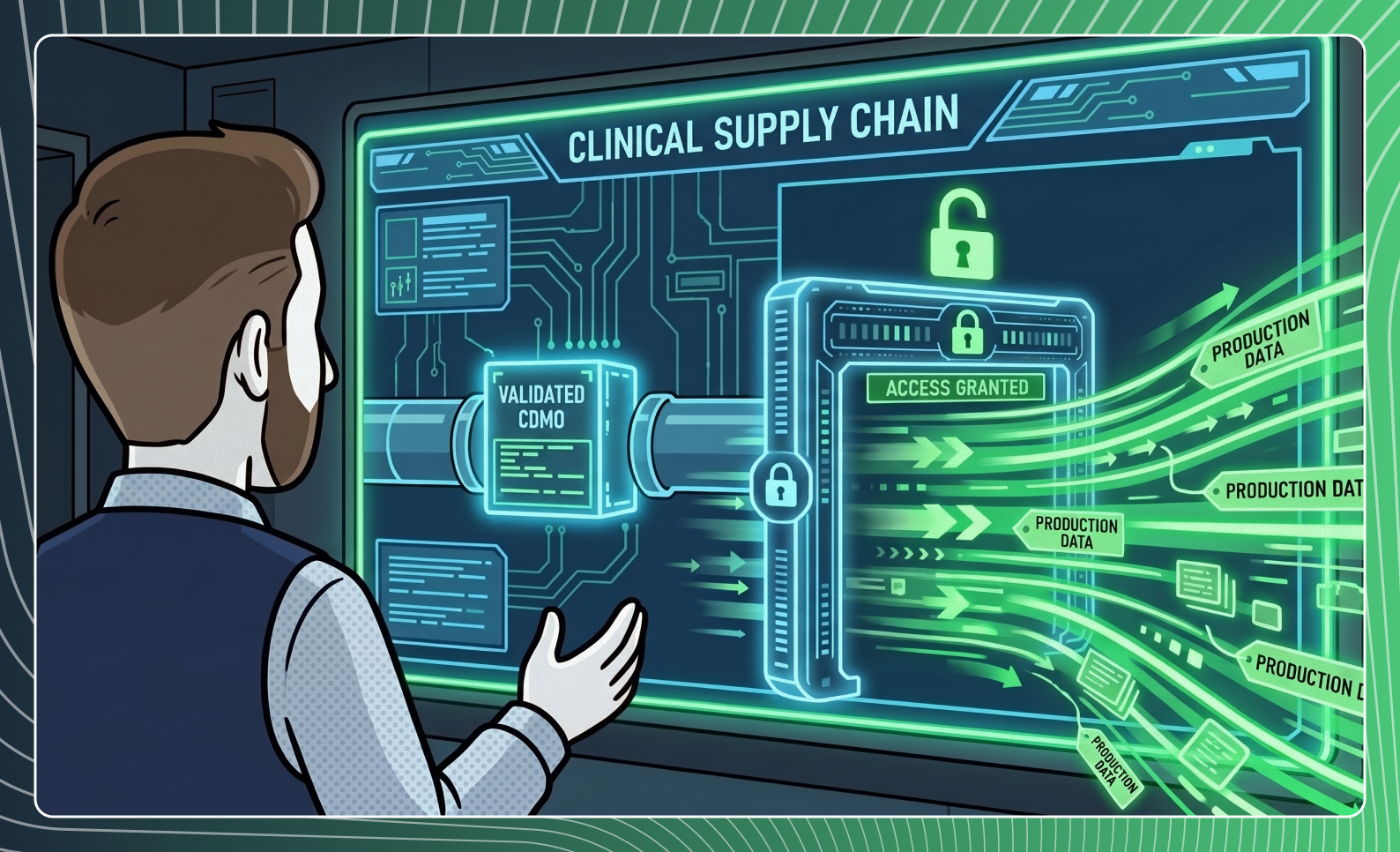
Data integrity is fundamental to GxP compliance. A centralized orchestration model ensures that verified vendor profile data, licensing credentials, and qualification status are synchronized across all connected enterprise applications. Rather than maintaining disparate vendor master entries in separate platforms, organizations can maintain a validated golden record of accurate supplier data that acts as a single source of truth across ERP, QMS, and eTMF environments. This seamless synchronization prevents duplicate data entry, reduces error rates, and ensures that supplier activation in financial systems occurs only after full quality sign-off.
Operational Checklist for GxP Supplier Qualification Acceleration
Life sciences leaders seeking to streamline their onboarding workflows while bolstering regulatory controls can evaluate their operations against the following key objectives:
- Standardize Intake Protocols: Replace informal, email-driven vendor requests with a single digital intake portal that captures full business context up front.
- Implement Automated Risk Triage: Configure dynamic scoping logic that automatically segments vendors by GxP relevance and risk tier before generating assessment tasks.
- Enable Parallel Review Cycles: Eliminate linear handoff delays by allowing Quality, Legal, Finance, and Security to perform concurrent evaluations within a unified workspace.
- Automate Credential Tracking: Establish automated alert mechanisms for expiring ISO certifications, GMP licenses, quality agreements, and audit renewals to maintain constant audit readiness.
- Enforce ERP Activation Gates: Integrate onboarding orchestration with financial platforms to prevent purchase order issuance until all mandatory quality and compliance approvals are complete.
Enhancing Enterprise Control with Graphite Connect
Achieving an optimal balance between onboarding speed and GxP compliance requires modern infrastructure designed specifically for complex enterprise networks. Graphite Connect serves as an enterprise orchestration layer that bridges the gaps between disparate procurement, quality, legal, and financial systems. By providing a centralized, secure environment for supplier data collection and automated workflow routing, Graphite Connect enables life sciences organizations to align internal stakeholders across Quality, Procurement, and Legal without disrupting core QMS or ERP architectures.
Through supplier network collaboration, automated risk-based routing, and real-time integration across system boundaries, organizations can drastically reduce onboarding cycle times, eliminate manual re-work, and ensure that every GxP partner remains fully validated and inspection-ready throughout the commercial relationship.