

Get Started
Graphite's supplier management tool helps you onboard faster, cut time on risk reviews and streamline supplier validations. Save time and money.
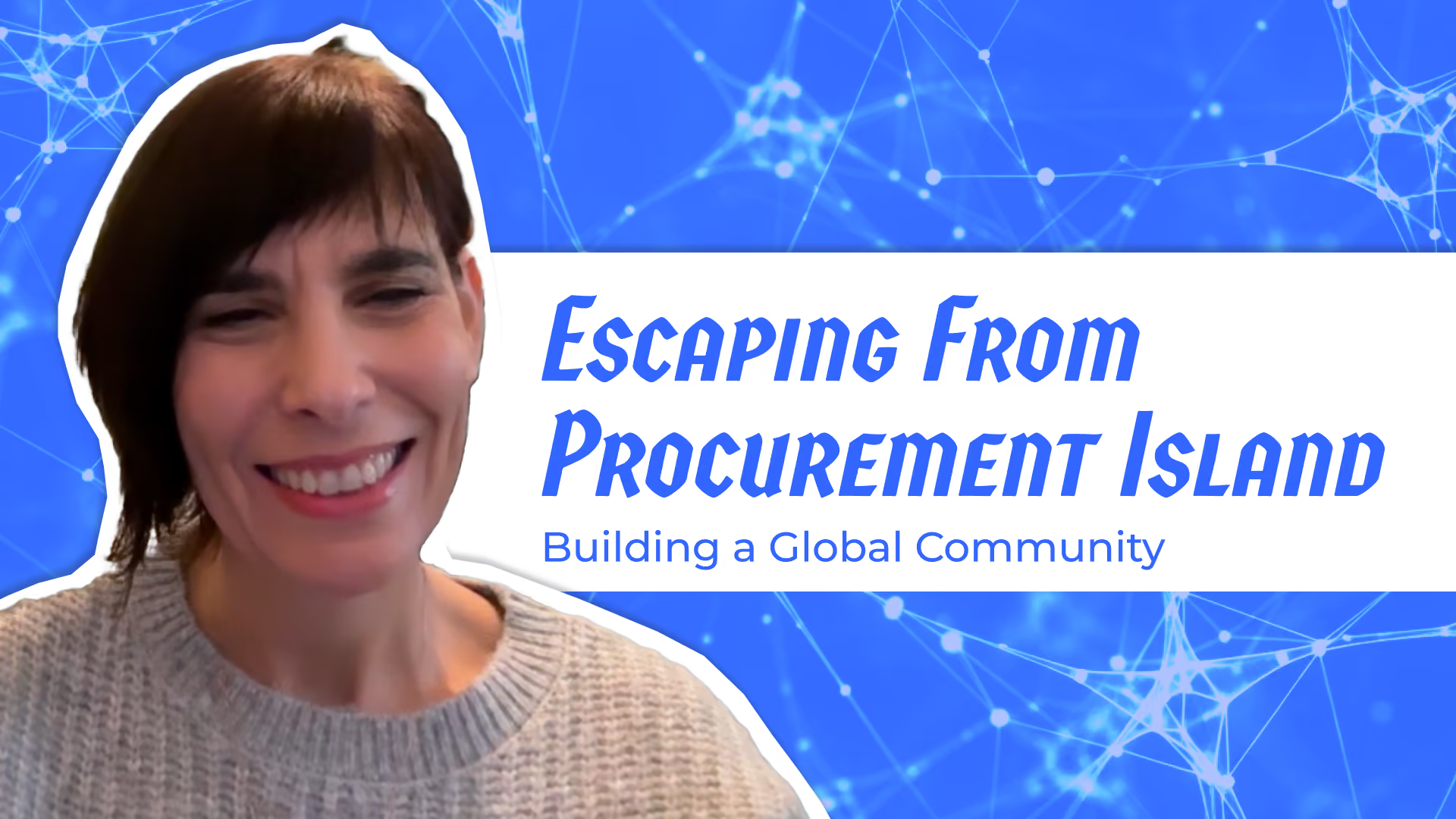
Escaping Procurement Island: Building a Global Community
Procurement can often feel like a lonely profession. We manage millions of dollars, negotiate complex enterprise contracts, and navigate intense stakeholder dynamics—yet many of us feel like we are operating on an isolated island within our own companies.
In Episode 46 of Proc & Roll, host Conrad Smith sits down with Shunit Kainy, a procurement leader at Lemonade and the founder of a thriving 260-member procurement community in Israel. Shunit shares her fascinating journey from being the "black sheep" of an art-focused family to becoming a leader in high-tech sourcing.
If you are feeling stuck, siloed, or intimidated by the rapid pace of technological change, this episode is a wake-up call. Here are the core insights from their conversation:
1. The Power of the "Native Gig" Economy
When Shunit started as a cloud procurement expert in 2017, the category was so new that she had no peers to talk to. She realized that resources were heavily focused on direct supply chain rather than the specific needs of IT and high-tech. Her solution was to start a community to share knowledge and learn from others.
Today, this operates like a "native gig" economy. Instead of hiring expensive consultants for every new SaaS tool, community members generously share their time and category expertise with each other. You don't have to know everything; you just need the vulnerability to ask your peers.
2. Overcoming the Introvert Trap
Conrad candidly admits that, like many in procurement, he identifies as an introvert who often wants to hide in his hotel room during networking events. However, waiting for stakeholders to come to you is a massive missed opportunity.
Shunit points out that some of the most impactful processes she has ever led started simply by overhearing a "water cooler" conversation that didn't make sense. By stepping out of your bubble—whether it's grabbing a coffee with a peer or attending an industry event—you position yourself to deliver value early rather than just acting as a late-stage gatekeeper.
3. Step Up or Step Out of the Way
Procurement sits in a uniquely powerful cross-functional position. As Shunit notes, procurement sees everything across the company and acts solely in the enterprise's best interest, with no hidden agendas.
This gives procurement a massive opportunity to drive leadership and introduce new processes. Shunit delivered a true mic-drop moment regarding this responsibility: "Now it's either we decide to be that leader or we decide to give it to others".
4. The Real Barrier to AI: Imagination
The community frequently discusses the rapidly changing tech landscape, observing that we are already drafting emails and negotiating with AI bots without even realizing it.
But when Conrad asked about the biggest barrier to AI adoption in the procurement community, Shunit's answer was profound: it's human imagination. Our thinking is still largely limited to basic administrative tasks, and that lack of imagination limits us far more than the actual capabilities of the technology.
The Bottom Line
You cannot afford to operate in a vacuum. Whether it's balancing your team's analytical tasks with strong relationship skills or reaching out for a simple coffee chat to learn about a new vendor, community is your ultimate competitive advantage.
Transcript: Proc-N-Roll | Escaping Procurement Island: Building a Global Community
Conrad: Hello everybody, and welcome back to Proc Enroll. I've been waiting for this podcast for weeks. We manage millions in spend across our organizations, yet many of us feel like we're on an island, sometimes going for decades without real insight and advice from peers on the same road. I met Shunit in Amsterdam at DPW on the day a ceasefire was announced in Israel, and we connected instantly over our shared belief in the power of community. Shunit has invested a ton of time building the procurement community in Israel. Shunit, how did you find your way into this profession?
Shunit: I am actually the black sheep of my family; they are all from an art background, doing painting or theater, and I ended up in the high-tech world, which is baffling to them. I got into procurement supporting my then-husband's IT business. What kept me in procurement is the relationship aspect of negotiations. It is a puzzle you need to resolve to get the smartest solution where the vendor is happy, the stakeholder is happy, and you are happy.
Conrad: It is easy to get distracted by the business outcomes and forget the people, but finding common ground and figuring out what matters to both the business and the supplier all comes from conversations. Talk to me about this leadership community you've built. How did it start?
Shunit: I come from IT and tech procurement, and I found that whenever I wanted to learn something, the existing resources were completely focused on direct supply chain. The resources were either too techie or too supply chain, so I had nowhere that matched my needs. In 2017, I took on a role in cloud procurement when it was very new, and I had absolutely no one to talk to. I started the community simply to share what I knew and learn what others had already figured out.
Conrad: So it started around a specific category and grew from there?
Shunit: Exactly. Now, four years later, the community is around 260 people. We host quarterly meetups—we recently had one with over 60 people attend. We talk about AI, how SaaS is moving into niche solutions, and negotiation skills. We even ask questions like, "How is it to negotiate with a bot?" We are realizing that we are already basically negotiating with AI without noticing; people are using tools like GPT or Copilot to draft their emails, and the responses we get are also drafted by AI. But a salesperson recently asked if AI will replace us, and I told him that as long as there is a human salesperson, there will be a human procurement person.
Conrad: As you grow this into a global community, will you keep the focus on IT?
Shunit: Yes, starting with tech, because all other categories (like HR) are slowly moving into the tech space via AI tools. If you look at indirect procurement at tech companies, 80% of it is essentially IT procurement. Locally, we use WhatsApp and Slack every day to ask about vendors and get immediate value.
Conrad: This is like a "native gig sharing" economy. Instead of paying high consulting fees when you get tossed into an unfamiliar category, you pay in community participation—sharing expertise and helping each other.
Shunit: Absolutely. People are incredibly generous with their time and knowledge behind the scenes, and it bridges the gap perfectly.
Conrad: What advice would you give to someone wanting to start contributing to a community?
Shunit: You have to be vulnerable, ask questions, and be willing to not be the smartest person in the room. In the tech space, we can't possibly know every single software tool or platform out there. But you look so smart when you consult with peers and simply ask your business, "Hey, I heard about this solution. Did we check that out?" Procurement sees everything cross-company, and our only agenda is the best interest of the company. Now it's either we decide to be that leader or we decide to give it to others.
Conrad: That is the mic drop moment for the whole podcast: decide to be a leader, step up, or step out of the way. But it's hard. I describe myself as an introvert. If you put me in a cocktail party, I just want to go into a dark corner and back to my hotel room. It's easy to just do your job and not talk to strangers, but if you do that, you're missing a huge opportunity.
Shunit: Some procurement people say they don't need to socialize because the business must come to them eventually. I totally disagree. The best processes I've led started because I overheard a water cooler conversation that didn't make sense to me, and everything opened up from that point. If you aren't putting yourself out there, you miss the leadership opportunity.
Conrad: I have never seen an exception to the principle that early involvement delivers more value. And this requires finding a balance on the continuum between being task-focused and relationship-focused.
Shunit: I look at the team as one unit. None of us are perfectly balanced individually. If I am very strong in relationships, I need a team member who is strong in tasks and analytics to balance me out so we are complementary.
Conrad: For someone just getting started, how do you get the snowball rolling?
Shunit: Go to events that already exist in your category, even if they aren't strictly procurement. Don't be that 9-to-5 person who thinks they can't afford to lose half a day of work. You get so much growth and new ideas from meeting peers. I try to have coffee with someone from the community at least once a month.
Conrad: Exactly. Decide every month to have an interaction with someone outside your company. It's a real investment in you as a person that drives better results for your business.
Conrad: We're down the home stretch. I have some rapid-fire questions for you. What's better for a CPO: a better ERP or a better group of teammates?
Shunit: Teammates, 100%.
Conrad: What's the biggest barrier to AI adoption in the procurement community today?
Shunit: It's the imagination, basically. We need to loosen our minds to imagine what we can do. Our thinking limits us more than AI capabilities because our thinking is still limited to administrative tasks.
Conrad: I completely agree. My mind is blown right now. We've been playing ferociously with OpenClaw, and the conversation about agentic AI in 2026 is entirely new. We're going to have a podcast in a couple of weeks to dive into OpenClaw and do a show-and-tell, so folks, make sure you don't miss that one!
This transcript has been edited for clarity while maintaining all substantive content