

Get Started
Graphite's supplier management tool helps you onboard faster, cut time on risk reviews and streamline supplier validations. Save time and money.
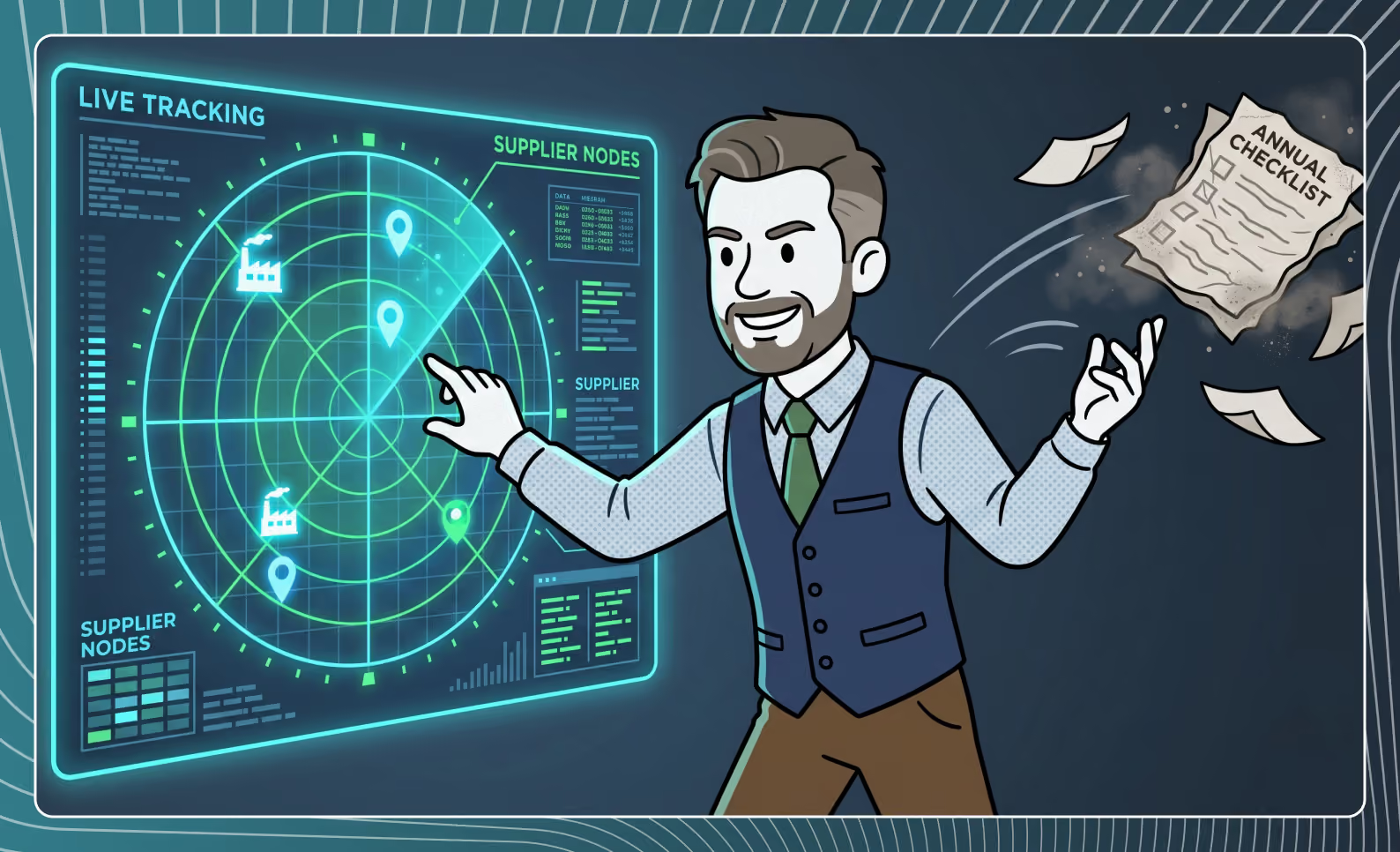
Continuous Supplier Compliance Monitoring: Moving Beyond Static Assessments
Introduction: The Operational Reality of Static Vendor Assessments
Consider a typical scenario in a growing biotech enterprise: A primary Contract Development and Manufacturing Organization (CDMO) is onboarded to produce clinical trial material for a pivotal Phase II study. Onboarding is thorough: QA reviews validation packages, Procurement negotiates master service agreements, and Compliance runs standard sanction screenings. The vendor passes all checks, is approved in the ERP, and starts batch production.
Six months later, the CDMO updates line procedures, hands batch release oversight to a new quality unit, and restructures its leadership. Under traditional vendor risk management, these operational shifts remain invisible. The sponsor relies on static, point-in-time assessments—renewed annually or triennially via manual surveys. With no automated alerts to QA or Procurement, purchasing and batch scheduling proceed blindly.
Nine months later, a regulatory inspection uncovers the unrequalified manufacturing line. The impact is swift: batch releases halt, clinical timelines stall for months, regulatory filings require emergency amendments, and financial write-downs mount. This reveals the core flaw of static supplier management: initial qualification offers false security when disconnected from real-time operational change.
Regulatory Rigor and Operational Realities
Operating in life sciences requires navigating complex regulatory frameworks where third-party non-compliance directly threatens product safety, market authorization, and corporate integrity. Third parties—from CROs to logistics vendors—act as direct extensions of the sponsor. Consequently, regulatory bodies hold sponsors strictly accountable for the ongoing compliance of their entire vendor ecosystem.
FDA GxP Guidelines and Quality Agreements
Under FDA GLP, GCP, and GMP regulations, sponsor oversight must be continuous and fully documented. Quality Agreements require vendors to report changes in facilities, equipment, test methods, key personnel, or subcontractors before execution. When a vendor fails to report shifts—or the sponsor lacks the infrastructure to act—the sponsor incurs direct regulatory liability. Undetected GxP deviations can invalidate trial data or prompt FDA Form 483 observations and Warning Letters.
Beyond technical quality and manufacturing compliance, life sciences organizations face strict oversight regarding commercial and medical affairs interactions. Third-party vendors frequently manage healthcare provider (HCP) engagements, speaker bureaus, advisory boards, and clinical investigator grants. The Physician Payments Sunshine Act mandates accurate tracking and reporting of all transfers of value made to covered recipients, whether provided directly by the sponsor or indirectly through third-party intermediaries. Simultaneously, the Anti-Kickback Statute (AKS) prohibits improper remuneration to influence prescribing behavior. If a third-party vendor executes non-compliant HCP payments or fails to maintain rigorous Fair Market Value (FMV) documentation, the sponsor faces substantial civil monetary penalties and reputational damage.
Workflow Breakdown and Cross-Functional Stakeholder Alignment
Continuous compliance monitoring requires breaking down internal silos. A robust workflow must synchronize QA, Procurement, Legal, Regulatory Affairs, and Compliance into a unified control framework. Without cross-functional alignment, critical risk signals captured by one team will fail to reach those responsible for mitigation.
Cross-Functional Roles and Responsibilities
Effective monitoring relies on clearly defined departmental ownership across the supplier lifecycle:
- Quality Assurance (QA): Owns GxP qualification, audit scheduling, Quality Agreements, deviation tracking, and change control evaluations.
- Procurement: Manages commercial relationships, contract execution, purchase orders, and supplier performance.
- Legal & Compliance: Oversees sanctions screening, anti-bribery/anti-corruption (ABAC) vetting, Sunshine Act integrity, and contract terms.
- Regulatory Affairs: Monitors submission impacts, inspection readiness, and agency filings triggered by supplier shifts.
The Continuous Monitoring Control Loop
The operational workflow shifts oversight from a static cycle to a continuous control loop across four key stages:
- 1. Automated Signal Capture: External feeds continuously ingest regulatory updates (e.g., FDA inspection databases, sanctions lists, cybersecurity scores) alongside internal operational triggers.
- 2. Triage & Impact Analysis: When a signal flags—such as an inspection observation—the system immediately evaluates the supplier's risk tier and active contracts.
- 3. Automated Risk Routing: Remediation tasks automatically route GxP issues to QA, financial concerns to Procurement, and sanction alerts to Legal.
- 4. Governance Action & ERP Controls: If a high-risk change is verified, the system triggers an automated hold on PO creation or payments within the ERP until re-qualification occurs.
Failure Point Analysis: Root Causes of Operational Breakdown
Traditional vendor management collapses under operational complexity. Pinpointing root failure points helps life sciences organizations design resilient workflows:
Siloed Data Systems and Fragmented Records
Vendor data is often fragmented: QA tracks audits in an eQMS, Procurement uses an ERP, Legal relies on a document repository, and Compliance tracks background checks in spreadsheets. When a risk signal emerges, no central system connects the dots—leading to scenarios where Procurement issues major POs to a vendor currently placed on quality hold.
Questionnaire Fatigue and Low Response Quality
Periodic, massive questionnaires cause vendor fatigue, resulting in delayed or superficial responses. Worse, static surveys reflect only a single point in time. A supplier reporting full compliance in January may suffer a major quality breakdown in March that goes undetected until the next annual review.
Missing Documentation and Expired Credentials
ISO certifications, GxP re-qualifications, licenses, and insurance policies expire continuously. Tracking these manually across hundreds of suppliers inevitably causes oversight, exposing the firm to immediate regulatory liability during audits.
Solution Architecture: Modernizing Vendor Risk Management
To address these vulnerabilities, enterprise life sciences firms must adopt an orchestration layer that links real-time risk intelligence directly to core business systems across three core pillars:
Continuous Data Integration and Risk-Based Routing
Modern architectures ingest real-time risk intelligence from regulatory, legal, financial, and operational databases. When a feed flags a change, system rules route alerts based on vendor criticality: a minor address update triggers a passive record refresh, while an FDA Form 483 for a primary API manufacturer triggers immediate QA re-validation.
Integrated Qualification and Master Data Governance
Continuous monitoring requires a single vendor master record. Building an audit-ready supplier qualification process links all compliance documents, quality agreements, audit findings, and risk scores directly to a central profile. Additionally, robust centralized vendor master data governance ensures vendor data synchronized across ERP, eQMS, and procurement tools stays clean, verified, and current.
Practical Action Plan: Operational Implementation Framework
Transitioning to continuous monitoring requires a structured, phased rollout:
- Phase 1: Tiering & Criticality Mapping: Categorize suppliers by operational risk, separating GxP, HCP-facing, and high-spend vendors from low-risk administrative suppliers.
- Phase 2: Master Record Consolidation: Eliminate duplicate records across ERPs and eQMS tools to establish a single vendor database.
- Phase 3: Automated Feed Integration: Connect automated external streams for sanctions, regulatory databases, financial health, and adverse media.
- Phase 4: Cross-Functional Workflow Orchestration: Configure automated risk routing and task assignments across QA, Legal, Procurement, and Regulatory Affairs.
- Phase 5: ERP Control Interlocking: Enforce transactional holds that block PO creation or payments for vendors with active compliance holds.
Conclusion: Operational Readiness with Graphite Connect
In highly regulated life sciences environments, relying on annual questionnaires and static assessments leaves organizations vulnerable to operational disruptions, regulatory penalties, and patient safety risks. Shifting to continuous compliance monitoring gives teams the visibility required to identify and resolve vendor risks before they escalate.
Graphite Connect provides the orchestration and operational readiness layer needed to integrate with existing ERP, GRC, eQMS, and clinical systems. By centralizing vendor master data, automating risk-based routing, and synchronizing data enterprise-wide, Graphite Connect helps life sciences firms stay audit-ready, secure their supply chain, and enforce cross-functional compliance at scale.