


Get Started
Graphite's supplier management tool helps you onboard faster, cut time on risk reviews and streamline supplier validations. Save time and money.
Collaborative Procurement: A Complete Guide for Modern Procurement Teams
Collaborative procurement helps organizations build stronger supplier relationships, improve purchasing decisions, and create long-term business value. Instead of treating procurement as a series of individual transactions, it brings procurement teams, internal stakeholders, and suppliers together around shared goals.
By improving communication, standardizing processes, and sharing accurate supplier information, organizations can reduce administrative friction, manage risks, and identify opportunities for continuous improvement. Understanding how collaborative procurement works, which tools support it, and how to measure its impact can help procurement teams build more productive supplier partnerships.
What Is Collaborative Procurement?
Collaborative procurement brings internal teams and external suppliers together to coordinate purchasing activities, share information, and achieve mutually beneficial outcomes. It emphasizes communication, transparency, and shared accountability throughout the procurement process.
Rather than focusing exclusively on purchase price or individual transactions, collaborative procurement considers the broader value of supplier relationships, including operational efficiency, quality, risk management, and innovation.
Understanding Procurement Collaboration
Procurement collaboration involves coordinating activities across departments and working with suppliers to improve purchasing decisions. Procurement teams may collaborate with finance on budgets, legal on contract terms, IT on system integration, and operations on delivery requirements.
External collaboration extends these efforts to suppliers. Buyers and suppliers share relevant information, align expectations, and resolve problems before they disrupt business operations.
For example, a manufacturer that shares demand forecasts with a critical supplier gives that supplier more time to plan production and allocate resources. The buyer may benefit from fewer delays, while the supplier gains better visibility into upcoming demand.
What Is Supplier Collaboration?
Supplier collaboration is the ongoing process of working with suppliers to coordinate activities, share information, solve problems, and identify improvement opportunities. It extends beyond negotiating prices or issuing purchase orders. Effective supplier collaboration includes setting performance expectations, communicating operational changes, reviewing results, and developing solutions to shared challenges.
Supplier collaboration also plays an important role in supplier relationship management (SRM). By maintaining consistent communication throughout the supplier lifecycle, procurement teams can build relationships that support both immediate requirements and longer-term business objectives.
Collaborative Procurement vs. Traditional Procurement
Traditional procurement often prioritizes individual transactions, cost savings, and compliance with purchasing procedures. Collaborative procurement takes a broader approach by incorporating supplier input and cross-functional coordination into decision-making.
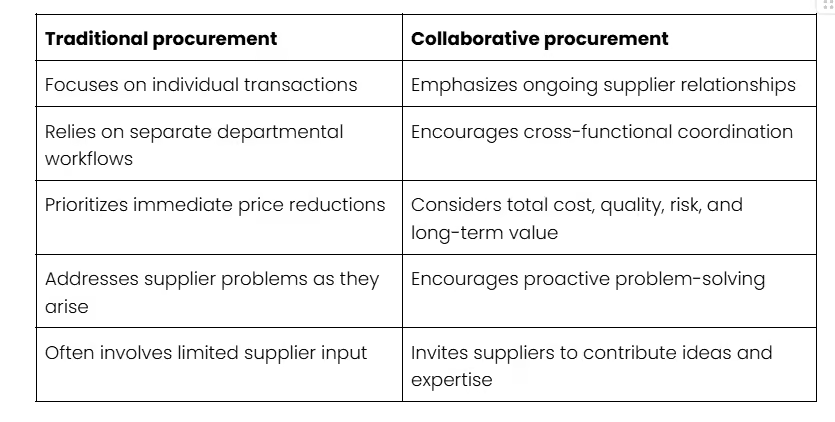
Both approaches have a place in procurement. Routine, low-value purchases may require limited interaction, while strategic supplier relationships often benefit from deeper collaboration.
What Are the Benefits of Collaborative Procurement?
Collaborative procurement can help organizations improve supplier performance, control costs, and make better-informed decisions. Its value extends beyond purchasing efficiency because stronger supplier relationships can support business continuity, drive innovation, and improve operational performance.
Improved Supplier Relationships and Trust
Consistent communication helps buyers and suppliers understand each other's priorities, constraints, and expectations. When both parties communicate openly, they can address concerns earlier and avoid misunderstandings.
A collaborative supplier relationship also encourages shared accountability. Buyers set clear requirements, while suppliers flag potential problems and suggest improvements.
Over time, this approach can create more productive supplier partnerships. Suppliers who understand a customer's objectives may be better positioned to recommend alternatives, anticipate changing requirements, and support long-term plans.
Greater Cost Efficiency and Value Creation
Collaborative procurement can uncover cost-saving opportunities that conventional price negotiations may overlook. Sharing demand forecasts, coordinating order schedules, and discussing product specifications can help both parties identify inefficiencies.
Suppliers may recommend alternative materials, more suitable order quantities, or changes to delivery schedules that reduce costs. Procurement teams should also consider total cost of ownership, not just purchase price. Transportation, maintenance, quality problems, administrative work, and supply disruptions can all affect the actual cost of a supplier relationship.
Better Risk Management and Supply Continuity
Supplier collaboration can improve visibility into risks that affect procurement and supply chain operations. Regular communication helps buyers identify potential delivery delays, capacity constraints, compliance concerns, and changes to supplier operations. Suppliers may also provide early warnings when shortages or other disruptions threaten fulfillment.
Accurate supplier information strengthens these efforts. Procurement teams need reliable records, current documentation, and appropriate verification processes to assess suppliers and respond to changes.
Increased Innovation and Continuous Improvement
Suppliers often possess technical knowledge and operational experience that buyers cannot develop internally as quickly or efficiently. Inviting suppliers to participate in product development, sourcing discussions, and process reviews can uncover new ideas.
A supplier might suggest a different component, recommend an improved manufacturing process, or identify a way to simplify fulfillment. Regular performance discussions also create opportunities to turn recurring problems into improvement initiatives.
Improved Operational Efficiency and Decision-Making
Disconnected systems and manual workflows can slow procurement and create unnecessary administrative work. Collaborative processes help teams coordinate approvals, exchange information, and maintain consistent supplier records. Standardized workflows reduce repetitive requests and clarify responsibilities.
Better information also supports more informed decisions. When procurement, finance, legal, and operations work from reliable supplier data, they can coordinate activities with fewer delays and conflicting records.
Key Principles of Effective Procurement Collaboration
Successful procurement collaboration requires more than frequent communication. Organizations need clear expectations, appropriate processes, and a shared understanding of what each relationship should accomplish.
Shared Goals and Clear Expectations
Procurement objectives should align with broader business priorities. These may include cost control, product quality, delivery reliability, regulatory compliance, and supply continuity.
Teams should define responsibilities, decision-making authority, and escalation procedures at the beginning of a supplier relationship. Suppliers also need to understand how buyers will measure performance and evaluate contractual commitments. Clear expectations give both parties a consistent basis for making decisions and resolving disagreements.
Transparency and Consistent Communication
Effective vendor collaboration depends on timely, relevant information sharing. Procurement teams should establish appropriate communication channels and meeting schedules based on supplier importance and operational complexity. They should also promptly communicate changes to specifications, delivery requirements, or contractual expectations.
Suppliers need an equally clear way to raise concerns, request clarification, and report potential disruptions.
Accountability Across Internal Teams and Suppliers
Collaboration works best when both buyers and suppliers take responsibility for their commitments. Procurement teams should track agreed performance indicators, document decisions, and follow up on outstanding actions.
Internal stakeholders must also meet their responsibilities, including providing accurate requirements, completing approvals, and communicating changes. Regular reviews help both parties identify problems and agree on corrective actions without turning every disagreement into a confrontation.
Supplier Segmentation and Relationship Management
Not every supplier requires the same level of collaboration. Strategic suppliers may warrant frequent performance reviews, joint planning, and closer communication because their performance significantly affects business operations. Transactional suppliers may need simpler, more standardized interactions.
Segmenting suppliers by business impact, risk, dependency, and strategic importance helps procurement teams allocate resources where they create the most value.
How to Implement a Collaborative Procurement Strategy
Organizations can introduce collaborative procurement through a structured approach that improves coordination without creating unnecessary administrative work.
Step 1: Assess Existing Procurement Processes
Map the current procurement workflow, from sourcing and supplier onboarding to purchasing, approvals, and performance reviews. Identify disconnected systems, duplicate data entry, unclear responsibilities, and communication gaps.
Review existing performance measures, such as supplier onboarding time, purchase order processing time, approval delays, and error rates. Establishing a baseline helps teams measure whether future changes deliver meaningful improvements.
Step 2: Identify Key Stakeholders and Suppliers
Bring together the departments involved in procurement decisions. Depending on the organization, these may include procurement, finance, legal, IT, operations, and business unit leaders.
Next, identify suppliers whose performance significantly affects costs, quality, delivery, or business continuity. These relationships may benefit from more frequent communication and joint planning. Lower-risk, transactional suppliers can follow simpler processes that preserve efficiency.
Step 3: Establish Shared Objectives and Performance Metrics
Define the outcomes that procurement collaboration should deliver. Objectives might include improving on-time delivery, reducing purchasing costs, shortening approval cycles, improving data accuracy, or resolving supplier issues more quickly.
Assign measurable indicators to each objective and clarify how the organization will collect and review performance data. Buyers and suppliers should understand which measures matter, how the organization will evaluate them, and what actions it will take when performance falls below expectations.
Step 4: Standardize Supplier Onboarding and Information Sharing
Supplier onboarding establishes the information and controls that procurement teams rely on throughout the supplier relationship. Create a consistent process to collect business information, review documentation, verify submitted details, and obtain required approvals. Assign clear ownership for validating supplier records and managing subsequent changes.
Provide suppliers with a straightforward way to submit information and respond to requests. Avoid collecting the same information repeatedly across different departments. A standardized process improves supplier data quality and gives internal stakeholders a more consistent foundation for collaboration.
Step 5: Improve Purchase Order Collaboration
Purchase order collaboration helps buyers and suppliers coordinate order details and address changes before they create operational problems. Establish clear procedures for communicating quantities, prices, specifications, and delivery schedules. Encourage suppliers to confirm order details and promptly flag potential fulfillment issues.
When either party needs to change an order, document the change and ensure relevant stakeholders receive the updated information. Clear purchase order collaboration reduces misunderstandings, minimizes manual follow-ups, and improves coordination between procurement and supplier operations.
Step 6: Conduct Regular Supplier Performance Reviews
Regular performance reviews give both parties an opportunity to evaluate results and identify improvements. Use supplier scorecards to assess key measures, including delivery reliability, cost control, service quality, compliance, responsiveness, and ease of doing business.
Discuss the reasons behind performance gaps rather than focusing exclusively on the numbers. When a supplier underperforms, agree on corrective actions, assign responsibilities, and establish realistic deadlines.
Invite suppliers to evaluate the relationship from their perspective. Their feedback may reveal internal delays, unclear requirements, or other issues that buyers can address.
Step 7: Continuously Improve the Collaboration Model
Procurement collaboration should evolve as business needs and supplier relationships change. Review performance data, gather stakeholder feedback, and identify recurring problems. Update workflows when they create unnecessary delays or fail to reflect current requirements.
Teams can then expand successful practices to other suppliers and departments, adjusting collaboration levels to suit each relationship.
Common Challenges in Collaborative Procurement and How to Overcome Them
Even well-planned procurement collaboration can encounter organizational, technical, and operational barriers. Identifying these challenges early helps procurement teams build practical, effective processes.
Siloed Departments and Conflicting Priorities
Procurement may prioritize cost savings, while operations focuses on continuity and finance emphasizes budget control. Without coordination, these priorities can lead to delays and inconsistent decisions.
How to overcome it: Establish shared objectives, clarify decision-making responsibilities, and create cross-functional workflows. Involve relevant stakeholders early enough to resolve conflicting requirements before they delay purchasing activities.
Poor Supplier Data Quality and Limited Visibility
Inconsistent supplier records, outdated contact details, and fragmented documentation make it hard for teams to rely on a single source of truth. Poor data quality can also affect risk assessments, approvals, and supplier payments.
How to overcome it: Maintain a centralized, validated source of supplier information. Standardize data collection, assign responsibility for updates, and establish verification procedures for important changes.
Resistance to Change and Low Supplier Adoption
Employees may prefer familiar manual processes, while suppliers may resist unfamiliar systems or repeated requests for information. Complex workflows can discourage adoption even when the underlying technology offers useful capabilities.
How to overcome it: Explain the benefits to each stakeholder, simplify workflows, and provide clear instructions. Reduce duplicate requests and make it easy for suppliers to complete required tasks.
Security, Compliance, and Information-Sharing Risks
Sharing supplier information across departments and organizations introduces questions about data accuracy, confidentiality, access, and regulatory requirements. Poorly controlled processes can expose sensitive information or allow unauthorized changes to supplier records.
How to overcome it: Establish appropriate access controls, define information-sharing requirements, and implement verification and approval procedures. Review compliance obligations and ensure that relevant controls apply throughout the supplier lifecycle.
Difficulty Measuring Collaboration Outcomes
Organizations may invest in new processes or technology without establishing how they will evaluate the results. Communication volume alone does not demonstrate that supplier relationships are improving.
How to overcome it: Establish baseline metrics and track measurable outcomes, including cycle times, delivery performance, cost improvements, data accuracy, and supplier satisfaction. Review results consistently and adjust the approach when the data reveals gaps.
Technology can help address several of these challenges by coordinating workflows and improving access to supplier information.
Procurement Collaboration Tools: Features and Capabilities to Look For
Procurement collaboration tools help organizations coordinate activities, exchange information, and manage supplier interactions more consistently. Depending on the organization's requirements, these capabilities may be available through procurement platforms, supplier collaboration software, supplier portals, or integrated enterprise systems.
Centralized Supplier Information Management
A centralized supplier record gives authorized stakeholders access to consistent information about supplier identities, contact details, documentation, and relevant compliance requirements. It reduces the risk of departments maintaining conflicting versions of the same record.
When evaluating supplier collaboration tools, look for capabilities that support data validation, controlled updates, document management, and appropriate access permissions.
Supplier Collaboration Portals and Self-Service Workflows
A supplier collaboration portal gives suppliers a structured way to submit information, respond to requests, and manage relevant updates.
Self-service workflows can reduce repetitive email exchanges and manual data entry. They can also help procurement teams standardize how they collect information across suppliers. Ease of use matters. Suppliers are more likely to complete required tasks when instructions are clear, and the process avoids unnecessary complexity.
Purchase Order Collaboration and Workflow Automation
Purchase order collaboration capabilities help buyers and suppliers coordinate order information, communicate changes, and track relevant approvals. Workflow automation can reduce delays caused by manual handoffs and unclear responsibilities.
Organizations should evaluate whether a platform supports their actual purchasing requirements rather than assuming every supplier management tool includes comprehensive purchase order functionality.
Integration With ERP and Procurement Systems
Integration with enterprise resource planning (ERP) and procurement systems can reduce duplicate data entry and improve consistency across business applications. Teams should assess how supplier information moves between systems, which system controls the authoritative record, and how the organization handles updates or discrepancies.
Accurate synchronization and appropriate access controls are essential for reliable reporting and operational decisions.
Supplier Performance Monitoring and Analytics
Supplier scorecards, dashboards, and performance reports help procurement teams track agreed metrics and identify trends. These tools can support performance reviews, highlight recurring delivery problems, and help teams prioritize corrective actions. The most useful metrics connect supplier performance to business objectives.
Supplier Verification and Risk Controls
Supplier collaboration tools should support the organization's security and data integrity requirements. Depending on the platform, relevant capabilities may include identity verification, document checks, bank account validation, and controlled approval workflows.
Procurement teams should assess how the technology helps maintain accurate supplier records and manage important changes throughout the relationship. The goal is to combine usability and efficiency with appropriate verification and risk controls.
How to Build a Strong Supplier Collaboration Network
A supplier collaboration network connects procurement teams with suppliers through consistent processes, clear communication, and shared expectations. Building an effective network requires organizations to invest in the relationships that matter most while keeping routine interactions efficient.
Prioritize Strategic Supplier Partnerships
Identify suppliers that have a significant influence on business continuity, quality, innovation, or cost. Develop relationship plans for these suppliers and allocate appropriate resources to joint planning, performance discussions, and improvement initiatives. Strategic supplier partnerships should focus on long-term value rather than treating each purchase as an isolated negotiation.
Establish Regular Communication and Joint Planning
Schedule business reviews to discuss performance, upcoming demand, operational challenges, and opportunities for improvement. Encourage suppliers to raise concerns early and recommend practical solutions. Establish escalation procedures for issues that require prompt attention. The frequency and depth of communication should reflect each relationship's importance and complexity.
Encourage Collaboration Across the Supplier Network
Where appropriate, share relevant forecasts, specifications, and operational requirements with suppliers that depend on the same plans or processes. Better coordination helps suppliers anticipate demand and manage their resources more effectively.
At the same time, organizations must respect confidentiality requirements and limit access to sensitive information. Effective collaboration requires sharing the right information with the right parties, not sharing everything indiscriminately.
Measure the Value of Supplier Partnerships
Evaluate whether supplier relationships improve delivery performance, quality, responsiveness, cost control, and risk management. Gather feedback from both suppliers and internal stakeholders to identify opportunities for improvement. Use these findings to refine relationship plans and determine which suppliers could benefit from deeper collaboration.
How to Measure the Success of Collaborative Procurement
Procurement teams need measurable indicators to determine whether their collaborative procurement strategy delivers business value. The right metrics depend on organizational objectives, supplier categories, and the complexity of the procurement process.
Procurement Efficiency Metrics
Useful indicators include supplier onboarding cycle time, purchase order processing time, approval cycle time, administrative workload, and manual error rates. These measures help teams identify bottlenecks and determine whether standardized workflows improve efficiency.
Supplier Performance Metrics
Teams can monitor on-time delivery, quality and defect rates, supplier responsiveness, compliance with contractual service levels, and completion of corrective actions. These indicators show whether suppliers meet agreed expectations and where additional support or intervention may be necessary.
Relationship and Business Value Metrics
Supplier satisfaction, stakeholder feedback, cost savings, cost avoidance, supplier-led improvement initiatives, and risk incident resolution times can provide a broader view of collaboration outcomes.
Establish a baseline before introducing major changes, then review performance regularly. Avoid relying on a single indicator because improvements in one area may come with trade-offs elsewhere. Ultimately, successful procurement collaboration should improve operational outcomes while strengthening supplier relationships.
How Graphite Connect Supports Collaborative Procurement
Effective collaboration depends on accurate supplier information, consistent processes, and reliable coordination between internal teams and external suppliers.
Graphite Connect supports supplier onboarding and supplier data management by helping organizations streamline information collection and verification. A more standardized approach can reduce administrative friction and give teams a consistent foundation for managing supplier records.
Accurate supplier information matters, especially when procurement, finance, and other departments rely on the same records to make decisions or manage supplier-related workflows. Verification controls can also help organizations address data accuracy and supplier risk requirements.
For procurement teams seeking to improve collaboration, supplier onboarding is a practical place to start. Standardizing how suppliers provide information and how organizations verify and manage it can build stronger processes for the relationship that follows. Graphite Connect can help organizations build that foundation while supporting a more efficient supplier management process.
Build Stronger Supplier Partnerships With Graphite Connect
Collaborative procurement helps organizations move beyond transactional purchasing toward stronger supplier relationships, better information sharing, and continuous improvement.
Start by assessing your current workflows, identifying your most important supplier relationships, and addressing gaps in supplier data quality and cross-functional coordination.
If you’re ready to streamline supplier onboarding and supplier data management, schedule a demo with Graphite Connect to explore how your procurement team can reduce administrative friction, improve supplier information management, and establish a more consistent foundation for supplier relationships.