

Get Started
Graphite's supplier management tool helps you onboard faster, cut time on risk reviews and streamline supplier validations. Save time and money.
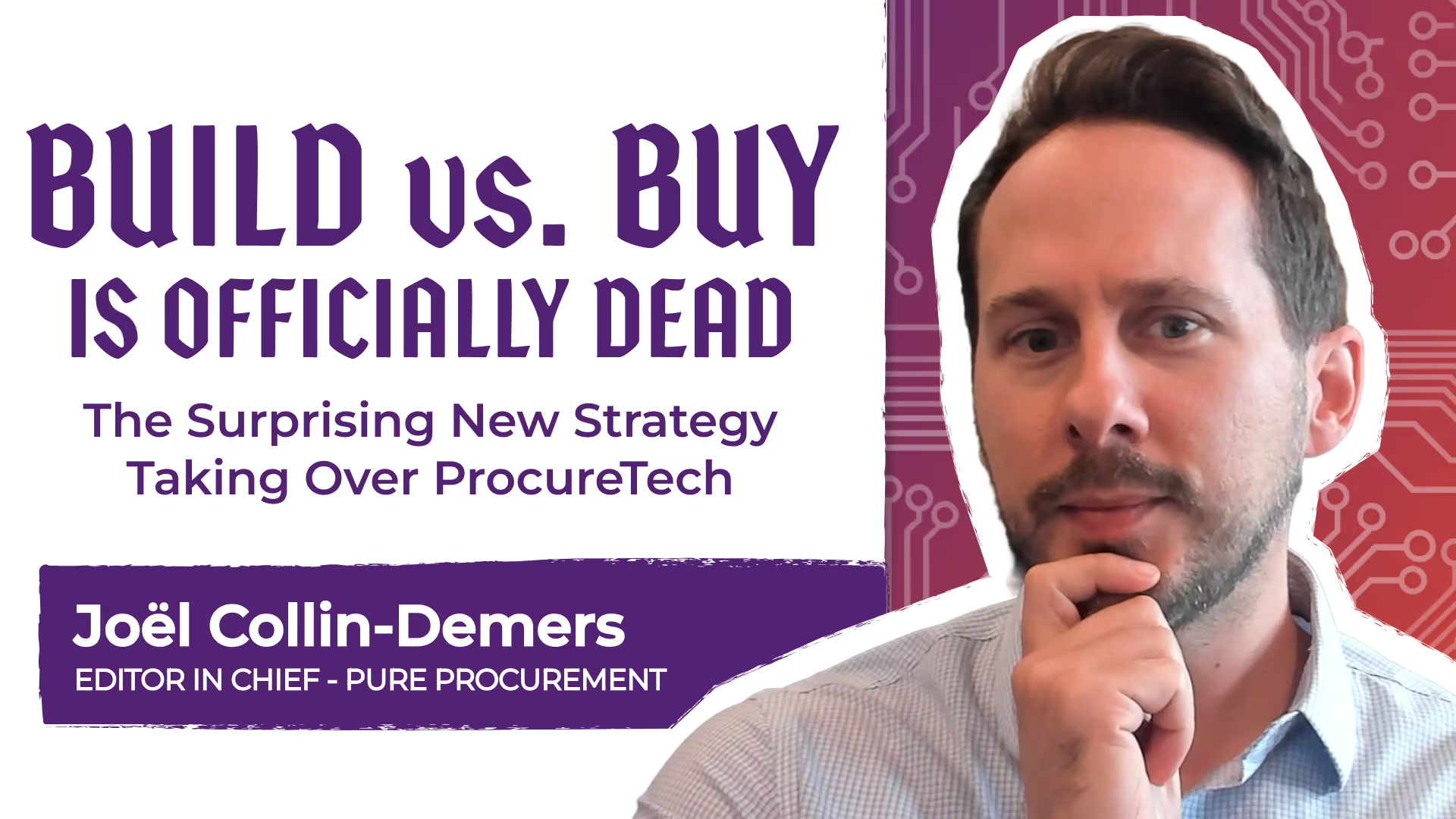
Build vs. Buy is Officially Dead: The Surprising New Strategy Taking Over ProcureTech
The age-old software debate in procurement has always been a binary choice: Do we build a highly customized solution from scratch, or do we buy a rigid, off-the-shelf suite and force our processes to fit?
According to digital procurement mentor Joël Collin-Demers, that debate is officially over.
In this episode of the Proc n Roll podcast, Conrad and Zach sit down with Joël to unpack the massive shifts happening in ProcureTech right now. From the death of "build vs. buy" to the integration magic of the Model Context Protocol (MCP), here is a breakdown of the critical insights every sourcing leader needs to know.
Welcome to the "Buy-to-Build" Era
The dichotomy of build versus buy isn't quite right anymore. Today's leading platforms offer a new paradigm: Buy-to-Build.
Instead of waiting months for an IT enhancement request and getting stuck in what Joël calls the "IT ticket death spiral," modern platforms provide a hybrid approach. You buy the core application suite to get 80% of your standard procurement workflow out of the box. To cover the remaining 20%—the nuanced, company-specific processes that usually result in painful "swivel chair" activities—the platform provides an AI and workflow toolbox. You simply build the rest yourself.
"It's this idea that... if you're going to build, you're going to build on something. And if you're going to buy something, you're not going to buy something that's 100% prepackaged either." — Joël Collin-Demers
The Rise of the Digital Procurement Lead
While AI tools like Claude or ChatGPT can help write code faster, they do not replace the need for sound software architecture. Generating code without understanding technical debt can open up major security vulnerabilities.
As Joël notes, "It's not magic; it's just a longer wand".
To wield this wand effectively, procurement teams urgently need a Digital Procurement Lead. This is a hybrid professional who understands both pure procurement competency and the software development lifecycle.
A Practical Hiring Hack:Conrad shared a brilliant strategy for sourcing teams: hire an engineer to run your IT sourcing category. You get a two-for-one deal —a category manager who speaks the exact language of the vendors, and an in-house technical expert who can help drive your digital transformation. If a full-time hire isn't in the budget, Joël recommends bringing in a fractional expert to get the ball rolling.
Stop the AI Guessing Game
When we talk about AI agents executing procurement tasks, we often talk about "nuance". But in the world of Large Language Models (LLMs), nuance translates to a statistical exercise. The model is essentially guessing the right outcome.
If you are building an agent for mission-critical tasks, failure is not an option. To build a high-performing agent, you must shift as much of the process as possible away from statistical guessing and toward deterministic, math-based business rules.
Instead of feeding an agent a 150-page PDF policy and asking it to interpret the rules, give it a structured calculator or a clear if/then algorithmic path. Minimize the unstructured guessing, and your agent will become a flawless execution engine.
The MCP Restaurant Analogy
Integrations have historically been the most painful part of ProcureTech. Enter the Model Context Protocol (MCP).
Joël explains MCP using a perfect analogy: The Restaurant Menu.
- The APIs: Before MCP, connecting to a system meant custom-building links to specific actions (create a requisition, approve a PO).
- The Menu: An MCP server acts as a restaurant menu, listing all of the available API actions and their descriptions in one place.
- The Integration: When an LLM connects to the MCP server, it instantly reads the "menu" and knows exactly what actions it can take to execute a task.
The result? Time-to-integration drops from months to mere minutes.
Key Takeaways for Procurement Leaders
- Treat Tech as a Strategic Category: Stop relying on massive, six-month IT business cases. Partner with vendors who allow for continuous improvement and capability building over time.
- Start Experimenting Now: Become best friends with your IT business partner and start building simple agents on the generic enterprise platforms your company already owns (like Microsoft Copilot Studio).
- Don't Accept 'No' for an Answer: If your IT team blocks you from experimenting at work, go home and learn on your own time. The art of the possible is moving too fast to wait for permission.
Ready to dive deeper into the future of ProcureTech? Listen to the full jam session with Joël Collin-Demers below!
Transcript: Proc-N-Roll | Build vs. Buy is Officially Dead: The Surprising New Strategy Taking Over ProcureTech
Conrad: Hello and welcome to Proc and Roll. Today we're sitting down with Joël Collin-Demers. Many of you will already know Joël is the digital procurement mentor, the translator between procurement and IT, and one of the most followed voices in digital procurement. His newsletter, Pure Procurement, reaches more than 13,000 readers every week, and he has spent his career inside large-scale procurement technology projects across a wide range of industries. Joël, welcome to the show.
Joël: Thanks so much, I think that may just be the best intro I've ever heard.
Conrad: We're in a new age regarding the "build versus buy" debate. You've coined the concept of "buy-to-build" in procurement. What does it mean?
Joël: The dichotomy of build versus buy isn't quite right anymore, because if you're going to build, you're going to build on something. If you're going to buy something, you're not going to buy something that's 100% prepackaged either. "Buy-to-build" means you buy a platform that gives you prepackaged content that may do 80% of what you need out of the box. But there's always a 20% gap that creates "swivel chair" activity. So these platforms now give you an AI or workflow toolbox to build out that remaining 20%, keeping you out of the IT ticket death spiral where you wait months for enhancements.
Zach: I was at the World Procurement Congress in London, and I saw exactly what you're talking about. All the vendors had something where you can build your own agent or workflows. What's your view on actually using AI, like Claude or ChatGPT, to code these yourself?
Joël: I kind of shy away from building from scratch with those tools. You still need high levels of software development competence to ensure you aren't opening security vulnerabilities or creating technical debt with bad architecture. It's powerful for proof of concepts, but you still need expertise to keep it on the rails.
Conrad: This feels like history repeating itself, like past false promises that you wouldn't need IT to configure things anymore. I remember Ariba having a weird file structure to make a workflow, and it was a huge overpromise.
Joël: I love the terminology of history repeating itself. It's not magic; it's just a longer wand, and you still need to be trained on magic to make the magic happen. We still need a digital procurement lead or business analyst sitting in every procurement department doing the work of change management and business process hierarchies.
Zach: I agree. Why don't procurement teams hire engineers and teach them procurement instead of relying on vendors?
Conrad: I did exactly that! One of the best hires I made was bringing an engineer in to run IT sourcing. Having somebody on staff who could speak the language helped us do category management and text stuff better.
Joël: Exactly, the person with both technical and pure procurement competency is a great fit for that digital procurement role. If you are a smaller organization, go get a fractional one to get the ball rolling and raise the baseline of your team.
Conrad: How should a procurement leader think about this new world of AI agents?
Joël: I see an agent as an automated business process that supports nuance, taking inputs to get an outcome while being influenced by data and policies. But introducing nuance becomes a statistical exercise of guessing. If I want a higher performing agent, I need to shift as much stuff away from LLM statistical guessing into math-based, deterministic business rules.
Zach: Agents are learning, but you can't just give them a 150-page Word document policy and expect perfection. That increases the surface of judgment where agents hallucinate. It's much better to give the agent a deterministic tool, like a calculator, to eliminate the risk.
Conrad: Exactly. Do I need an AI to guess if the CFO needs to approve a $100 million contract? No. If a policy is configured in a structured way, the guessing goes away. Eliminate the guesses that you don't need to make to increase the probability of success.
Zach: Integrations have always been super painful. How transformative do you think MCP is going to be on the tech stack?
Joël: Think of going to a restaurant and getting a menu of options—entrees, mains, desserts, and the descriptions of the meals. An MCP server creates a menu of all those API actions, like creating a requisition or doing an approval, and makes it available for an LLM to read and integrate. It drastically reduces time to integration.
Zach: But what about security? Will it access all my contracts and POs?
Joël: You have to tailor the menus. Not everyone gets the full menu, and some people can order off-menu because they know the chef. You still need to build roles and data governance so users only have permissions for what they are authorized to do.
SAP's API Policy & Rethinking the Tech Stack
Zach: Let's talk about SAP's recent API update. A lot of people are freaking out about access to data. What's your view?
Joël: Think of it like the Apple App Store or Google Play Store. Millions of apps go through a certification process because if there is a data breach, Apple or SAP is on the hook based on your contracts. The policy didn't surprise me; they just need to guarantee the security of your data to a certain standard.
Conrad: Natasha predicted CPOs will be reevaluating their tech stacks this year. How do leaders make these high-risk decisions?
Joël: You need to treat your technology stack as a strategic category. Get out of justifying massive IT business cases that take six months. Partner with vendors who will help you execute continuous improvement, rather than just selling you software and disappearing until the bill comes.
Conrad: Let's wrap up with some practical tips. My tip is to not put all your chips on the table yet, but start putting a couple of chips in. Roll up your sleeves, start playing with AI, and actually build your own agent.
Joël: My tip is to become best friends with your IT business partner. Start experimenting by building agents on the generic enterprise platforms your business already has, like Microsoft Copilot studio. Once you hit the barrier of the "art of the possible" there, you'll be knowledgeable enough to make bigger bets.
Zach: If your IT team blocks you out, don't accept no for an answer. Go do it on your home PC on the weekends to learn, just don't put any confidential data into public LLMs. Keep your eyes peeled because the art of the possible is always moving. Thanks for tuning in!
This transcript has been edited for clarity while maintaining all substantive content