

Get Started
Graphite's supplier management tool helps you onboard faster, cut time on risk reviews and streamline supplier validations. Save time and money.
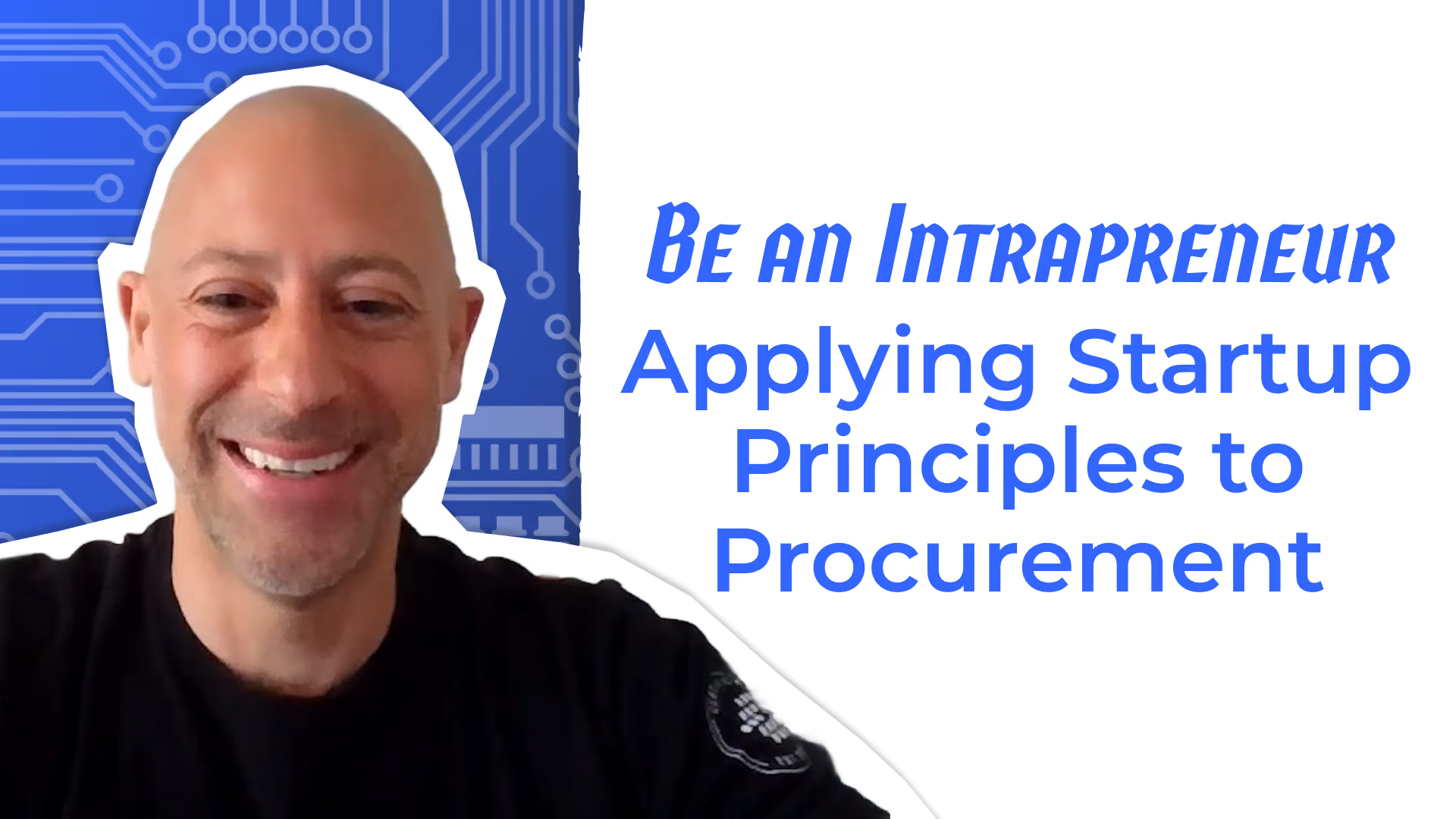
Be an Intrapreneur: Applying Startup Principles to Procurement
In this weeks Jam Session host Conrad sits down with Peter Teresi, Founder and CEO of Certificial. Peter shares his journey from his early days as a systems engineer at Microsoft to leading tech transformations in the insurance industry. Whether you are dreaming of launching your own startup or just trying to move the needle inside your current procurement organization, this episode is packed with practical advice on how to build an innovator's mindset.
Here are our top takeaways from the conversation.
The Power of "Intrapreneurship"
You don't have to quit your job to become a successful founder or innovator. Sometimes, the best place to start building is right where you currently sit. Before founding Certificial, Peter was already flexing his innovation muscles from within his previous company, ACORD. Noticing a gap in the market, he started a side project: building an API solution to operationalize the adoption of data standards. That "side project" didn't just fade away. it was so successful that it led to the creation of the ACORD Solutions Group, a subsidiary that Peter eventually led as CEO. Building and scaling that internal solution gave him the exact confidence and leadership experience he needed to eventually take the ultimate plunge into startup life.
Efficiency vs. Transformation
When we talk about innovation, it is incredibly easy to confuse efficiency with transformation. Peter breaks down the difference using a brilliant, everyday example: the Easy Pass toll system. While Easy Pass is highly efficient. allowing you to fly through a toll booth without stopping to hand over cash. it isn't truly transformative because the foundational element (the toll booth itself) is still there. Peter advises leaders to dig deep into the root of a problem. If a process is fundamentally flawed, making it 10% faster won't fix the core issue. Instead of asking, "How do we improve this form?" you need to go to the whiteboard and ask, "It's not 1970 anymore. How would we solve this problem today?".
The 30-Hour Rule
If you are working 50 hours a week just to keep your head above water, when are you supposed to innovate? Conrad shares a golden piece of career advice: you have to figure out how to do your primary job in 30 hours a week. If you can optimize your core responsibilities and deliver the outcomes your leadership expects in less time, you instantly free up 10 extra hours a week. That newly reclaimed time is your creative headspace. You need those 10 hours to invest in problem-solving, brainstorming, and innovating how your organization will function in the future. If you just keep "turning the crank" without carving out time to think, you will never have the mental bandwidth to plant the seeds for your next big idea.
Don't Second-Guess Yourself
Innovation starts with looking at your day-to-day life, finding what frustrates you, and simply deciding not to settle for it. As Peter notes, the moment you identify a problem, you've just created an opportunity. If you have a vision building inside of you—whether it's a massive process overhaul for your procurement team or a brand-new tech startup—don't wait too long to pursue it. Believe in yourself, build the right team, and start executing.
Transcript: Proc-N-Roll | The Big 50: Practical Steps to Building the Procurement Model of the Future
Conrad: Hello everybody and welcome back to Proc Enroll, your guide to practical procurement. Today I have the distinct privilege of introducing you to Peter Terisi. He is founder and CEO at CertOfficial. As a co-founder, he and I share a really interesting bond of having created something from scratch to solve a problem. What does your career kind of look like? How did you get going and make the transition into being a founder?
Peter: My career really did start with Microsoft. I went to interview for Microsoft, I didn't know I was interviewing for Microsoft. I was actually interviewing for a company I heard of, that really no one really knew of at the time called MSNBC. My whole family has been technical, so it's kind of in the DNA. My father was an electronics major and he would bring home broken laptops from work and we would solder circuit boards together. From such an early age is tech was never was never what are you going to do? It was clear, you know, it was going to be involved in technology.
Conrad: So much of my personal career has like I take innovation for granted myself. Where does innovation come from? Have you spent much time thinking about the source of innovation and how to innovate? Is this innovation something that someone can learn?
Peter: I look at my life, I look at everything around me, what I do in my day to day, whether it's from business or personal life, and I say, what doesn't work for me? As soon as you identify it, you've just created an opportunity. You don't have to do it all on your own. I used to meet up... on Wednesday nights... and actually go over ideas and prototype stuff. I found that hiring was a problem. I looked at resumes and I said, wow, my goodness, like resumes are just... resumes have a lot of inaccurate information on them.
Conrad: I was like, why didn't I invent Facebook? I started thinking about the blank space. I was like, okay, well, the blank space is actually like a corporate business to business sort of a social network. And those two ideas kind of came together in this light bulb moment that's hard to describe because I don't think it was, it wasn't very scientific.
Peter: Don't limit how you solve a problem. Transformation is always an important element to me when I think about innovation. If I give an example, I think like, Easy pass, right? From paying a toll to just flying right through it, right? It's efficiency. It's not transformative. You're still a toll. If it's not foundational, you can probably get away with an efficiency play. But if you really get into and you realize foundationally, this is flawed, then you really need to start thinking more transformative.
Conrad: I think if you want to be a good innovator, you've got to be a good problem solver. You've got to figure out how to do your job in 30 hours a week. I need to be able to do this job in 30 hours a week because I need that other 10 hours a week to innovate. And that puts you in this leadership or in this career path that is this person isn't just doing their job, this person is moving the needle in how the organization is going to work in the future.
Peter: 80 % of investors invest in the person almost as much as the idea and the technology. A good idea does not mean a successful outcome. Your execution, how you plan to actually execute on that idea is gonna be the next critical component. I would probably say, you know, don't second guess yourself. I waited very long before I actually really decided to pursue an idea, you know, and really go after something. Don't underestimate how important it is to be very diligent, very careful in selecting team members, hiring in small organizations and startup companies.
Conrad: You have unlimited potential. You can accomplish the vision and the dream that you're having. Believe in yourself. Don't sell yourself short. To all of you listeners out there, thank you for spending some time with us. Don't forget to like, comment, and share
This transcript has been edited for clarity while maintaining all substantive content