

Get Started
Graphite's supplier management tool helps you onboard faster, cut time on risk reviews and streamline supplier validations. Save time and money.
Use of AI in Procurement: AI Readiness Needs to Match AI Usage
AI is supposed to make procurement faster. Yet adopting AI does not automatically improve procurement performance. The 2026 Procurement Benchmarking Report found that organizations using AI to support supplier onboarding may experience longer onboarding times than those that do not use AI.
The issue is not necessarily the technology. It is whether the data and workflows underneath it are ready to support automation. For procurement leaders, the distinction matters: using AI and being ready for AI are two different things.
What Is AI in Procurement?
The use of AI in procurement involves applying AI to activities such as analyzing information, processing data, supporting decision-making, and automating repetitive tasks. Rather than replacing procurement teams outright, AI can help teams handle information and workflows more efficiently.
AI for procurement can appear across different stages of the procurement process, including supplier onboarding, supplier data management, analysis, and decision support.
Traditional Automation vs. AI
Traditional automation typically follows predefined rules. AI can interpret information, identify patterns, generate outputs, and support decisions based on the information available to it.
Generative AI in procurement is one example. Teams can use generative AI to help summarize information, work with documentation, or assist with routine communications. Other procurement AI applications may focus more heavily on analyzing supplier information or identifying patterns across large volumes of data.
The important distinction is that AI does not operate independently of the systems around it. Its output depends on the quality, consistency, and structure of the information it receives.
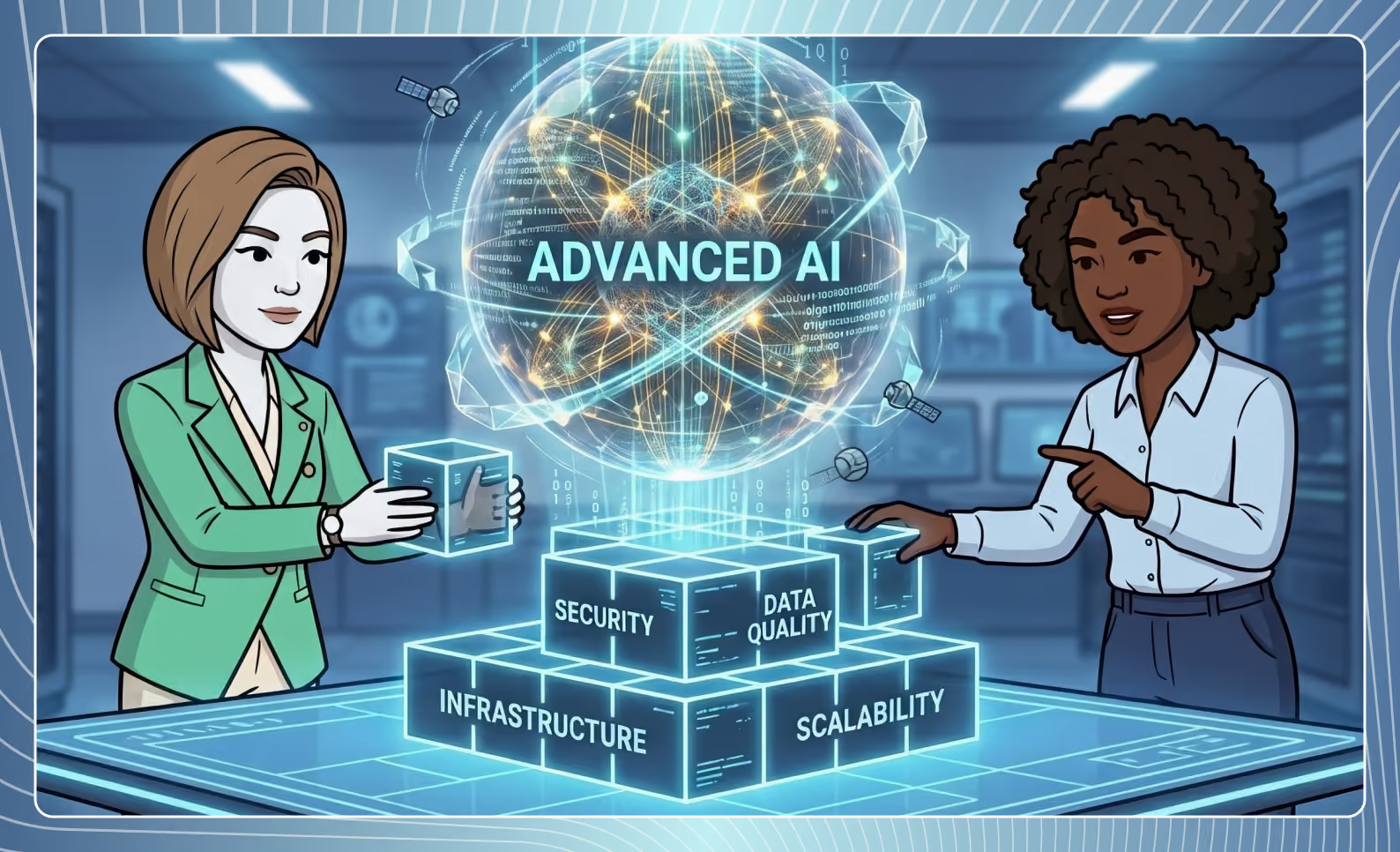
That makes the foundation underneath procurement AI just as important as the technology itself. Before looking at where AI can help, procurement leaders need to understand whether their existing processes can support it.
How Is AI Being Used in Procurement?
The potential use of AI in procurement extends well beyond a single workflow. Procurement teams can apply AI to repetitive, information-heavy activities and use the resulting insights to support human decision-making. Several applications are particularly relevant to supplier management and procurement operations.
Supplier Onboarding and Data Processing
AI can assist with processing supplier information and reducing repetitive administrative work during onboarding. For procurement teams dealing with large volumes of supplier information, this can create opportunities to reduce manual effort and move information through workflows more efficiently.
The catch is that faster processing does not automatically mean better data. If supplier records contain duplicate, incomplete, or inconsistent information, AI still has to work with those inputs.
Supplier Data Analysis and Risk Identification
Procurement AI can also help teams analyze supplier information and identify patterns that deserve attention. Better access to structured supplier information can help teams evaluate suppliers, manage relationships, and assess potential issues.
Reliable supplier data remains essential. Without a consistent view of supplier information, teams may struggle to determine which records are accurate or how different records relate to the same supplier.
Procurement Decision Support
AI can process large amounts of information and surface insights that help procurement professionals make decisions. That can be valuable when teams need to compare information, identify patterns, or prioritize areas that require human attention. The role of AI here is best viewed as decision support, rather than a substitute for procurement judgment.
Generative AI for Procurement Workflows
Generative AI can assist with information-heavy tasks such as summarizing documents, working with procurement content, and supporting routine communications.
Those applications can save time, but procurement teams still need appropriate controls around the information being processed and the outputs being generated.
AI Across Supply Chain and Logistics
The broader use of AI in supply chain management extends beyond procurement to logistics, planning, and operations. Procurement remains one important component of the broader supply chain.
For procurement leaders, the more immediate question is not how many AI applications exist. It is whether their own data and processes can support the applications they want to deploy.
Why AI Usage Doesn't Guarantee Better Procurement Performance
AI adoption can look impressive on paper. An organization may have multiple AI-enabled workflows, give employees access to AI tools, and automate parts of supplier onboarding. None of those metrics necessarily prove that procurement performance has improved.
The 2026 Procurement Benchmarking Report highlights the problem. Organizations using AI to assist with supplier onboarding can report longer onboarding times than organizations that do not use AI. The finding points to a broader issue: AI adoption does not equal AI readiness.
The Data Foundation Comes Before the AI Layer
AI processes the information it receives. When supplier data is fragmented, inconsistent, or duplicated, adding AI does not automatically resolve those underlying problems.
Consider a supplier record spread across multiple systems. Different systems may contain different names, addresses, statuses, or other information. An automated process can move that information through a workflow more quickly, but the underlying inconsistencies still need to be resolved.
The 2026 benchmark identifies duplicate or inconsistent supplier records as one of procurement's leading obstacles, alongside increased risk exposure. Fragmented supplier information can make it harder to verify suppliers, assess exposure, and apply controls consistently.
The same principle applies to AI. If the foundation is unreliable, automation can accelerate the work without necessarily improving the outcome.
Workflow Standardization Matters Too
Data quality is only part of the equation. AI also needs consistent workflows to produce dependable results. If different business units follow different supplier onboarding processes, rely on different systems, or require manual intervention at different stages, AI has to operate within that inconsistency.
Standardized workflows give automation a clearer structure to work with. Procurement teams can define what information is required, where it should go, which checks are required, and when human intervention is necessary.
The distinction is simple: AI can automate a process. It cannot automatically create a well-designed process. That is why procurement leaders should evaluate readiness before measuring the success of AI adoption.
How to Know if Your Procurement Team Is Ready for AI
AI readiness is not a technology checklist. It is an assessment of whether an organization's data, workflows, and operating processes can support reliable automation. The 2026 Procurement Benchmarking Report suggests several practical questions procurement leaders can use to evaluate their position.
Ask These Questions Before Expanding AI Usage
A procurement team considering additional AI investment should first examine the conditions that AI will inherit. Ask:
- Supplier data quality: Do duplicate or inconsistent supplier records regularly appear across your systems? If so, additional automation may amplify existing data problems rather than eliminate them.
- Workflow consistency: Are supplier onboarding workflows standardized across business units and systems? Consistent processes give AI a clearer structure to operate within.
- Manual intervention: How much work still requires people to reconcile, validate, or correct supplier information? High levels of manual intervention can indicate that the underlying process needs attention.
- Onboarding performance: Has supplier onboarding actually become faster since AI tools were introduced? Adoption should be evaluated against operational results, not simply implementation.
- Data confidence: Does your team have a consistent method for assessing the quality of supplier data? Procurement needs confidence in the information feeding automated processes.
- Stakeholder experience: Do internal stakeholders still view procurement as a bottleneck? Slow internal experiences can reveal process problems that technology alone has not solved.
- Supplier experience: Are suppliers being asked to submit information they have already provided? Repeated requests can signal fragmented data and disconnected workflows.
Measure Readiness, Not Just Adoption
Procurement teams often measure AI success through adoption rates. Those metrics can tell leaders whether employees are using a tool, but they cannot tell them whether the organization is positioned to benefit from it.
A stronger measurement approach combines AI usage with operational indicators such as data quality, workflow standardization, onboarding performance, and manual effort. The goal is not to use less AI. The goal is to create the conditions in which AI can actually improve procurement performance.
What Is the Future of AI in Procurement?
The future of AI in procurement will depend on more than deploying increasingly sophisticated tools. Procurement organizations also need the underlying data and processes to support those tools.
That means the conversation around AI in supply chain management should move beyond adoption alone. Procurement leaders need to ask what their organizations can reliably automate and whether the underlying information can support those decisions.
Supplier data also requires ongoing attention. New suppliers enter the organization, existing suppliers change their information, and workflows evolve as teams add requirements or connect new systems. The 2026 Procurement Benchmarking report therefore frames data quality and AI readiness as ongoing operational disciplines rather than one-time fixes. A mature approach to AI starts with the foundation and builds upward.
Is Your Procurement Organization Ready for AI?
The use of AI in procurement can create meaningful opportunities to reduce manual work, process information, and support better decision-making. Even so, adoption alone does not determine whether those benefits materialize. AI readiness needs to match AI usage.
If your organization is investing in procurement AI, the next step is to understand how your data quality, onboarding performance, and procurement maturity compare with other organizations.
Download the 2026 Procurement Benchmarking Report to see what the research reveals about AI readiness, supplier data, and procurement performance.