

Get Started
Graphite's supplier management tool helps you onboard faster, cut time on risk reviews and streamline supplier validations. Save time and money.
The 2026 Procurement Benchmarking Report: Redefining Speed, Risk, and AI Readiness in Procurement
AI is supposed to make procurement faster. Yet for a meaningful share of procurement teams, the opposite is happening. A proprietary procurement benchmarking report surveying nearly 70 organizations across North America and Europe uncovered a surprising pattern: teams using AI to support supplier onboarding often take longer to onboard suppliers than teams that do not use AI at all.
The issue is not that AI cannot improve procurement performance. The data points to a more fundamental problem: organizations are trying to automate processes before they have the data and workflows needed to support automation. Here is what the 2026 procurement benchmark reveals about AI readiness, supplier data, onboarding speed, and what procurement teams need to do differently.
Why Procurement Needs a Real Benchmark in 2026
Most procurement leaders have a general sense of how their teams are performing. They know how long onboarding usually takes, where processes slow down, and which tasks create the most work. Yet internal comparisons only tell part of the story. The more useful question is how those results compare with other procurement organizations.
That gap is what the 2026 procurement benchmarking report set out to address. Researchers surveyed procurement organizations across life sciences, financial services, industrial manufacturing, transportation, the public sector, and other industries. The goal was to establish a broader view of procurement performance rather than rely on one organization's definition of best practice.
The results point to a clear tension between speed and confidence in supplier data. Teams that move quickly often report lower confidence in their data, while teams with greater confidence in their data tend to move more slowly. That tension becomes even more important when AI enters the process.
The Data Behind This Report
Several numbers establish the baseline for the findings:
- 47% of respondents rate their confidence in their own supplier data as neutral or lower.
- 18.8 days is the average supplier onboarding time across the sample, with results ranging from under 3 days to more than 91 days.
- Teams report spending 8.14 hours per week on onboarding tasks alone.
Those numbers show how much variability exists across procurement organizations. They also highlight a broader problem: supplier onboarding continues to consume significant procurement capacity while confidence in the data being collected remains low.
For procurement leaders, benchmarking provides a way to move beyond assumptions. Instead of asking whether an onboarding process feels efficient, teams can compare speed, data confidence, stakeholder friction, and AI readiness against measurable performance indicators.
A Tension Most Teams Haven't Named
Few procurement leaders would describe speed and data confidence as opposing forces. Yet the benchmark shows a relationship between the two. Teams that report faster onboarding tend to have lower confidence in their supplier data. Teams with higher data confidence tend to take longer to complete onboarding.
The pattern matters because neither outcome is ideal on its own. Fast onboarding is not an advantage if critical supplier information has not been properly validated. Strong controls are not an advantage if they create unnecessary delays for suppliers and internal stakeholders.
The real opportunity is to achieve both: faster onboarding and higher confidence in supplier data. That is where the report's most surprising finding comes in.
The AI Productivity Paradox
Procurement teams have invested heavily in AI with a straightforward expectation: to automate repetitive work and make supplier onboarding faster. The benchmark tells a more complicated story.
Organizations currently using AI to assist with supplier onboarding often report longer onboarding times than organizations that do not use AI. That does not mean AI is ineffective. It suggests that AI cannot compensate for fragmented data, inconsistent workflows, or weak process controls.
When those problems exist underneath an automated workflow, AI can process them faster without actually solving them. Duplicate supplier records remain duplicates. Inconsistent information remains inconsistent. Unstandardized processes remain difficult to automate.
The result is an important distinction for procurement leaders: implementing AI is not the same as being ready for AI.
Usage Doesn't Predict Performance
Many organizations measure AI success by adoption. They track how many workflows use AI, how many employees have access to AI tools, or how much of the procurement process has been automated. The benchmark suggests those metrics do not tell the whole story.
When organizations are segmented by AI readiness rather than simple AI usage, the performance pattern becomes clearer. Teams that are ready for AI see a different relationship between adoption and onboarding performance than teams that are not ready. The full benchmark breaks down those readiness groups and shows how onboarding performance changes across them. AI adoption tells you whether a tool is being used. AI readiness indicates whether the organization is positioned to derive value from that tool.
Why Readiness Is the Metric That Matters
Readiness should be treated as a procurement performance indicator in its own right. A team can use AI throughout its supplier onboarding process and still struggle if the data entering that process is incomplete, inconsistent, or duplicated. Automation does not remove the need for reliable supplier information. It increases the importance of having it.
The more useful question is not whether a procurement team has deployed AI. It is whether the data and workflows feeding that AI are standardized enough to support reliable automation.
That distinction changes how procurement leaders should approach AI investments. Rather than starting with the technology, teams need to assess the foundation on which the technology will depend. The broader maturity curve in the report helps explain why that foundation matters so much.
Why the Paradox Exists: The Maturity Curve Underneath It
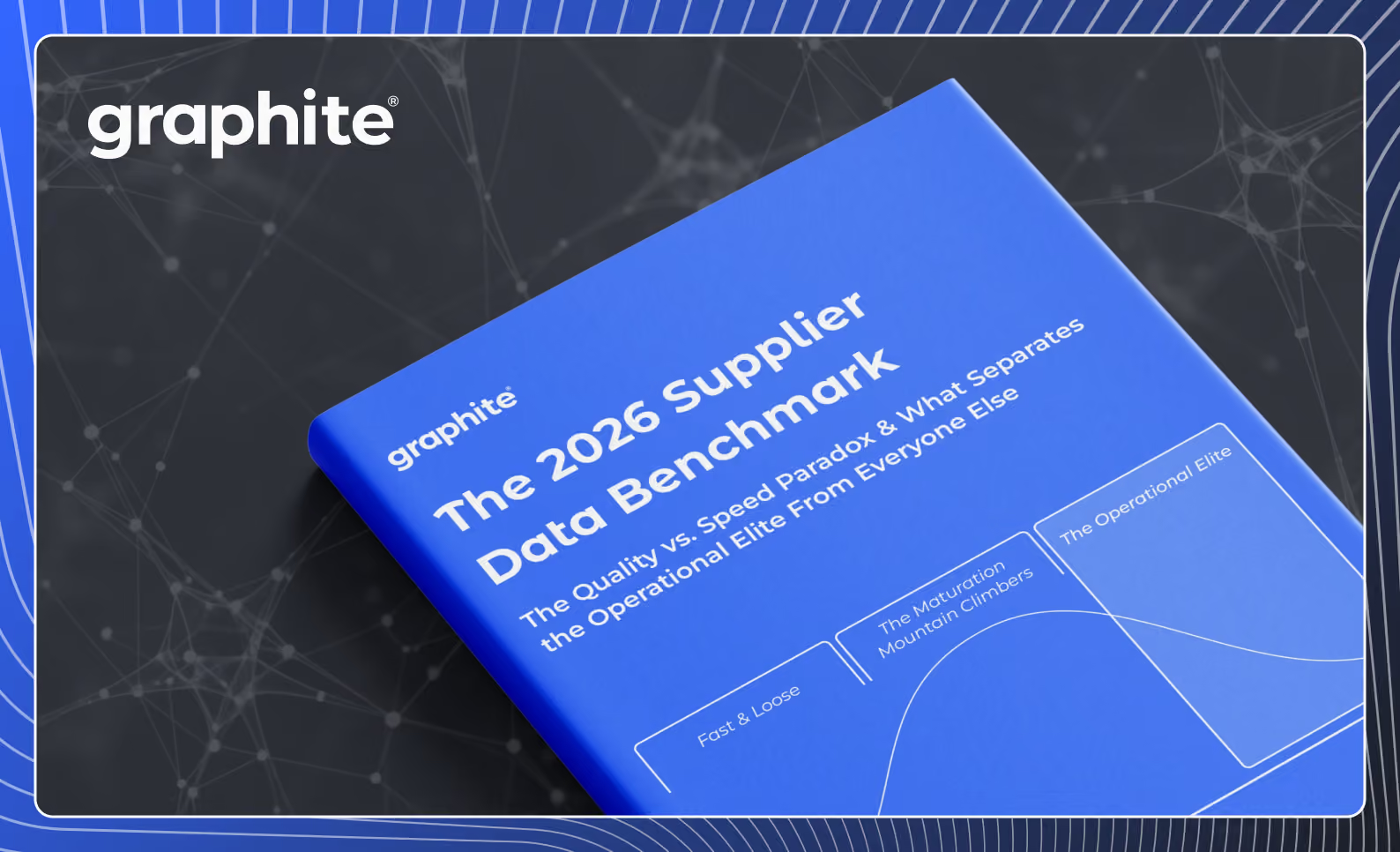
The AI paradox does not exist in isolation. It sits within a broader procurement maturity pattern that separates organizations according to how they balance onboarding speed with confidence in supplier data. The benchmark identified three distinct groups:
- Fast & Loose organizations: move quickly but report lower confidence in supplier data. Their speed can come at the expense of validation and control.
- Maturation Mountain Climbers: have introduced stronger controls and improved their confidence in supplier data, but often experience longer onboarding times as a result.
- The Operational Elite: represent a smaller group that has managed to move beyond the traditional trade-off, achieving both faster onboarding and higher confidence in supplier data.
The distinction matters because it gives procurement leaders a way to think about performance beyond a single metric. A fast onboarding process does not necessarily indicate procurement maturity, just as a heavily controlled process does not automatically indicate operational excellence. The more important question is where an organization sits on the curve and what is preventing it from moving toward the top.
What Separates the Operational Elite?
The Operational Elite are not simply organizations that have adopted more technology. The report points to a fundamentally different approach to supplier data management.
Their advantage appears to come from how they structure data governance, supplier validation, and workflows rather than from any single tool. The full report examines those differences and maps how the highest-performing organizations operate compared with the other groups.
That distinction is particularly relevant for procurement teams evaluating AI. Two organizations can deploy similar technology and see very different results if the processes and supplier data underneath that technology are not equally mature. The maturity curve provides the context for understanding why. The next question is what sits underneath the curve in the first place.
The Root Cause: Duplicate and Inconsistent Supplier Data
Increased risk exposure ranks as the biggest obstacle procurement teams report, while duplicate and inconsistent supplier records rank second. The relationship between those problems is structural.
When supplier records are spread across multiple systems with conflicting names, addresses, and statuses, procurement teams lose a consistent view of their supplier base. That can make it harder to verify supplier identities, assess exposure, and apply compliance controls consistently.
A fragmented supplier master also creates unnecessary work. Procurement teams may have to reconcile records manually, request information more than once, or investigate discrepancies that should have been resolved earlier in the process. The result is a data problem that affects both procurement efficiency and risk management.
What Fragmented Data Means for AI
AI does not automatically correct fragmented supplier data. It processes the information it receives. If supplier information exists across multiple systems in inconsistent formats, automation still needs a reliable basis for determining which information is accurate. Without that foundation, AI may accelerate a process without improving the quality of the underlying decision.
That is why data readiness needs to precede AI deployment. The technology can automate work, but it cannot replace the need for reliable supplier information and standardized processes. The full benchmark examines how this relationship between data quality, AI readiness, and procurement performance plays out across the organizations surveyed.
The Human Cost Runs on Both Sides
Supplier data problems also create friction for the people procurement teams support. 57% of internal stakeholders say procurement is a bottleneck, while 1 in 3 suppliers report being asked for information they have already submitted.
Those complaints highlight the same underlying challenge from different perspectives. Internal teams want procurement to move faster. Suppliers want a process that does not repeatedly ask them for information they have already provided.
The full report examines those complaints in more detail, including how stakeholder and supplier frustrations differ and what those differences reveal about procurement processes. The question then becomes more practical: what does it take to move from recognizing the problem to changing the underlying operating model?
What Fixing the Foundation Actually Looks Like
Breaking the AI paradox does not require abandoning automation. It requires using technology in the right sequence. The first priority is establishing a reliable supplier data foundation. From there, procurement teams can standardize workflows, reduce unnecessary manual intervention, and determine where automation can deliver measurable value.
Air Liquide provides a useful example.
The global organization has approximately 62,000 employees across 75 countries and nearly €28 billion in annual revenue. Its procurement environment had become highly fragmented following successive waves of external growth, particularly in healthcare, with nearly 40 disparate ERP systems contributing to a complex supplier data environment.
The full report goes deeper into how Air Liquide approached that challenge, including the unified workflow it established and the supplier data model that gave teams greater visibility across business units. The case study provides a useful example of what supplier data transformation looks like when the problem extends across a large, complex enterprise.
The Operational Elite Playbook
The benchmark does not stop at identifying the problem. It also outlines a practical playbook for organizations that want to move toward the Operational Elite. The framework centers on three critical areas that are closely connected. Improving one without addressing the others can leave procurement teams stuck in the same cycle of manual work, slow onboarding, and limited confidence in supplier data. The full report explains what each part of the framework looks like in practice and connects the recommendations back to the benchmark findings.
Why This Is an Ongoing Practice, Not a One-Time Fix
Supplier data does not automatically stay clean. New suppliers are added. Existing suppliers change banking information, ownership, addresses, certifications, and other details. Workflows also evolve as procurement teams add new requirements or connect additional systems.
That makes supplier data quality an ongoing operational discipline rather than a one-time cleanup project. The same principle applies to procurement benchmarking. Teams need to regularly revisit data quality, workflow performance, onboarding speed, and AI readiness. Ongoing measurement makes it easier to identify when performance is slipping and determine what needs to change.
That leads to a more useful question for procurement leaders: where does your organization stand today?
Is Your Procurement Team Ready for AI?
Procurement leaders planning or expanding an AI strategy should ask more than whether their teams are using AI. A better starting point is to assess whether the organization has the data and processes needed to make AI useful. Ask a few practical questions:
- Do duplicate or inconsistent supplier records appear regularly across your systems?
- Do internal stakeholders view procurement as a bottleneck?
- Do suppliers have to provide the same information more than once?
- Has supplier onboarding actually become faster since AI tools were introduced?
- Do your teams have a consistent way to assess supplier data quality?
- Are supplier onboarding workflows standardized across business units and systems?
The answers can provide an early indication of where an organization may sit on the procurement maturity curve. The benchmark goes further by comparing these conditions across nearly 70 procurement organizations and examining the relationship between supplier data confidence, onboarding speed, AI usage, and AI readiness.
For procurement leaders, the value is not simply knowing whether AI is being used. It is understanding whether the organization has the foundation required for AI to improve performance.
Your Data Foundation Determines Your AI Ceiling
AI can accelerate procurement, but only when the underlying data and processes are ready to support it. The 2026 Supplier Data Benchmark gives procurement leaders a way to compare their current operating model against research from nearly 70 organizations across North America and Europe. The report examines the quality-versus-speed paradox, identifies three procurement maturity profiles, and explores why AI adoption does not automatically translate into faster supplier onboarding.
The full report also includes the complete procurement maturity curve, AI readiness analysis, detailed benchmark data, supplier and stakeholder findings, and an Air Liquide case study that shows how a global enterprise addressed fragmented supplier data across nearly 40 ERP systems.
If AI is part of your procurement roadmap, the benchmark gives you a stronger starting point than adoption metrics alone. Download the Full 2026 Supplier Data Benchmark and see where your procurement organization stands, what the highest-performing teams are doing differently, and what it takes to build the foundation for faster, more reliable procurement.